Annapurna Circuit Trek Group Join- Fixed Departure Date:
The annapurna circuit trek is one of the most popular adventures – classical trekking routes in Nepal lie around the annapurna mountains range. Annapurna Circuit Trek Group Join- Fixed Departure Date for 2026 and 2027 with the early bird discount. Book today and save 10% from annapurna circuit group join trek package.
The legendary annapurna circuit trek offers the best views of the distance of annapurna mountains, beautiful villages, fascinating culture, landscapes, and snowscapes, including the world’s most popular Thorong la pass alt. 5416m above sea level. If you and your friend are planning for trekking an annapurna circuit trek in 2026 and 2027 and looking for a group to join for an annapurna circuit trek then book this trek today and save some money. You will be trekking with the expertise of mountain guides who are familiar with the route and have guided the group in the mountains for many years.
Acclimatization day at Manang village.
Welcome to join the Annapurna circuit group trek and make it budget-friendly and enjoyable, fun, safe and security , meet new people; share the expenses of the trek cost; and make a good trekking experience an annapurna with a memory for a lifetime. If you are travelling solo and looking for company to trek an annapurna then joining a group trek to annapurna circuit trek is the best idea to share the experience, culture and travel history together. Please go through the details below for more information.
Why choose the group joining trekking annapurna circuit trek ?
Planning to join a group trek to the annapurna circuit trek have several advantages for you. From the saved cost to make the best trekking experience in a lifetime.
Low cost – joining a group trek and an annapurna circuit trek you get the cheap cost because the annapurna circuit trek cost will be shared, such as Guide, Porter, Transportation, Accommodation , etc.
Fixed departure date: when you plan to join a group trek, the departure date is guaranteed. You can choose any date convenient for you.
Meet with the potential travelers—you can find the other travelers who are looking for a similar trek experience and share the cost and make a safe trek an annapurna. During the trek you will have a good opportunity to exchange culture and travel history and get some chances to know more about travelling.
Stress-free to plan the trek: you will have less stress to plan the trek as you can share the information with the other travelers. It can be helpful to each other.
Smoother trek: as you are in the group the trek can be easier to organize like making permits and arranging transportation, and pre-booking accommodation in group and trekking with the professional guide and strong porter will be a different experience for you.
Safe trek : During the trek, in case any emergency happens like an accident or altitude sickness, then if you are in the group, you can get quicker help and evacuate to a safe place faster than on a solo trek.
Annapurna circuit group join trek – Best season:
The best time to trekking is after the monsoon ends in Nepal from early September, October , November till the mid December and Spring season mid March , April, May, and June every year. During these months the weather is clear skies, sunshine, reliable temperature, and good visibility, and the mountains are more welcoming.
Trekking an annapurna circuit trek is not recommended in monsoon season like in July and August, or in the winter season, January and February, as the weather is not clear; it is cloudy, hazy, and rainy in summer and snowy in winter and the temperature falls.
On the way to Yak kharka from Manang.
Annapurna circuit trek group join fixed departure dates for 2026 and 2027
Here are the fixed departure dates for the annapurna circuit trek for 2026 and 2027. Individual or couple: if you are looking to join a group trek an annapurna please make your reservation with us without any hesitation. We promised to make your trip the best experience trekking in Nepal.
Group joining dates for 2026:
March , 15, 25 April : 2, 8, 16, 25
May: 3, 10, 18, 25 June: 2, 15
Autumn season 2026:
September : 10, 22, October: 2, 10, 15 , 26
November: 3, 12, 18 , 26 , 30 December: 4, 10, 20
Group joining dates for 2027:
March , 15, 25 April : 2, 8, 16, 25 May: 3, 10, 18, 25 June: 2, 15
Autumn season 2027:
September : 10, 22, October: 2, 10, 15 , 26
November: 3, 12, 18 , 26 , 30 December: 4, 10, 20
Why you choose for the Annapurna circuit group Join Trek:
Annapurna circuit trek is one of the best, most popular and adventure-scenery-rewarding trekking trails in Nepal. By doing an annapurna circuit you can have a good trekking experience and explore the hidden gem of nepal and learn local culture and religion, including the strengthened views of annapurna mountains in close distance. Here are some highlights of the trek and why you doing annapurna circuit trek
Explore the beautiful local villages,
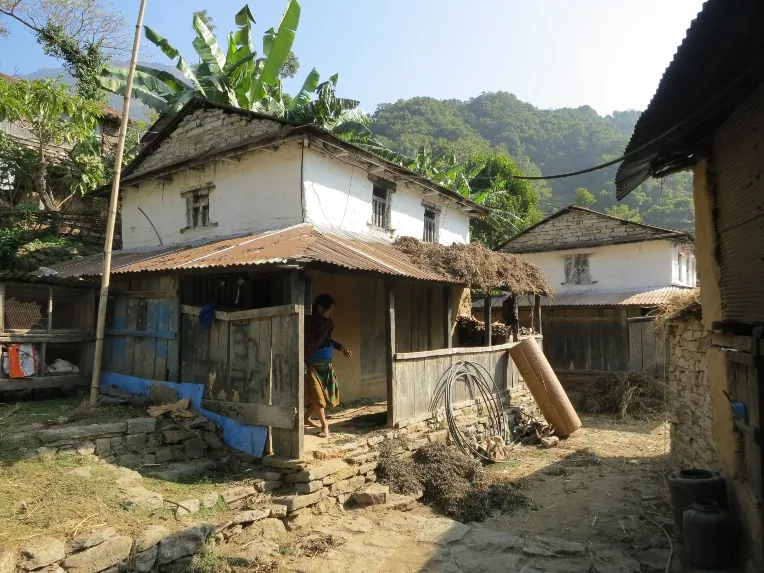
as the annapurna circuit trek lies from lower evasion alt. 750m to the higher elevation of 5416 m. along the way you will cross numbers nepalese local villages and we can see their basic daily lifestyle.
Cultural diversity:
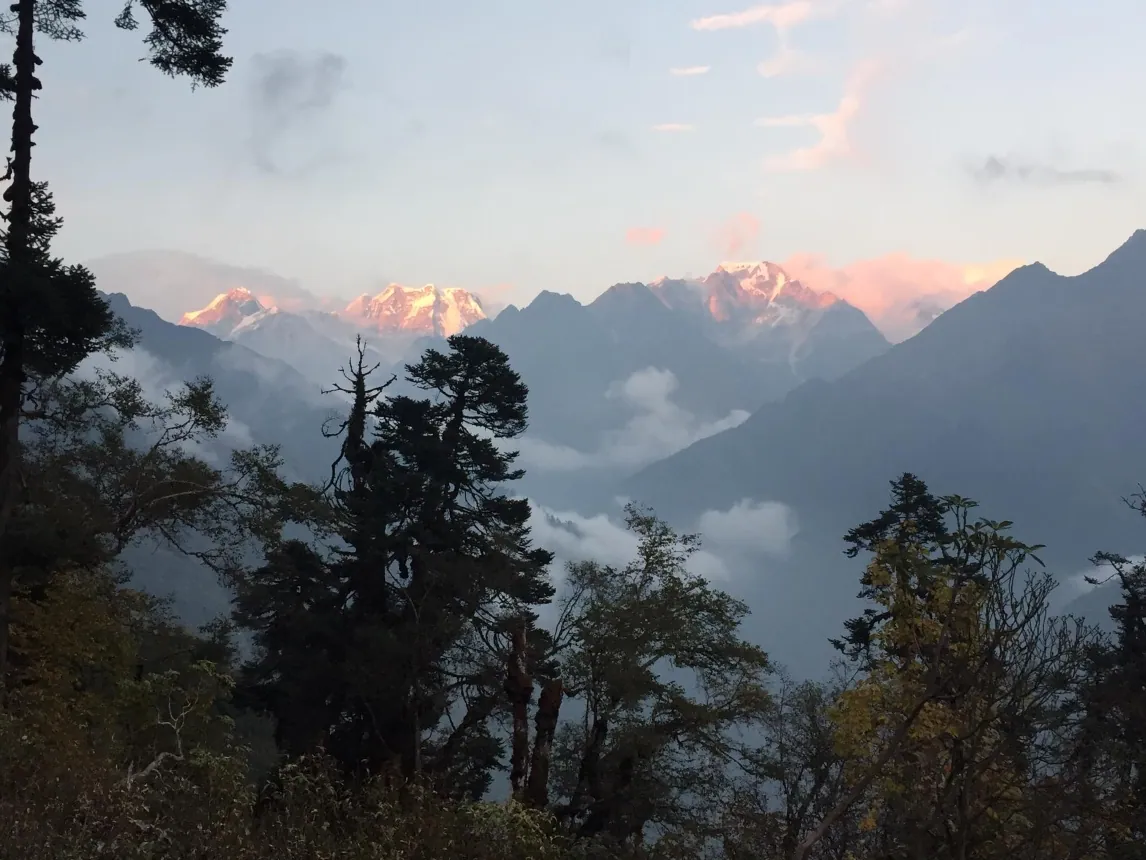
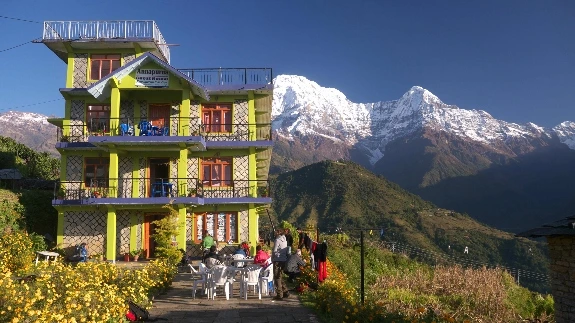
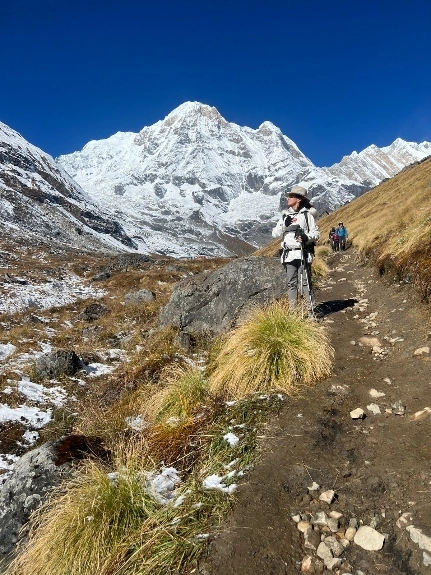
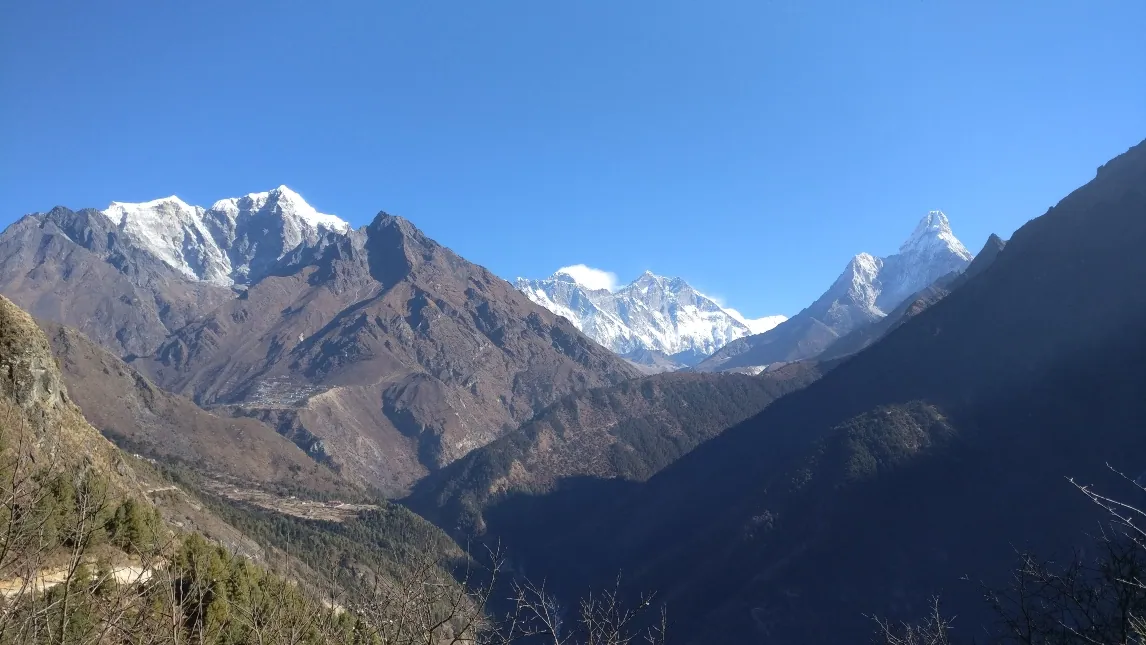
what a good weather. picture took on the way to Annapurna circuit trek!
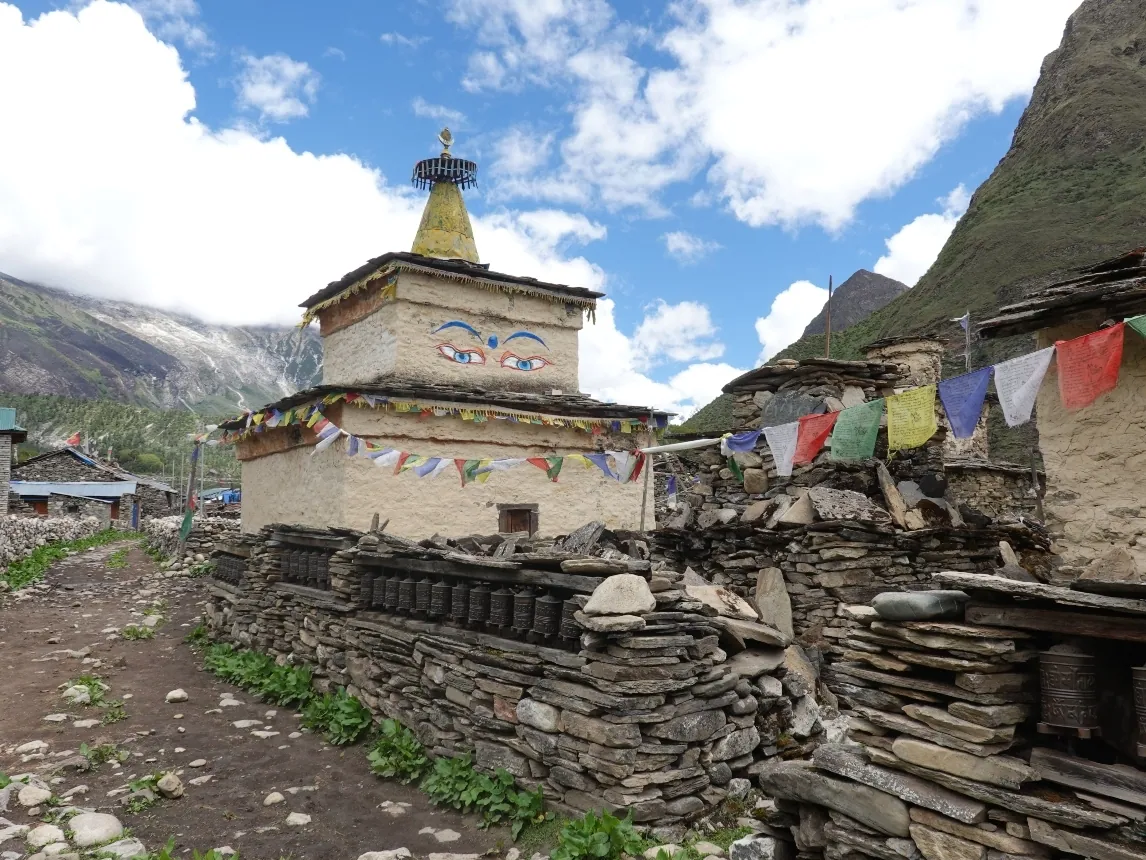
as the annapurna circuit trek is covered, the long area from the lower sections of the trek to the higher sections of the route, you will cross many traditional temples, monasteries, chortens, mani walls, prayer flags, meditation caves many more. Lower sections of the trek you will meet more hindust religions culture and higher sections of the routes you will explore mor buddhist culture such as we visit the old monastries, Museum, Tshorten, Mane wall etc
Thorongla pass (alt. 5416m) –
its the biggest and adventure high pass that we cross on this trek. It is the most highlighted day of this trek, as it takes 9-10 hrs and reaches an elevation of 5416m from sea level. Rewards with the annapurna and Dhaulagiri mountains.
Manang Valley:
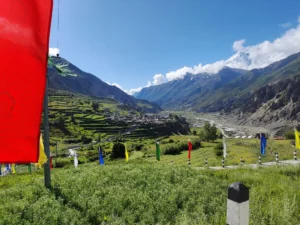
Manang valley in the summer season
The beautiful Manang valley is very famous during this trek as you see the old monasteries, the mane wall surrounded by buddhist culture, and the Annapurna mountain ranges leading to the beautiful Manang village. Religions. Significantly, reach buddhist religious and historical places, years-old local habitation and their daily lifestyle, which make it feel like a really blessed place where you can meditate, Pray and feel like you’re in heaven with beautiful manang landscapes kissed by the white Annapurna mountain range.
Muktinath temple :
the Muktinath temple is a popular site that lies beneath the Thorong la pass and Lower Mustang at Muktinath village. It’s a busy place where hundreds of pilgrims used to visit every year locals and international. Muktinath is a powerful temple and believed to be the home of the god Vishnu. Here are one hundred and eight tops and small places where you can take a shower and pray to Vishnu for a better life and more blessings, reminding you of the annapurna journey back to Pokhara. Muktinath also has many old monasteries and old caves, and the landscape is more dry and less green as well surrounded by Mt. Dhaulagiri, Nilgiri and Dhampush peak includes many peaks. Natural Hot spring in Tatopani—at the end of the trek you will also get the great opportunity to take a bath at nature Hot spring. It is more relief for you after the long trek around the annapurna
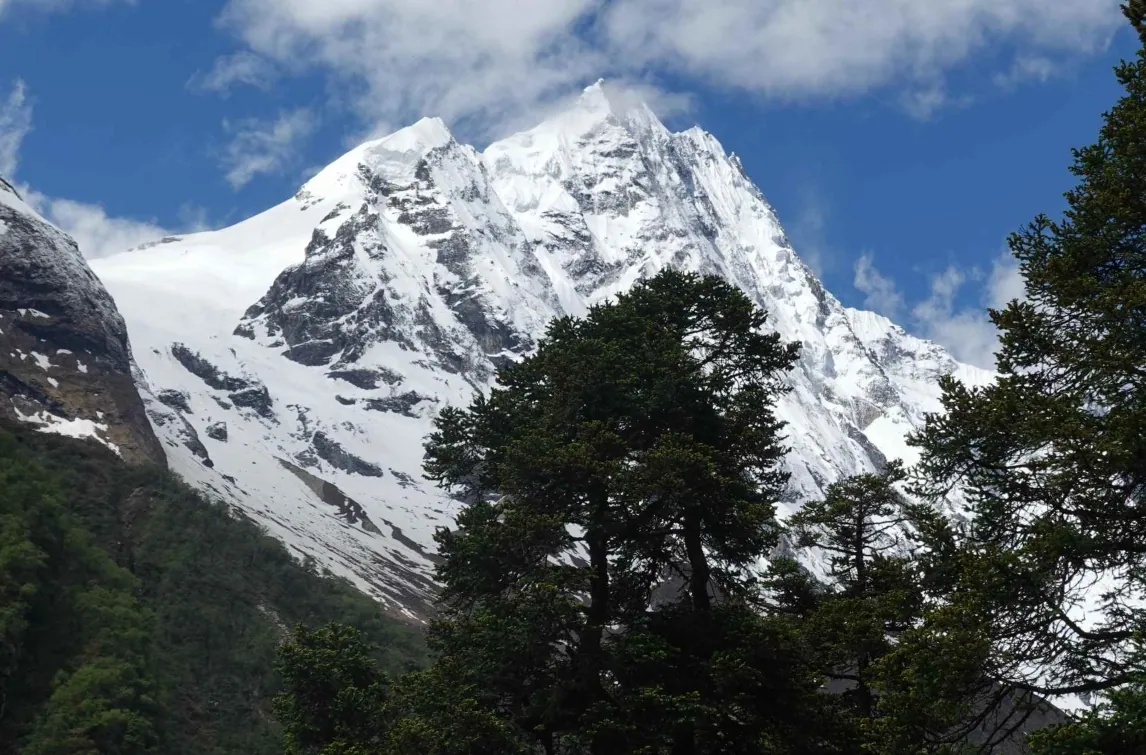
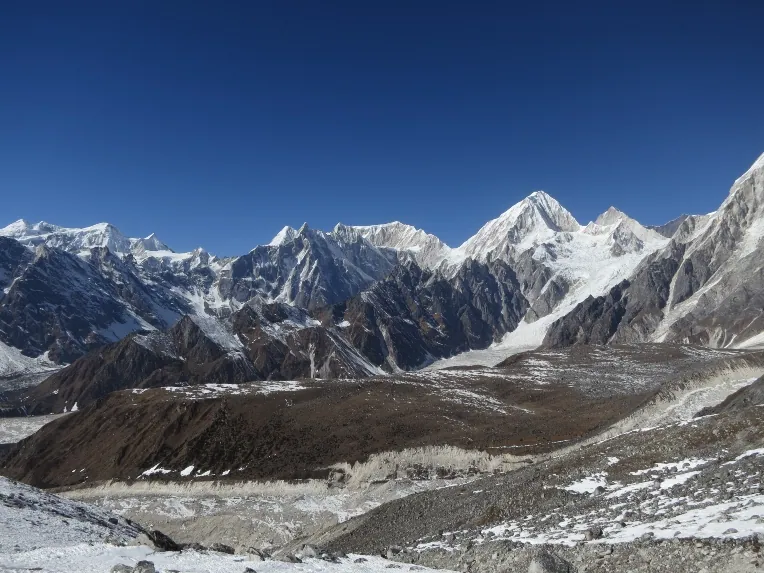
Strengthen the scenery of Annapurna mountain and the Dhaulagiri range in the distance.
From the beginning of the trek to ends you will be surrande by annapurna mountains ranges from Annapurna II, III, IV and Gangapurna , Tilicho peak , Pisang peak , Thorng la peak , Chulu east and west peak and Muktinath side Mt. Dhaulagiri, Nilgiri, and Dhampush peak includes many beautiful peaks.
Annapurna circuit group joins the general trek itinerary:
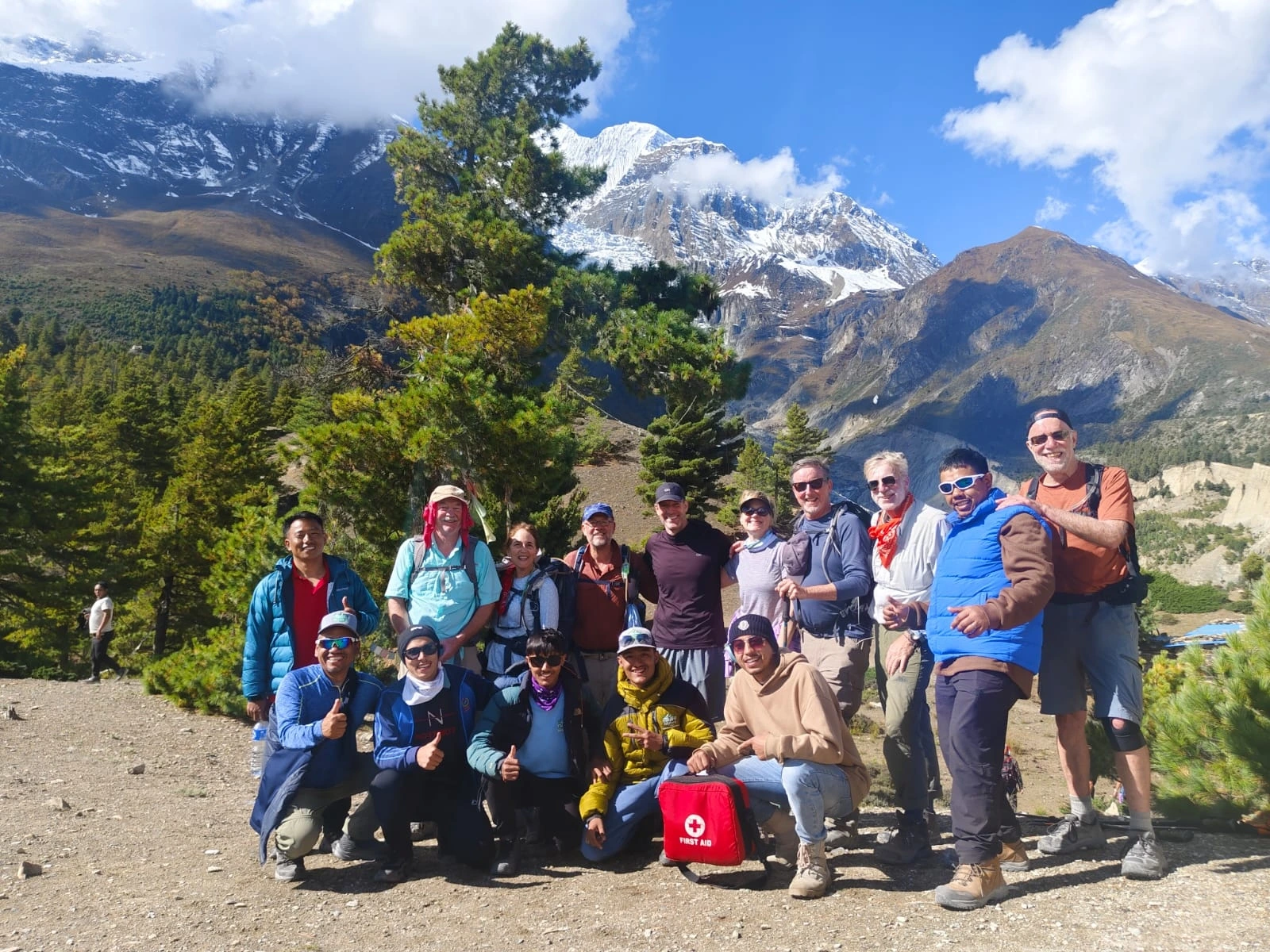
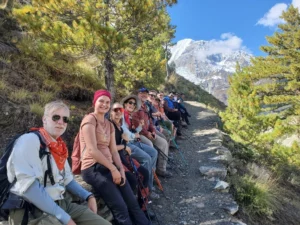
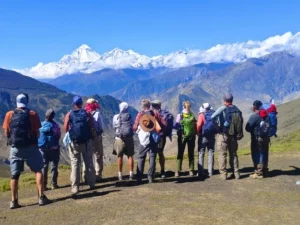
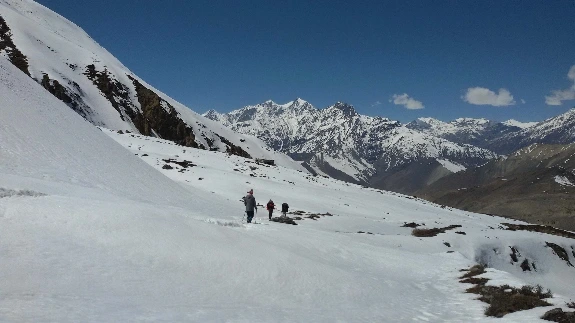
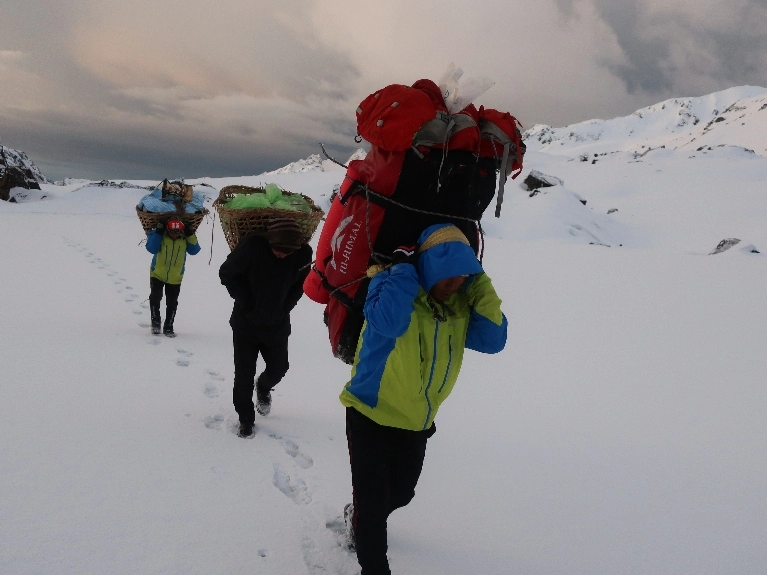
Trekking group heading to Thorong la pass
Annapurna circuit group joins the itinerary, which basically starts from 8 days to 14 -15 days. Group joins the general itinerary we have for 9 nights and 10 days. The trek starts from Dharapani after a scenic drive from Kathmandu and ends in Pokhara after taking a drive from Mukatinath. But solo private groups and any private group can customize the trip as per your interest and timetable. You can add the side trip to Tilicho lake, Ice lake , and you can walk back to Jomom and Marpha, and instead of driving, you can take a short flight back to Pokhara from Jomsom or you can extend the trip to Poon Hill-ABC.
Group joins annapurna circuit trek trekkers also can extent the time if everyone in group agree in same optins and at the end of trek if someone want to ends quicker and if some of you want to extend the trip it is possible and we always happy to help in this condition. Those who back out early, some of our guides will take you back and some guides will guide you on the extended routes. But this is only possible after the Thorong la pass from Muktinath, as from here you can have alternative options available to explore more or end the walk in Muktinath.
Day 1: Drive from kathmandu to Dharapani via Beshishar (alt. 1860m , 6100 ft), 190-200km (65km from Beshishar to Dharapani) 9-10 hrs with the breaks for lunch and toilets.
Day 2: Trek from Dharapani to Chame, alt. (2670m) Ft. 8760.) , 5 hrs, 10 km.
Day 3: Trek from Chame to Upper Pisang (alt. 3300m , 10870 ft.) , 6 hrs trek, 12km
Day 4: Trek from Upper Pisang to Manang via the Nwal, (alt. 3500m , 11480 Ft.) , 8 hrs
Day 5: Acclimatization day in Manang. Visit the Chhongkhor viewpoint (alt. 4400m ) 3-4 hrs.
Day 6: Trek from Manang to Yak Kharkha, 4 hrs (4050 m, 13285 Ft.) 8 km
Day 7: Trek from Yak Kharka to Thorong la Phedi / High Camp (Alt. 4500m , 14760 Ft. ) 4 hrs , highcamp 5 hrs (alt. 4700m)
Day 8: Trek from Thorong phedi to Muktnath (alt. 3800 m, 12464 ft) through the Thorong la pass (alt. 5416m 17765 Ft.) 9/10 hrs. 15-18km
Day 9: Drive back from Pokhara via the Hot spring (Tatopani) 6/7 hrs via the Jomsom, Marpha, and Beni bazaars, and finally reach Pokhara. (Alt. 740m.), 172km
Day 10: Drive back to Kathmandu. 6/7 hrs, 200km alt. 1300m treks end here.
Alternative options: if you want to extend the trek to Ghorepani PoonHill viewpoint and the Annapurna base camp trek, then you have to stop the drive in Tatopani and then you can walk up to ghorepani to meet the Annapurna base camp trail in ghorepani.
It is the annapurna circuit trek group that joins itinerary but if you have your private group and solo trekkers, you can always costomize the itinerary and make a completely new itinerary as per your interest and time.
Annapurna circuit trek group join package cost for 2026 and 2027.
Annapurna circuit trek group join package cost basically starts from USD 700 – 800 perperson as per the general itienray . The cost includes meals (Breakfast, lunch, and Dinner) Transportation sharing-based, professional Guide , Strong porter (each two people), Hot drinks, Trekking permits, (ACAP) Daily trekking maps, trek logistics, Shared room in tea houses as per the itinerary, fresh fruits,First-aid kit, oximeter, etc.
The cost also depends on the service you want to include in the package. And as an alternative option, you can also only hire a guide and porter, and you can pay for permits, accommodation and food drinks, and extra expenses by yourself.
The additional in-full-package service you have carries some cash for cold drinks, bottled water, wifi, laundry, the bar menu, tips for the guide and porter, travel insurance, and trekking equipment not mentioned in the itinerary that we don’t include in the cost.
Who Should Join This Trek?
Budget travelers
Who are looking to join the new company to make this trip more enjoyable?
Adventure travelers who have good fitness level for this type of the trek
Looking for safer trips, especially solo female travelers
First-time high-altitude trekkers
Open people – friendly people and not serious people—never mind for small mistakes in groups, etc.
Anyone who loves the scenic nature of Nepal. And the cultural diversity of annapurna region.
Who should not join in the group joins
Looking for a customized itinerary
Comfortable with the budget
Short-time visitors in nepal
Photographer
First time in trekking
Senior trekkers
Want to do the trek without a rush and more comfortably
Want to have peace and quite during the trek
Want to do the side trips like to Tilicho lake, Ice lake , PoonHill – ABC etc.
Why you book this trek early for 2026 and 2027
Tilicho (Tal) Lake (alt. 4900m)
Guarantee space and prefer date and season
Early birds – 10% discounts
Better chances to join large groups
More time for training and preparation for the trek, which can play a vital role in ending the trek successfully with the group.
Enough time to arrange the basic trip necessary arrangements like permits, pre-teahouse booking, professional guide and all the trek logistics.
Final Say:
Annapurna circuit group joins the trek in 2026/2027 is one of the most popular trekking routes located in the annapurna mountain area. The route lies between the four nepalese popular himalayan disteicted namely Lamjung, Mang ,Mustang and Myagdi. Group joining annapurna circuit trek is budget-friendly and fun, and it’s safe. You get to meet new people and share the culture and experience of the trek. You can have a great trekking experience an annapurna. If you are travelers and looking to share the cost for these trek packages and want to do the trek with less stress but more enjoyment and want to create some lifetime memorable nepal trekking experiences, then join this trek with a group.
view of the Annapurna ranges from Muktinath
The Nature Explore Trek team has many years of experience in group guidance and is knowledgeable and familiar with the routes. We are always flexible with the plan. You can book the group join trek with us. he easily by email or WhatsApp, and ensure your spot on the trek by sending a 15% trip advance and with the clear nepal arrival dates or trek departure date, you want to start this trek and attach a copy of your passport.
Mera Peak Climbing Itineraries vary depending on your time constraints.There are several ways to reach the summit of Mera, which is 6476 meters above sea level, according to the Mera Peak Expedition. Mera is one of Nepal’s most exciting and daring peak climbs. If you have already completed some adventure treks and have aspirations of climbing a mountain in the Nepalese mountain ranges that is over 6000 meters high, are you interested in going on another small expedition in Nepal?
Summit of Mera peak at 6476m
The best option for you is Mera Peak, which is 6476 meters above sea level, less crowded, non-technical, and challenging to reach. The views from the summit are breathtaking because it is situated in the middle of several large mountains, including Mt. Everest, Kanchenjunga, Makalu, Choyuo, and Lhotse, as well as a number of other stunning peaks. Additionally, you are looking above 6000 meters, not lower or higher.
To reach this beautiful mera peak summit you have to trek at least one week but it depends on which routes you choose to base camp of Mera peak before starting the real climb or expedition section. There are three routes that are more popular and reasonable for you based on our past clients feedback and our experience as well.
Please go through the details for routes for those travelers who are looking forward to finding the best mera peak expedition itinerary for your upcoming 2025/2026/2027 or 028 mera peak expedition.
Mera peak itinerary via the Upper Trail—13-14 days
The Mera peak upper trail is one of the scenic and short ways to reach mera peak summit. The Mera peak upper trail starts after scenic flights from kathmandu ro Lukla. Lukla is the gateway to the Everest base camp trek as well. And the mera peak is located south of Lukla. You will essentially begin walking through the Chuthanga, passing Zawtrala Pass at an elevation of 4600 meters, Kharki dyang, Kothe, Thangnak, and finally you will reach Khare at an elevation above 5000m. Basically after the khare mera peak climbing is begins through the Mera la camp , highcamp and summit mera peak. Along the way back, you will follow the same trails as you went up.
One the to mera peak expedition via the Upper trail
The Mera peak upper trail is suitable for those travelers who have a limited time frame, want to skip the long drive but still want to climb mera peak. This route is more suitable for experienced hikers who have completed high-altitude treks and hikes because of its remote location, high passes like Zetrawla Pass (slt. 4600m) above Lukla, and numerous ups and downs. Mera peak upper trails routes are suggested for 13 to 14 days, including a minimum of three days summit duration. But you can customize the itinerary as per your timetable and flexibility.
Here is the mera peak 13 days upper trail suggested itinerary and route.
Day 1: Fly to Lukla from Kathmandu in 30 minutes and trek to Chhuthanga (4 hrs trek (alt. 3560m)).
Early morning drive to the domestic terminal from your hotel and catch a flight to Lukla. It takes 30 minutes, where you will meet your supporting staff (porter) after organize all basically you will starts your first day of mera peak expedition. The routes today lead to gradual ascents to Chhuthanga in 3 to 4 hours slowly. Rewarding is the fact that It is surrounded by lush forest and beautiful mountains. You will pass numbers of sherpa people traditional villages, mountains, snowscapes, Hills, charming people and their fascinating culture, and many more.
Take note that if you are planning to do this expedition in Autumn – October, November and spring (March and April), the Lukla flight will fly both way from Ramechhap airport. From Ramechhap, which is a three- to four-hour ‘drive from Kathmandu, all airlines operate flights.
Day 2: Trek from Chhutanga to Kharki Dyang (4200m) via the Zatrawala pass (alt. 4600 m), 6/7 hrs, 12 km
After breakfast, you will start your day. You will ascend to Zawtrala pass about 3 hours. There is a teahouse in the center of the hill where we will pause for lunch before continuing on. You can look back all the way from Lukla, where you spent the last 1.5 days trekking, and enjoy breathtaking views of the mountains once you reach the summit of Zatrawla Pass, which is 4600 meters above sea level, its finest vantage point. Following that, we will continue our trek for three more hours to Kharki Dyang. The route consists of two hours of gradual ascent and a final hour of descent to the teahouse, where we will spend the night.
Day 3: Trek from Kharki dyang to Kothe (alt. 3500m), 6/7 hours. 8.5 km
Trekking from Kharki dayng to Kothe takes five to six hours. The route begins with a gradual climb of about one hour, and you will descend to taktor another two hours for lunch. Continue descending and climbing for three more hours after lunch to reach Kothe where we will spend the night. The trail today is mostly surrounded by forest and hills. In the morning, if the weather permits us, you will have first views of Mera peak in the distance. When compared to previous days of trekking or trekking further, Koteh is a more comfortable place to stay because it has good lodging and delicious food. Koteh is a charming little Sherpa town where a few hundred people used to live.
Day 4: Trek from Kothe to Thaknak, 4-hour trek (alt. 4300m). 8-9 km
After breakfast, we will trek today from kothe to thaknak in 3 to 4 hours. Since you will only be walking for three to four hours before lunch, today’s trek is brief and easy. Since the trek is only a short day, we will eat lunch at the same location in Thaknak. If you would like, you can then hike a short acclimatization hike a few hundred meters up from your hotel after lunch. Because you will be higher than where you are sleeping overnight, this will help you get a good night’s sleep.
Today the trail leads primarily in a gradual ascent toward the Hinkhu River, passing both the tranquil Lungsungba monastery and alpine meadows before arriving at the Thanknak valley.
Day 5: Trek from Thaknak to Khare camp—3 hrs. (alt. 5045 m), 4 km.
After breakfast, we will start our day 5 of mera peak expedition. It is another short day of this trek. You will trek today for 3 to 4 hours slowly, slowly. We’ll have lunch when we get to Khare, and then you’ll have some free time. Alternatively, you could take the quick hike from yesterday, which would take you higher than where you were sleeping. Which will allow you good acclimatization. You will have breathtaking views of Mera Peak and numerous other stunning peaks on your journey to Khare today. It is also known as the Mera peak base camp, as after the khare we will not meet any teahouses. We will stay here one extra day for final Mera peak summit preparation and good acclimatization before we head to the high camp.
Day 6: Acclimatization day:
Today is your rest and free day of mera peak expedition, but in the morning before lunch we will go for 3 – 4 hours hiking to khare la viewpoint about 3 to 4 hundreds metters higher nearly 5500m then the khare camp (alt. 5045m). Today hikes will allow you good acclimatization before we head to camp at about 5800m. This hike is more than just a walk to get over 5,500m. you will have a spectacular views of Mera peak rangesin distance, ama dablam , includes many beautiful peaks surrounded.
Following our return to Khare for lunch and some downtime, our climbing guide will give you a few hours of basic climbing instruction, which will include rope climbing and descending as well as many other skills required for the climb routes that will lead to the summit of Mera Peak in the coming days. Overnight at khare.
Day 7: Khare to high camp (alt. 5800 m), 6-7 hrs via the Mera la camp (alt. 5400 m) 6-7km
After an early breakfast today, we will trek to camp today via the mera la camp . It is a 6- to 7-hour adventure trek to reach camp, as the today walking path involves more ice, glacier and ascending all the way from khare (alt. 5045) to camp. alt. 5800 m. You will receive a packed lunch, and our kitchen staff will prepare hot beverages, soups, and freshly prepared meals once we arrive at HighAMP.
It’s undoubtedly a long and difficult day because of the high-altitude trails and the walking through the glacier and ice. After two hours of walking from Khare, we will arrive at the crampon point, where we will don crampons to enable us to walk over the snow and ice. Until we return to the same location, you will continue to use crampons to reach the summit tomorrow. Along the route you will also meet the crevasses, slippery ice, etc., but our climbing guide will lead the trail carefully and we will just follow his footprints all the way up to camp.
Once you reach the mera la camp to the camp section of the walk is amazing, with stunning views of the mountain in the distance. From high camp, you will be able to see the Mt. Everest range, Makalu, Baruntse, Kanchenjunga, Ama Dablam, and many other places.
Since we have to start very early tomorrow morning, you will eat dinner early today and go to bed early.
Day 8: Summit day of Mera Peak, elevation 6476m, and return to Khare in 10/11 hours.
Today is one of the longest, biggest and demanding day of this expedition. The day starts with early wakeup at around one in the morning, and following hot beverages and a light breakfast, we will begin our last ascent of the Mera Peak (altitude: 6476 meters) with head touch lights. Your guide will help you you to Considering the extreme cold, you might not be able to complete the task on your own without the climbing equipment, boots, and crampons. For this reason, our guides are always pleased to assist. We will begin the day once everyone is ready. You must follow your guide as he leads the trail. Although there are some steep ascents and gradual ascents along the trail, there isn’t a technical climb unless you’re 30 to 40 meters below the actual summits of Mera Peak. The final 30 to 40 meters of the summit are a true vertical climb, but there is a guide already there who will fix the rope; all you need to do is follow him.
Once you reach at the summit of Mera peak you will have mesmerizing views of eastern parts of nepalese himalayas ranges in the distance including five above eight thousand meters in height, namely Mt. Everest, Mt. Lhotse, Mt. Kanchenjunga, Mt Makalu, Mt. Cho yuo , Mt. Ama dablam , island peak, Lobuche peak includes hundreds of beautiful peaks and amazing landscapes to the eastern side of nepal. It’s the real heaven where you can see stunning views of mountains and memorize views of nepalese landscapes.
Although the beginning of the climb is not particularly difficult or technical, the Mera Peak route typically leads after the camp on the northeast side of the peak. However, because it is a mountain that is over 6400 meters high, you will most likely be climbing. With the high camp at 5800m and the Mera Peak summit at 6476m, you will have climbed over six hundred meters. The final ascent requires technical climbing skills and is a little challenging.
After taking in the views from the summit, you will descend to the high camp in a few hours. Still, we have to be careful coming down, as it is more slippery and not stable from tiredness and feel less energy. So we will walk back slowly, taking care of every steep descent, as we can also meet several crevasses. Once we reach high camp, you will be served hot beverages and warm food. In the afternoon, you will gradually return to Khare Camp after spending a few hours sleeping at High Camp.
Day 9: Reserve Day
Day 9 is your reserve day of the expedition. In the event of weather-related delays that prevent you from starting in the morning or other unforeseen circumstances, we will use this buffer day to ascend Mera Peak. After the summit of Mera Peak, if all goes according regular plan, we will spend this day somewhere pleasant to rest. It’s optional to return to early Kathmandu and rest.
Day 10: Trek back to Kothe, 5 hrs (alt. 3500m)
After breakfast, at around nine or ten in the morning, you can begin your hike back. You will return to Kothe today, and the trail is familiar because you went up the same way and it mostly descends in a gradual manner. After reaching the 6476-meter summit of Mera Peak, it will be easier and more comfortable to walk back because you will have already acclimated well.
Day 11: Return trek to Kharki Dayng, elevation 4200m, 6/7 hrs
We will begin our eleven-day trek back to Kharki Dyeing from Kothe after breakfast. The walk takes 6 to 7 hours. There are mixed sections in the trail, such as gradual descents at the beginning and mostly ascents towards the end of the hike. The route is well-known since we followed it, but it can be a little difficult to return and hike the same trail up today because there are more ascents.
Day 12: Trek back to Lukla, alt. 2860m , 6 hrs
We will conclude our trek in Lukla today before returning to Kathmandu by plane, so this is your last day of the expedition. You will climb from 4200m to 4600m to reach Zawtrala Pass three hours in the morning. It takes an additional three to four hours, including lunch, to return from the top to Lukla. In either Kathmandu or Ramechhap, we will wait for our flight back. Overnight at Lukla
Day 13: Fly back to Kathmandu or Ramechhap—30 minutes
After an early breakfast, as per our flight scheduling time, we will take a flight back from lukla to kathmandu. Its 30 minutes flight duration and once you land in kathmandu we will pick you up and transfer you back to your hotel. Your trek/expedition comes to an end here. Tonight we will have a celebration dinner together, which will be invited by us in typical ethnic cultural nepalese resturants with some cultural dance shows. The arrival day in Kathmandu and the departure day following the trek or expedition are not included in the itinerary. Please include fewer days in your itinerary for both your arrival in Kathmandu and your departure from Kathmandu.
Route number 2: Middle route to Mera peak expedition via the Lukla, Piya—15 days.
One of the greatest options for travelers who are new to or inexperienced with high altitude but have flexible schedules is the middle route to the Mera Peak Expedition. Since you won’t be walking directly on the higher portion of the route, the middle route offers a more comfortable hike, adequate acclimatization, and a lower risk of altitude sickness. On many days, you will be walking at elevations below 3000m. You will have the best chance to adjust to the high altitude in this way.
views from Ramilo dada.
Following a picturesque flight from Kathmandu to Lukla, the middle routes continue on to Surke, Piya-Pangompa, Sibuche, Ramailo Dada, Chhatrala Khola, and finally Kothe, where all the trek routes converge, before continuing on to Mera Peak Summit.
Let’s discover the day-by-day itinerary of the middle route of mera peak expedition.
Day 1: Fly from kathmandu to Lukla and trek to Piya via the Surke and chheubash villages. Alt. 2700m, 6 hrs, 8 km walk
To catch your flight to Lukla, you will have to drive to the domestic airport early in the morning. After we get through customs, you will fly to Lukla via the breathtaking views if the weather is nice and there are no problems in Kathmandu or Lukla. It will take you thirty minutes to fly from Kathmandu to Lukla. The members of our support staff will greet you when you arrive in Lukla. We are preparing everyone for the trek, which will begin today and take five to six hours from Lukla to Piya via the Surke.
The trail descends 500–600 meters from Lukla to surke and then climbs to Chheubash. We’ll pause here for lunch. Following lunch, you will make the easy, gradual trek to Piya for a few hours, spending the night at Piya.
Day 2: Trek from Piya to Panggomba, 5-6 hours (alt. 2850 m)—10 to 11km.
Second day of mera expeditions, you will be gradually ascending and descending to Pangom today. Along the way you will stop for lunch at khali kharka after a 2.5 hours walk from Piya. after lunch you will walk another 3 hours to reach Pangom for an overnight stay. You will primarily be walking through the hills and forest today. If the weather holds out until noon, you will have fantastic views of Mera Peak, which is home to many traditional Sherpa villages and their simple way of life. In the lower Khumbu region of Nepal, Pangom is situated above the well-known Kharikhola villages.
Day 3: Pangom to Ningso or Ramailo dada: 5-7 hrs walk (alt. Ningso, 2500m and Ramailo dada alt. 3000m), 8km walk.
Easy trekking day today. You can start late in the morning. Beginning of the hike, you will gradually ascend to Sibuche pass and descend to sibuche sherpa villages. Continue, and you will trek to Ningso, which is another one-hour duration before the lunch break. Here we can take a lunch before climbing the big hill to Ramilo dada. Some travelers used to stay in Ningso and some climb ramailo dada, but now, after the new teahouse was built at ramailo dada most of the people used to be on this hill, as it offers the best views of mera peak and landscapes of the lookback of the valley. Also, it will be easier for the next day. So the suitable and recommended camp is Ramilo dada.
Optional: if you couldn’t climb to ramailo dada and then you can still stay overnight at Ningso. Very few people stay in this place, as there are less views and it will be a longer day for the next day from Nigso to Chhatra la khola.
Day 4: Trek from Ramilo dada to Chhatra la Khola camp—5 hrs., alt. 2900m , 6km
Since the trail is new, it is not wide and comfortable in comparison to the upper trail or the beginning of the trek. As it is narrow, with steep ascents, cliffs, ups and downs, hills, and narrow walking surfaces covered in grass and some hard mud. This makes today one of the more difficult and challenging hike days. However, in order to get to camp, we will walk cautiously up each steep hill and keep a close eye on things. Since there are no teahouses along the route for a lunch break, we are heading straight to lunch camp today.
A rewarding walk today that offers stunning views of hills, forests, rivers, waterfalls, and snowcaps and the sounds of various birds and wild animals.
Day 5: Trek from Chhatra khola to Kothe via the Thaktor teashops. 5 hrs., alt. 3500m – 6-7 km.
After breakfast today, we will begin our fifth day, which will take five to six hours, including lunch, to get from Chhatra Khola to Kothe. At the intersection of the upper and lower trails, you will pause for lunch at the Taktor teashop. Following lunch, you will continue your journey for a few more hours with short descents and ascents through the lush forests of bamboo and black oak pine trees and final hour, you will trek through the Hinkhu river. Kothe is a pleasant spot for food and beverages, and it is encircled by lush, natural forests with pine trees, rhododendron, bamboo, and the soothing sounds of the Hinkhu River.
Day 6: Trek from Kothe to Thaknak, alt. 4300m, hrs., 6.5 km.
Day six of your mera peak expedition via the middle route to reach to the mera peak base camp or khare before purchase to the summit. The gradual ascent to thanknak will be followed by the Hinkhu river. Along the way you will cross several local shops, an old monastery, a stone chorten, a Mani wall, and buddhist pry flags. Rewarding by stunning views of mera central includes a number of beautiful peaks.
today is your short day trek. Basically it takes 4 to 5 hours to reach the camp. You will continue your journey to Thaknak without stopping for lunch because it is a short day’s walk. You can have lunch when you get to Thaknak, and then we’ll hike the short distance—at least a few hundred meters—up from your teahouse. You will sleep better because you will be higher than you were tonight. Overnight at thaknak.
Day 7: Trek from Thaknak to Khare—4 hrs. Walk (alt. 5045m) 4.5 to 5 km.
Easy ascending to khare from Thanak. Along the way you will be surprise by memarizing views of mera peak range including numbers beautiful peaks. The trail leads graudla ascending the khare. Along the way you can also have hot tea, as there are many new teashops open. Because of the high altitude, which makes our buddy feel less oxygenated, and the steep slope ascents of the trail, the last hour is particularly difficult. However, you will proceed cautiously. You will have plenty of time because the trek isn’t long. Similar to yesterday, if you’re still feeling energetic, we’ll take you on the short hike of about a few hundred meters up from the teahouse, which will help you sleep well. overnight at khare
Day 8: Acclimatization and climbing preparation day.
After breakfast, you will go on a short hike of about 400-500 m, ascending from khare.this will help you in the following days in the mera peak climbing section. After we return to the teahouse for lunch, we will have time to rest, and our climbing guide will teach you basic climbing skills, which are very useful while we are climb mera peak in the following days. We will also have time to check the climbing equipment one last time, and if anything was left behind or not brought from Kathmandu, you can still rent it here for the last climb. Checking your essential climbing equipment at the last minute is crucial, and being prepared is one of the most important factors in reaching the summit without any problems. overnight at khare.
Day 9: Trek from Khare to mera peak highcamp – 6-7 hrs – (alt. 5800m), 6-7km.
One of the biggest days of this expedition. As we will be ascends direct from alt. 5045m to alt.5800m total alt.750m ascending to reach at highcamp is quite challenging hike between khare to highcamp via the mera la camp. the route involves ice, rocky loose rocks, stone steeps and crevasses, including the high altitude gain.
After an early breakfast, you will start your day. The trail starts off with steep, rocky climbs that lead to the crampon point, where we will place the crampons because we will be walking over a slippery, icy trail later on. The trail will be led by your climbing guide, and you will stay together and get closer to them. Our speed is lower than in the lower portion of the route due to the high altitude. We will walk at a leisurely pace, taking deep breaths as we go. The packed lunch will be provided by you today, and we will sample hot beverages, soups, and hot foods when we get to camp.
High Camp is located 5800 meters above sea level. With breathtaking views of mountains like Mount Everest, it’s also rewarding. There are several stunning peaks in Lhotse, Nuptse, Ama Dablam, Mount Kanchenjunga, Makalu, and Baruntse. Spend the night in the tent.
Some people stop in mera la and go another day to High Camp, making two short days instead of going directly in one day, but some people prefer to do it in one day as they do not want to spend many days at the high altitude. Based on our clients’ prior experiences, we advise traveling straight from Khare to High Camp without stopping at Mera La Camp (altitude 5500 m). We have observed that individuals who travel directly to High Camp succeed, whereas those who travel more slowly and make two stops between Mera La Camp and High Camp fail. The majority of people used to go straight from Khare to High Camp and then plan for the summit the following day because it is more difficult to spend two nights at high altitude due to the remoteness, the inability to eat prepared foods, and the difficulty of sleeping at high altitude.
Day 10: Mera peak Summit day: High Camp to Mera peak summit (alt. 6476m, 21240 ft. from sea level). and back to Khare (alt.5045m) via the high camp). 10-12 hrs. 10 to 11km.
Today is your highlight day of this expedition. As you ascend the summit of this beautiful peak early in the morning, at 1:00 am or 1:30 am, your climbing guide will wake you up. After setting up all our gear and eating breakfast, we will embark on an adventure climbing journey to mera peak summit with a headlight, as it is very early in the morning. Your guide will also help you to put on gear and tight shoes, crampons, etc., as it’s very cold early in the morning, and you may not have the energy to tighten all the gear properly.
The easy ascent of the Mera Peak climbing route, which is situated northeast of the peak, still requires technical attention because it is a mountain with an elevation of over 6000 meters. Basically, after highcamp, the Mera Peak Route begins with a few hours of gradual ascent before encountering steep ascents in certain mountainous areas. Our professional guide will lead the path carefully and slowly because Mera Peak is not a technical climb; you will simply walk and follow the guide’s footsteps. However, you must exercise extreme caution because there are many dangerous crevasses. The technical climb requires about 30 to 40 meters before the summit. In this section of the climb guide, the rope will be fixed, and we will proceed cautiously while using the rope, ice ax, and other equipment.
Once you reach on the top of the mera peak alt. 6476m from sea level you will celebrate that your dream come treu to reach above 6400m higer mountain to climb in nepal. Mera peak is not only climbed for making a record to reach above 6000m. However, you will have one of the best views of the Himalayan ranges from the top of Mera Peak, which includes several well-known mountains that are over 8,000 meters high, including Everest, Lhotse, Kanchenjunga, Choyuo, and Makalu. It’s true 360-degree views provide breathtaking views of Nepal’s Himalayas and the far-off eastern region of the country. When compared to other peaks such as Island Peak, Lobuche Peak, and the Annapurna region’s Chulu East and West or Thorong La Peak, Mera Peak Summit offers the best views.
We will spend some time at the top taking some beautiful photos and videos and setting a new record of reaching an elevation of 6476 meters. Since it is much easier to descend than to ascend, we will gradually descend to High Camp in a few hours. You will return to Khare for an overnight stay after taking a rest in the afternoon.
Day 11: Reserve day incase of bad weather.
Day 11 of mera peak expedition is when we keep anemergency backup day, especially with the unpredictable weather conditions or any natural disaster happening along the trek. if the summit day the weather is not good or cloudy or there is no visibility, we will use this buffer day. If the plan goes on as planned, we will use somewhere in a nice place along the way to lukla before we take flight back to kathmandu.
Day 12: Trek back from Khare to Kothe, 4 hrs., alt. 3500m – 11km.
Day 12 of your mera peak expedition if the plan goes as planned, today we will start back down to kothe via the thaknak in 3 to 4 hours. Going down is much easier and not difficult for breathing and the trail is an easy descent day, you can start late in the morning, as it is a short day trek, and we can reach at kothe in the afternoon with an easy walk back.
Day 13: Trek from Kothe to Thuli kharka ( alt. 4200m,) 6-7 hrs., 8 km.
It takes six to seven hours to trek from Kothe to Thuli Kharka. The hike today is a little difficult because it requires a gradual descent and a mostly ascent of the hill, with the last hour being an easy, gradual ascent to Thulu Kharka. This hike will provide you with a little reminding challenge before the expedition ends at Lukla. You will stop for lunch along the way, and the trails are covered with lush forests and surrounded by snow peaks and hills.
Day 14: Trek from Thuli kharka to Lukla (alt. 2860m), 6-7 hrs. via the zatraw la pass (alt. 4600m)
Last day of the trek, after breakfast, we will start our mera peak last day hike. Today you will trek from thuli kharka to lukla in 6 to 7 hrs via the zatra la pass en elevation of 4600m from sea level. You will ascend from thuli kharka to zatra la pass in 3 hours, and from the top of zatraw la pass you will have stunning views of snowy peaks, including Lumber himal , Kusum kangaru himal includes the Lukla Bazaar. Then you will descend to lukla in 3 to 4 hours via the Chhuthnaga. Along the way you will stop for lunch at chhutanga before the end of the last day of mera peak expedition hike.
Today is the last day with your Nepalese crews, those who supported you during this expedition so you will celebrate last night together with them before you fly back to kathmandu.
Day 15: Fly back to Kathmandu from Lukla (alt. 1300m) 30 minutes flight duration.
If there is clear weather in both Lukla and Andu early in the morning, you will take a 30-minute flight from Lukla to Kathmandu, after which we will return you to your hotel. We will invite you to a traditional ethnic Nepalese restaurant for dinner and a cultural dance performance at the end of your Mera Peak expedition.
Note: if you planning to do this expedition in high peak season like autumn (October and November) or spring (March and April lukla flights fly from ramechhap instead of direct flights from kathmandu. But if your expedition is not in high season, then they still fly from kathmandu.
Note 2: We have not included your arrival and departure days in Kathmandu in the suggested itinerary. Take into account the arrival and departure dates as per the above-mentioned itinerary when making plans to climb Mera Peak.
3. Optional 3 itinerary: 16 days. Kathmandu to Kathmandu.
The Mera peak climbing itinerary goes by drive and comes back by flight from Lukla.
Option 3 or lower trail to Mera peak expedition. After short-out permits and all logistics for the expedition, you will drive from kathmandu to Phaplu/Salary in 7-8 hours via the BiPI highway by jeep, and still you can go further up to kharikhola the next day by driving, which takes another 4-5 hours via the basa village. Basically, you will start your trek from Kharikhola at an elevation of 2300m from sea level. Trekking continues to Pangam, Sibuche, Ramaito Dada, Chhatrow Khola, Kothe, Thaknak, and Khare. After Khare, the climbing portion begins after High Camp, Mera Peak Summit, and returns to Khare, Kothe, Khaki Dyang, Chhuthanga, and Lukla before returning to Kathmandu by plane.
On the way to Nunthala from jumbesi villages.
The lower Mera Peak expedition route is recommended for those who are not experienced hikers, have not been at higher elevations for an extended period of time, are flexible with their schedule, and want to experience more of Nepalese traditional villages, culture, everyday life, etc. The lower trail is more convenient for you. You will be adequately acclimated because the route passes through the lower mountains and involves numerous ascents and descents. You will have a good amount of acclimatization before you reach the trek’s higher elevation.
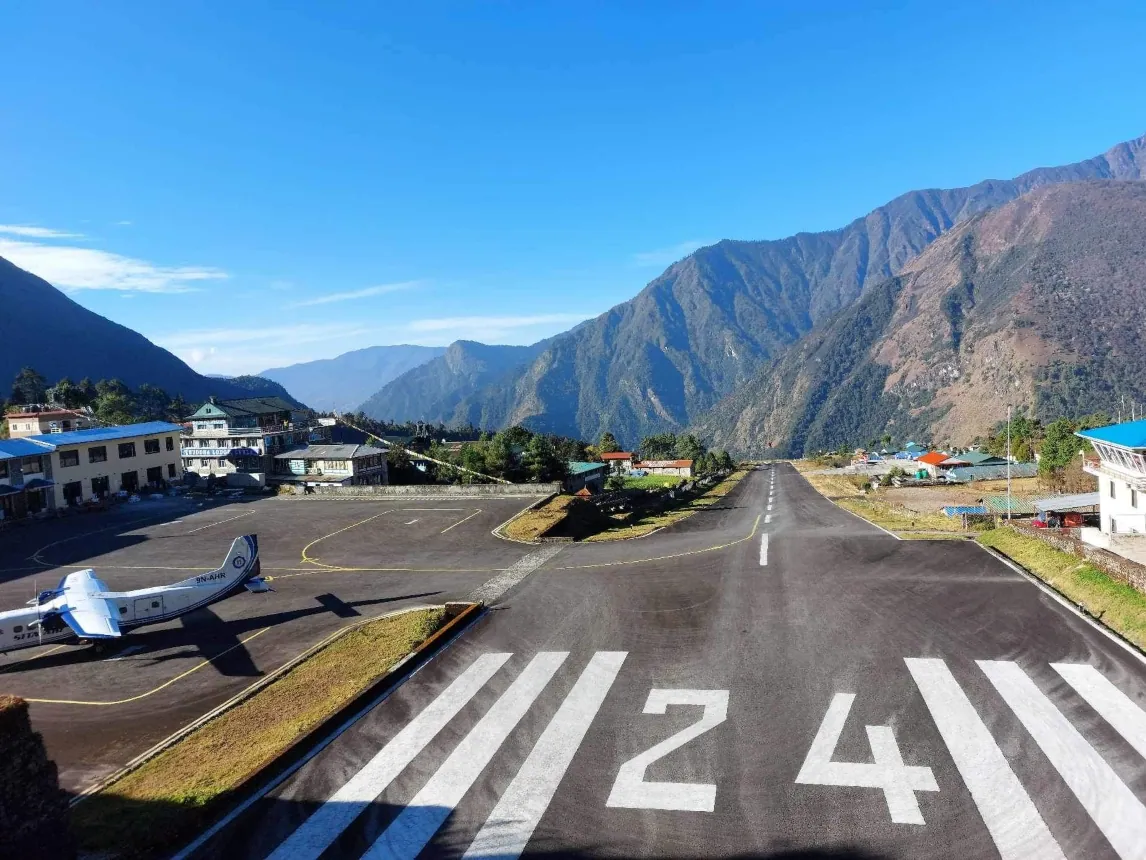
For those who wish to conceal Lukla flights—such as those that are canceled, delayed, or frightening at the most dangerous airport in the world—the lower route is also a good option. Because the Lukla flight is more costly than the jeep drive in sharing base, taking the drive also saves money. I would therefore strongly advise following this itinerary if you are among the travelers searching for a similar concept itinerary.
This is the daily schedule using the lower route:
Day 1: Travel 7-8 hours, at an elevation of 2300 meters, from Kathmandu to Phaplu or Sallery.
Early in the morning you will drive from Kathmandu to Salleri via the prithivi highway in 6 to 7 hours. It’s a scenic drive; we pass several local villages, hills, snowscapes, and mountains. Additionally, you will pause for lunch at Ghurmi. Following lunch, you will continue driving to Salleri via the Pattale viewpoints. You will get your first look at the Mt. Everest range, the Lumber Himal range, and the early Mera Peak view in the distance if the weather is clear. Overnight at salleri.
Day 2: Drive from Salleri to Kharikhola via the Basa villages (alt. 2020 m). 5 hrs
Second day of driving on this trip. After breakfast at Salleri, you will continue driving to khari khola via the basa villages in 5 hours. Sometimes it can also take a little longer or shorter if, in case, unpredictable things happen. Once you reach Khari khola you will check in at the guesthouse and take some rest. In the afternoon, you can visit around the villages. Khari khola is one of the most rewarded villages where mixed ethnic groups like sherpa, Magar, Tamang and Rai people used to live for hundreds of years , there is a beautiful monastery, temples and a traditional sherpa people village we can explore and good to know about their basic lifestyle. Overnight at the guesthouse.
Note that it takes two extra days to get to Kharikhol via the Nunthala if you would prefer to walk to Khari Khola rather than drive there on the second day.
Day 3: 4-hour trek at an elevation of 2875 meters from Khari Khola to Pangam.
Today is a quick and simple trek from Khari Khola to Pangom. It takes 3 to 4 hours only. The trail leads steeply up through the lush forest and nepalese mountain farmlands. Along the way you will also cross the numbers of cattle house , domestic animal many more. The views are always captivating, such as when you look back at the villages of Khari Khola and the snowscapes, mountains, and hills. The fascinating culture and nature never cease to amaze you.
At an elevation of 2840 meters above sea level, Pangom is a charming little Sherpa village where we can observe the old traditional monastery, potato farmlands, exquisitely decorated teahouses, and more. You are going to spend the night at Panggom today.
Day 4: Trek from Pangom to Ramailo dada, 5 hrs., alt. 3000 m.
Another day 4 beautiful journey starts with panoramic views of mountains, landscapes, and hills. After breakfast, we will head to ramailo dada. Beginning of the day, you will steadily ascend to Pangom la pass an elevation of above 3000m. And continue gradual descents to Sibuche villages, where you can stop for the hot tea with the beautiful scenery. And you will continue trekking to Ningsow for another two hours for lunch. Following lunch, you will climb 500 meters from Ningsow to Ramailo Dada. You can enjoy stunning views of Nepal’s lush hills, Sherpa, Rai,and Magar people villages, snow camps, and distant mountains from Ramailo Dada, one of the rewarded viewpoints. Spend the night at the Teahouse.
Day 5: Trek from Ramailo dada to Chhatra Khola (alt. 3000m), 4 hrs
The hike is a day of gradual ascents and descents. We will walk cautiously and slowly because the trail is fairly narrow and some parts of the trek are difficult because it is a recently opened trek route. Since the hike is only a day long, we arrive at our destination for the night at lunchtime. You will have some free time after lunch; you will have some free time. Overnight at Guesthouse.
Day 6: Trek from Chhatra Khola to Kothe—6 hrs, alt. 3500m
Day 6 of mera peak expedition via the lower route. You will trek from Chhatra khola to Kothe via the Taktok teahouse. Kothe is the meeting point for all routes of Mera peak expeditions. Continue on Kothe to Mera Summit and then take the same routes back to Lukla.
The Chhatra Khola to Kothe hike is more shadowed, surrounded by lush forests, and features a variety of hill climbs and descents. After lunch at Taktok, we will continue our journey to Kothe, which will involve three more hours of climbing and descending. It takes about an hour to get to Kothe villages. Its quaint villages offer organic food, comfortable dining halls, and beautiful lodges, making them an excellent place to stay the night.
Day 7: Trek from Kothe to Thaknak—4 hrs (alt. 4300m)
Day 7 of the Mera Peak Climb: Due to the shorter day trek, you will begin your day late in the morning because it is an easy day. Following breakfast, you will hike through the Hinkhu valley today, making a gradual ascent from Kothe to Takhnak in three to four hours. You will pass several local teahouses, historic monasteries, a cave, and breathtaking views of Mera Peak, which is surrounded by mountains.
Since the trek is short today, you will arrive at Thaknak Camp for lunch. Following lunch, I would advise all prospective travelers to complete the short ascent from your teahouse, which is only a few hundred meters up. Reaching a higher altitude will help you get a better night’s sleep than if you were sleeping at an elevation. Sleep in Thaknak.
Day 8: Trek from Thaknak to Khare—3 hrs. (alt. 5045m)
Another short day as we only trek from thaknak to khare in 3 to 4 hours slowly. And the trail is a gradual ascent through the Hinkhu valley. Along the way you will have a amazing views of mera peak range includes many beautiful peaks. Just like on day 7, you will reach at khare at lunch camp. After lunch you can do the short hike, which is advantageous for you for good night sleep. Overnight at khare
Day 9: Acclimatization day and preparation for the push to mera summit.
After breakfast, you will do the short hike to khare viewpoint at least 400 to 500m higher than your lodge. As this will help you to go further, ascend to mera high camp and continue to the summit. We will be back for lunch and after lunch your climbing guide will teach you basic climbing skills training and check your climbing gear for the final preparation to summit beautiful mera peak. Overnight at khare.
Day 10: Trek from khare to highcamp – 6-7hrs alt.5800m
The detailed itinerary is similar to the upper or middle route above; please follow the same information. Overnight at tent in camp
Day 11: Mera highcamp to summit (alt. 6476m) and back to Khare (alt. 5800 m), 10-12 hrs.
One of the highlights of this expedition. As we are attempting this amazing peak at an elevation of 6476m. Start very early every morning and reach the summit about 7-8 am and return to khare in the late afternoon.
generally , from highcamp to the summit takes 5-6 hours, and reuters back o highcamp two hours, and high camp to khare is three hours. For more information, please read another itinerary, as it has similar information.
Day 12: Reserve day.
This is a reserve day in case of weather changes or an unpredictable situation. If it comes, then we will summit today. If the plan goes on as planned, we will use this buffer day somewhere in a nice place for a good rest.
Day 13: Trek back to Kothe from Khare—4-5 hrs., alt. 3500m.
Easy descending day. It’s a 4- to 5-hour walk back to kothe from khare. The path is familiar and gradually descends.
Day 14: Trek from Kothe to Thuli Kharka, alt. 4200m—7 hrs.
Long day, mostly ascends and some sections of the walk will be gradual descents too. Mostly walk through the forests and it’s a new route for you, as you were gone on the lower route but now we take upper trail to reach Lukla.
Day 15: Trek from Thulu kharka to Lukla—7-8 hrs., alt. 2860m
Trek back to lukla. It’s quite a tough day, as it involves a high-altitude route , highpass like 4600m zawtrala and a descent to Lukla from 4600m to 2860m. Rewarded with snowcaps, mountains, Hills and beautiful landscapes inlcuds lukla bazzar
Day 16: Fly back to Kathmandu. Alt. 1300m (30 minutes)
You will fly back to kathmandu today and your trip will end. tonight we will invite you to a farewell dinner at a typical, cultural nepalese restaurants with a cultural dance show. For further information on the day, if you want to know more, please read our other route itinerary briefing, as it has the same day activities and same location.
How do i know which itinerary is suitable for me among the three of them?
It’s good to know which itinerary suits you. First of all, we would encourage any travelers to please go through the itineraries above. It may help you to know more or less about it. If you are new to climbing or have never done the long hikes in Nepal or anywhere else in the world, I would advise you to follow the lower trail if you are concerned about altitude, have a lot of free time, and want to see more of Nepal’s traditional sites. Lower routes are another great opportunity to learn about nepalese traditional culture and beautiful landscapes. Driving through the scenic roads from kathmandu to trekking places is a great experience for you, as the scenic views, Hills, Mountains , snowscapes, charming people and their fascinating cultures. Before summit mera peak you will have a good experience walking in the lower section of nepal and building the confidence to go to higher elevations.
on the way to Mera peak highcamp from Khare camp
Choosing Middle route is another great idea, as you still explore the traditional Sherpa villages, snowscapes, Mountains , Hills, Forest and also this route offers the good opportunity for good enough acclimatization before you reach the higher elevation. I would strongly advise taking a middle route to the Mera Peak Expedition if you are uncomfortable with the long drive but are searching for something that offers both options, such as a hidden long drive and good acclimatization.
Higher or upper trail to Mera peak expeditions route suites for those adventure lovers who have already done many trips and have good experience of walking and hikes in the past. Moreover, these routes are recommend for who have short leave from work but still possess a strong sense of adventure and patience, then this is all right for you. You can climb mountains in Nepal.
The upper trails are shorter, more suitable, and more rewarding because they lead from higher mountain regions. After a few days of walking, you must cross Zawtra La Pass, a 4600-meter high elevation pass. and a number of lengthy ascents and descents, as this is a faster route to the top of Mera Peak.
Final say:
If time is short but you do want a real Himalayan mountaineering experience, then Mera Peak Upper Trail (13–14 days) would be ideal for you. It’s picturesque, not too touristy, and has a real high-altitude feel to it perfect for experienced trekkers who wish to move into mountaineering.
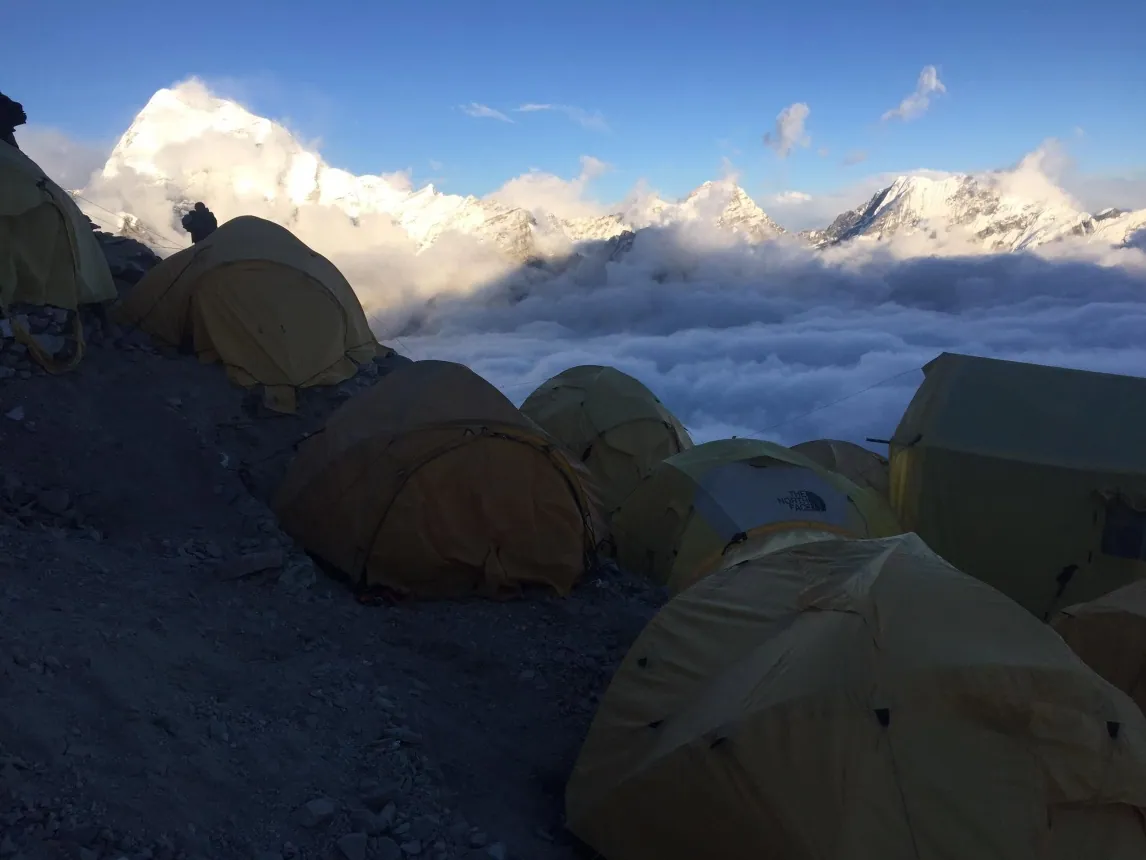
Mera peak high -camp alt. 5800m above from sea level.
We at Nature Explore Trek have been operating trekking and climbing expeditions since 2015. Our team is made up of experienced field staff the exact people who actually guide, carry, and support your way on the trail. That’s why we always say: “We do what we promise.”
This itinerary comes straight from the ground built by the people that work there, not from offices. We know what works, and we guarantee your experience is safe, memorable, and exactly what you’re after.
The Manaslu Circuit Trek in November and December is a good choice for those seeking adventure, solitude, and the rugged beauty of the Himalayas. As the autumn high-season crowds end, late-season trekkers can enjoy the experience in the rugged wilderness of this remote trek—pristine landscapes, clear skies, and invigorating crisp mountain air. The Manaslu Circuit trek in November is at the end of Nepal’s well-known trekking season, brings dry weather, and is known for the clearest conditions for observing Mount Manaslu and peaks to the west and the east, while December offers the tranquility and beauty of early winter-studded villages, frozen waterfalls, and wilderness. To fully experience the Himalayas in their most pristine condition, November and December promise a journey with less foot traffic and an immersion in nature.
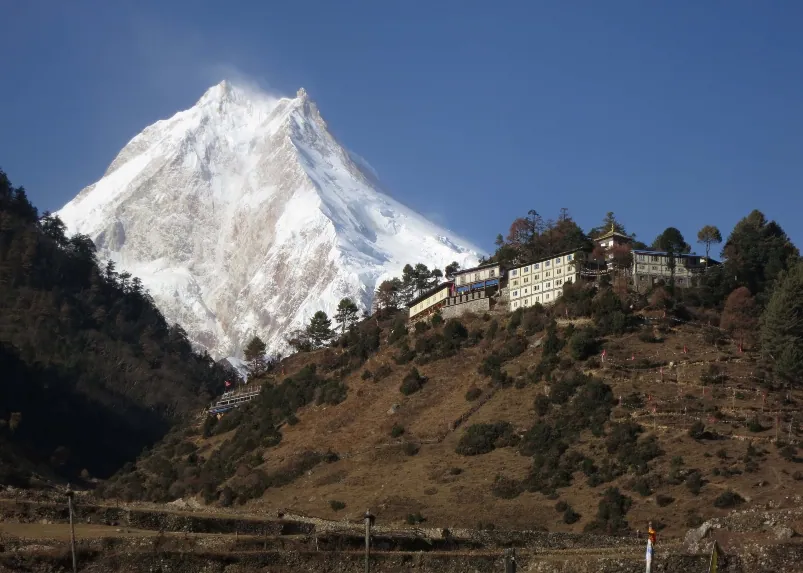
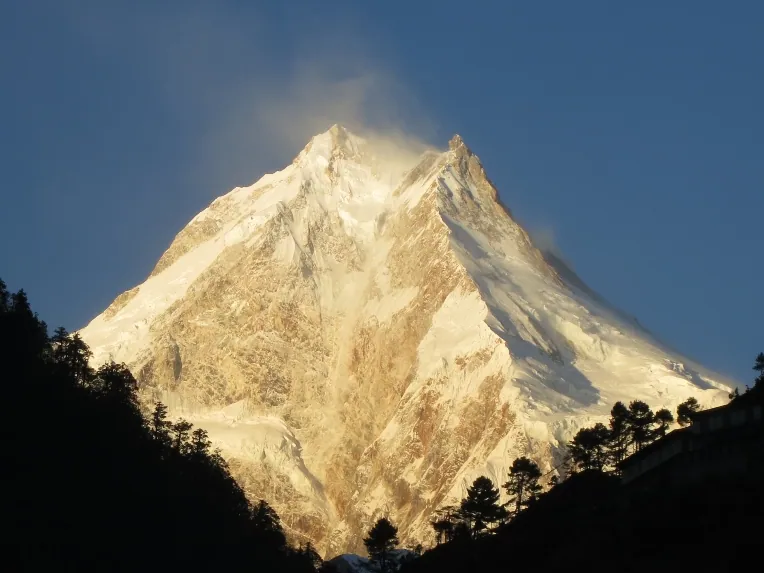
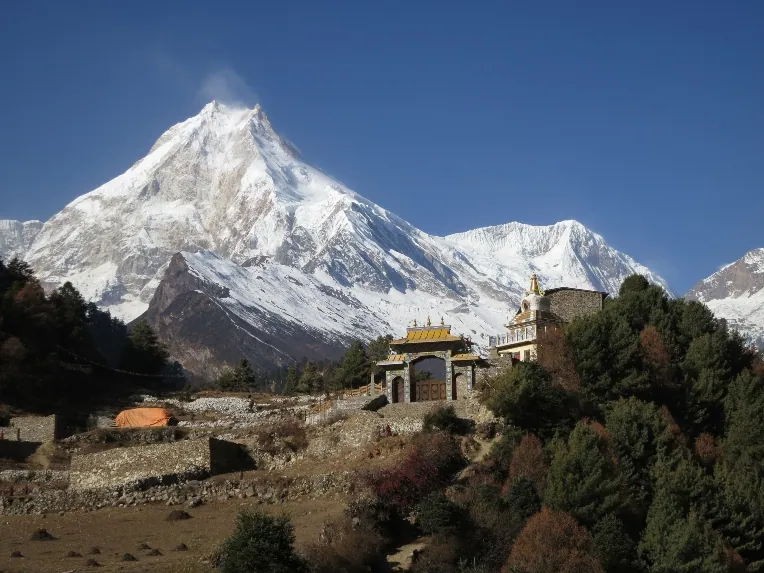
Mt. Manaslu (ALT.8163M)
This all-in-one guide will prepare you for late-season trekkers seeking a Manaslu Circuit experience. This guide will cover the weather of November, representing the clarity of post-monsoon conditions and December, representing the temperature drops associated with drier, colder temperatures. This guide also contains information on fluctuating weather with daytime warmth of around 10-15 °C and nighttime cold at high altitudes. It also covers the trek difficulty, with specific issues for the snow and ice on Larkya La Pass, and provides practical tips on how to acclimatize and prepare the route to avoid trouble and enjoy your adventure. The drop in tourists is one of the factors contributing to the Manaslu Circuit Trek in November and December. November and December provide an opportunity to experience the authentic Himalayan wilderness without putting up with large groups and busy tea houses. To overcome logistical problems, this guide provides great packing advice and essential lists to keep travelers warm, safe, and comfortable. Whether you’re an experienced trekker looking for a new challenge or a natural lover drawn to the peaceful solitude of the off-season, the Manaslu Circuit in November and December reveals the adventure of an unforgettable experience. With proper preparation, November and December of the year are emerging as one of the best times to see the wild heart of Nepal.
Why Trek Manaslu Circuit in November and December
Trekking the Manaslu Circuit in November and December provides the greatest mountain views, with stunning and unobstructed vistas. The air washed after the monsoon is free of dust and haze, providing enormous vistas of Mt. Manaslu, as well as its neighboring peaks. The view is infinitely better in the post-monsoon season with clear conditions and contrast, so the bright white snowcapped peaks pop against deep blue skies, creating a special condition for trekking and photographs.
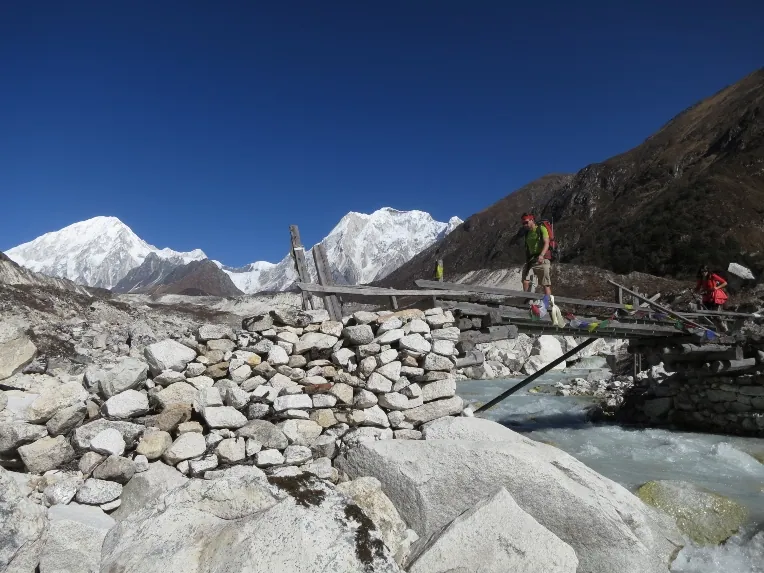
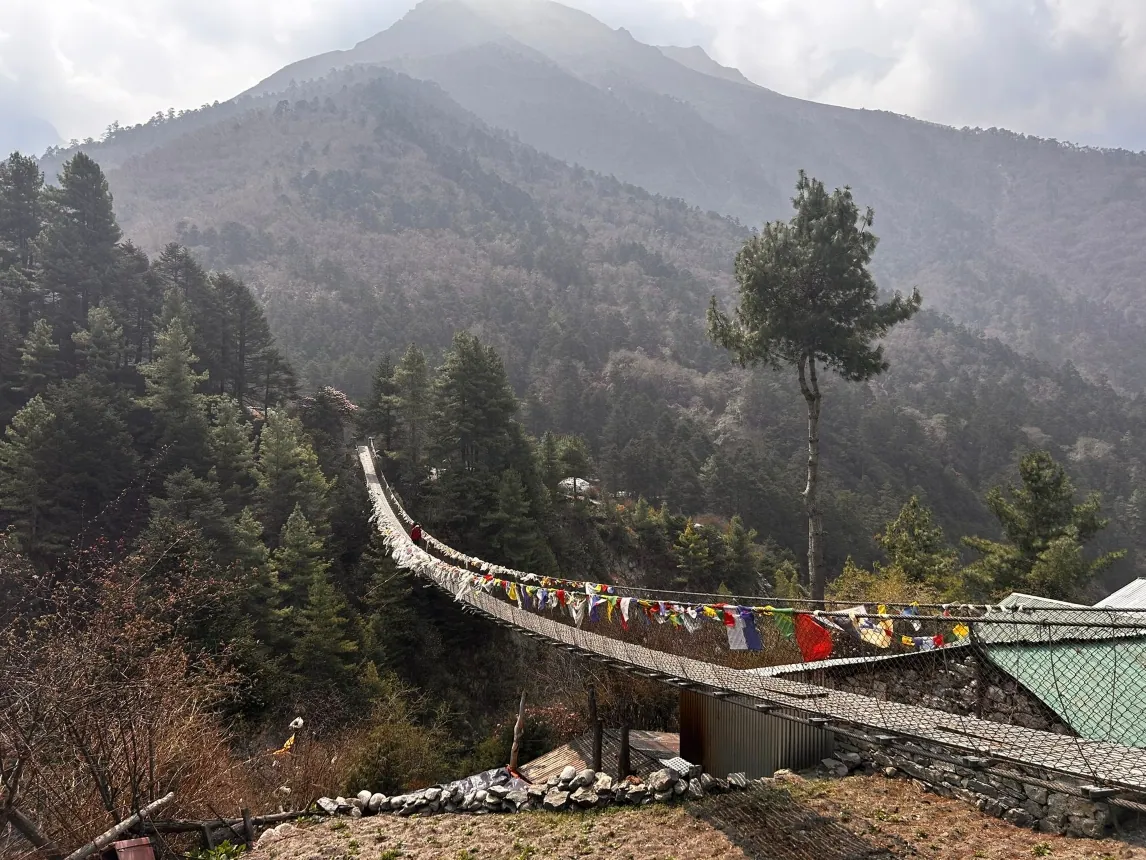
Crossing the suspension bridges along the way to Dharapani from Bhimthang.
Also, late autumn and early winter provide spectacular golden light that enhances contrast and lush auburn fields of millet and buckwheat in the valleys below. The busiest month for trekking is October, when there are many teahouses and crowded routes. Whereas November and December will have fewer trekkers on the trails, giving a better experience of the tranquility of the Manaslu region. Through the peaceful trails, one can enjoy the remote mountain environment without being rushed and crowded. Additionally, there is less competition for accommodation and space, so it improves safety as well as comfort. The calm at the end of the trekking season makes the teahouse experience more real and enjoyable. The local hosts are much more relaxed without the hustle and bustle of many tourists, giving them more time to spend with trekkers and share their culture and stories. The slow pace of village life in November and December provides an opportunity to immerse yourself in the culture of the Manaslu region.
Weather Overview: November vs. December
A. November (Late Autumn)
Manaslu Circuit Trek in November is characterized by mild and sunny daytime temperatures between 5°C to 15°C, depending on altitude. November is still regarded as the ideal month for trekking in Nepal because of the decreased moisture levels and the absence of the summer monsoon months’ oppressive temperatures. There may be some rain with less prevalent daytime thunderstorms. The sky is usually clear all day, with the positional changes in the monsoon weather creating impressive views of surrounding peaks and valleys. The night temperature may drop significantly, so it is important to stay comfortable at camps and lodges with warm sleeping gear and clothing for nighttime. November provides accessible conditions for trekking the highest point on the Manaslu Circuit, the Larke La Pass at 5,160 meters. Although November has clear trails free from heavy snow, there may be the possibility of having light snow and icy trails. Still, November is a favorite among many hikers due to its generally acceptable trail conditions and pleasant mix of unpredictable weather.
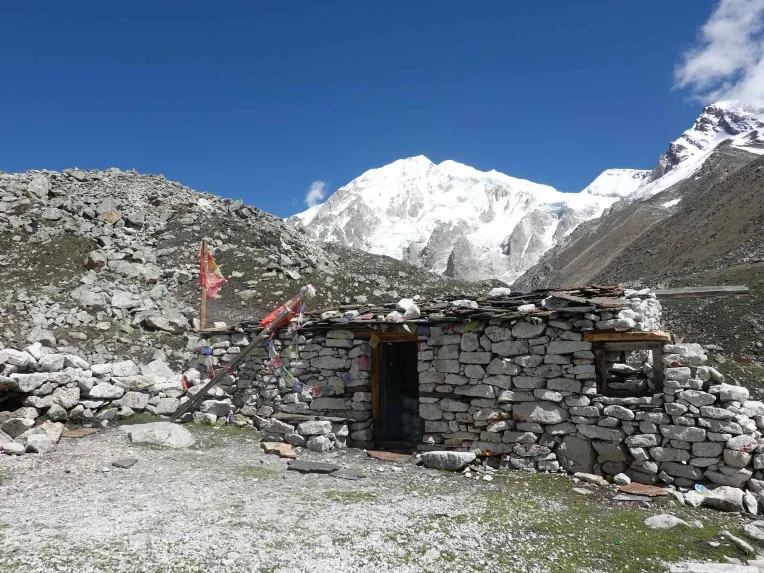
Porter shelter at Dharamsha la before crossing the Larke la pass.
B. December (Early Winter)
The Manaslu Circuit trek in December provides colder daytime temperatures of 0°C to 10°C. Daytime remains mostly clear and sunny, with colder temperatures, especially at higher elevations. Trekkers need to wear layers and be ready for the cold. The crisp air with clear skies provides good visibility along with beautiful views of the mountains. Cold air usually results in bright, sharp photographs with great contrast and vibrant colors.
During the Manaslu Circuit Trek in December, the temperature drops to -10°C and even lower at high elevations. This expected temperature range requires a sleeping bag rated for low-degree temperatures, insulated clothing, and insulation from sub-zero temperatures to prevent hypothermia and frostbite.
Furthermore, snow on Larke La Pass begins to accumulate in December, and pathways begin to be constructed. January and February are the most challenging trekking seasons; trekkers can anticipate some of these conditions in December too. The entire trail might be covered in snow, and it is snowing a lot, so crampons, trekking knowledge, and skills are required.
Manaslu Circuit Trek Difficulty in Late Season:
The Manaslu Circuit Trek is challenging in November and December due to the cold weather. At higher elevations, it is much colder during the day and much colder at night. At high altitudes, nighttime temperatures during the December Manaslu Circuit trek can fall to -10°C or below. The cold temperatures may cause problems like hypothermia or frostbite.
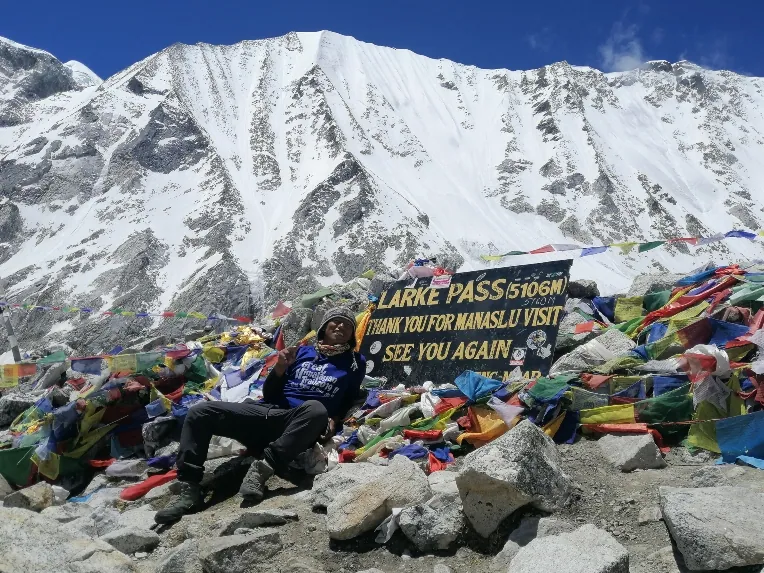
On the top of the Larke la pass 5130 m from sea level.
In the late season, snow and icy paths leading to the Larke Pass—the trek’s highest pass—present another difficulty on the Manaslu Circuit. Snow accumulation on the trail can obstruct it and cause areas to become slippery, making the path impassable, depending on the weather patterns. Finding a safe route is therefore challenging and may call for careful preparation, tools like crampons, and the flexibility to alter plans in the event that conditions become difficult. Finally, because November and December have less daylight, there is less time for hiking during the day and longer nights. The trekkers might be able to carefully manage their time and alter their itinerary as a result. Trekkers with sufficient preparation, previous high-altitude trekking experience, and the capacity to adjust to harsh and uncertain conditions would, however, be best suited for the Manaslu Circuit trek in December and November.
Crowd Levels: Quiet Trails Await
The crowd levels in November and December are different, which changes the overall experience of the trek. In early November, the trails have fewer trekkers because it is still the peak trekking season in Nepal. But in comparison to other popular routes like Everest or Annapurna, the Manaslu area will still feel less crowded. The trails will be quieter and less crowded as winter approaches because there will not be as many hikers.
Magic mountain views in the distance.
In December, the Manaslu Trek is a place of almost complete solitude. The colder weather and risk of snow limit the number of trekkers. As a result, the trails are almost deserted, giving you a closer look at the scenery as you traverse silent forests and snow-covered villages. The peace of December allows genuine wilderness adventure far away from the franticness of the busier months.
A significant advantage of trekking during these times is interacting with people along the way. With fewer trekkers passing through, teahouse owners and village people have the opportunity to connect with you to understand their culture and way of life. As a guest, trekkers may have an authentic and compelling cultural experience.
Ultimately, these seasons enhance the magical beauty and tranquility of the Manaslu Circuit. The trails are beautiful whether walking through golden fields in late November or snowy landscapes in late December; the stillness of the peaceful trails provides a meditative trekking experience. For trekkers who want to interact with locals, avoid busy crowds, and enjoy the breathtaking views, the late-season Manaslu trek is an excellent opportunity.
What to Pack: Essential Gear for November and December
Bring a down jacket, thermal base layers, and fleece for insulation in cold conditions.
A sleeping bag rated at least -15°C to keep warm on cold nights is also essential.
Microspikes or light crampons provide traction in icy and snowy sections of the trail, especially near Larke Pass.
Insulated gloves, neck gaiter, and thick socks that are moisture-wicking to avoid frostbite on extremities.
Sunscreen with a high SPF and UV-protective sunglasses to protect against strong UV rays up high.
A good, durable insulated water bottle or thermos to prevent water from freezing when it’s cold during the days and nights.
Trekking poles with snow baskets to provide stability on slimy or uneven trails.
A headlamp with additional batteries, as shorter daylight hours, may push you into low-light trekking at times.
A portable power bank and spare batteries, since battery life in cold conditions can be cut quickly.
Waterproof and windproof clothing, including jackets and pants, to help protect from sudden snow or wind chill.
Teahouse and Accommodation Tips
During Manaslu Circuit in November, teahouses are open with basic but comfortable sleeping accommodations. Many teahouses have heated dining areas for relaxing after a long day walk. At the end of the month, some teahouses at higher elevations (4,200 meters) near Larke La Pass may start to close. So it may be worthwhile to book ahead or check recent updates on availability.
By December, major accommodation options are even more limited and teahouses begin to close in higher elevations due to extreme cold weather. Food at teahouses is basic but substantial, as it not only sustains trekkers but also provides energy to combat cold temperatures. The main staple food is dal bhat, which consists of rice and lentil dishes. Teahouses also offer noodles and soups. As you trek higher, food options and variety will become limited. But thermal meals and tea are always available to generate energy and warmth for trekkers.
Although the majority of teahouses provide warm accommodation, a drop in temperature at night may necessitate sleeping bags and thermal clothing to stay warm at night as the warm clothing from teahouses will not be enough. If possible, use hot water bottles and spend evenings in a heated dining area prior to going to sleep. Don’t sleep with damp clothing, and try to keep electronics and empty water bottles in the warmth of your sleeping bag to prevent them from freezing.
Permits and Guide Requirements
Manaslu Circuit trek in November and December requires a Special Restricted Area Permit. This permit is required for the section between Jagat and Dharapani, as this is a restricted area since it is close to the border with Tibet. Seasonally, the cost of the Special Restricted Area Permit varies: from September to November, it costs $100 for the first seven days and $15 for each extra day; from December to August, it costs $75 for the first week and $10 for each extra day.
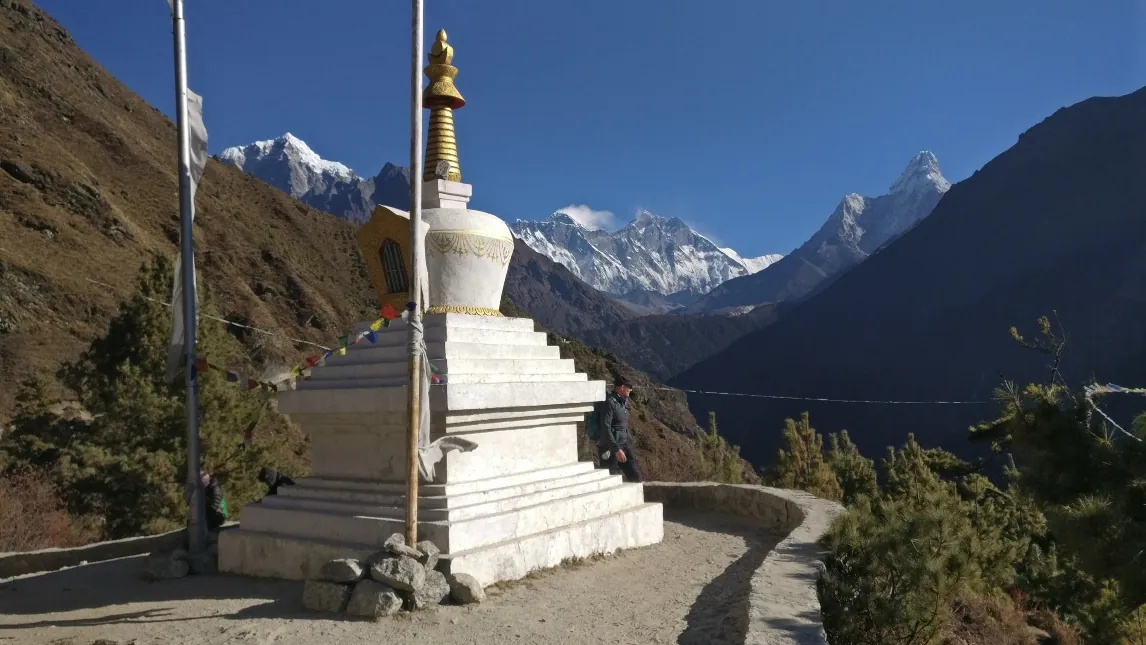
Buddhist mane wall along the way to Larke la pass.
In addition to a Restricted Area Permit, trekkers require both an Annapurna Conservation Area Permit (ACAP) and a Manaslu Conservation Area Permit (MCAP). These are required to enter and exit the areas of the conservation that the Manaslu Circuit goes through. The MCAP and ACAP are about USD 30 per person each and can be obtained through registered trekking agencies, or the Nepal Tourism Board office in Kathmandu.
The Manaslu Circuit requires every trekker to hire a licensed guide because independent treks are not allowed in this restricted area. Travel agencies are the only organizations that can obtain the necessary permits for their trekkers and guides are mandated to accompany every group. The guide’s knowledge and experience are especially beneficial toward the end of the season for the affected terrain.
It’s good to keep in mind that permit offices in Kathmandu and Pokhara may have reduced working hours during the winter season, especially around national holidays. Therefore, to avoid delays, trekker should plan accordingly, allow for processing time for their permits, and discuss all planned itinerary details with the agency to avoid delays.
Larke Pass Crossing: What to Expect
The Manaslu Circuit trek’s Larke Pass crossing is challenging physically and mentally, located at 5160 meters. The trail in the Passage is steep, rugged with large rocks, and even icy, making it the most challenging part of the whole trek. The key to having a safe crossing at this high altitude is acclimatization along with walking at a steady pace.
The potential for snow increases significantly in December. When it snows, it often covers the path with ice and layers of snow which creates difficulty and hazardous conditions in the trekking. Therefore, it is advised to begin the walk early because the possibility of higher temperatures and winds will make the climb into the Larke Pass even frigid and riskier.
The use of microspikes or light crampons on snow or ice trails will improve traction on the icy probed while trekking poles will assist stability on the uneven ground as you navigate the rocky terrain. Additionally, it is beneficial to add extra days to your travel plan as there may be any delay on the trek due to unpredictable weather and the possibility of snow build-up on the trails.
Expert Tips for Late-Season Trekkers
Early-day hiking is important to take advantage of the limited daylight hours in November and December.
Cold weather usually suppresses the thirst which increases the risk of dehydration, stay hydrated throughout the trek.
Allow your body to acclimatize to the altitude by moving gradually and resting between ascents to minimize the risk of altitude sickness.
Keep your energy levels steady by taking your time, especially when you’re getting close to high passes like the Larke La.
Be flexible with your schedule and add extra days to deal with snow or weather delays.
Regularly check with your guide about trail conditions and the weather to keep you informed about what is happening and how you can adjust your plans for the day.
Wear and pack appropriate warm clothing in layers to adjust to the changing temperatures during a single day.
Bring trekking poles and microspikes or crampons to increase stability on icy and snowy areas of the trail.
Conclusion
Trekking guide team
Manaslu circuit trek in November and December provides a remote and raw Himalayan experience, coupled with extraordinary mountain views and a sense of solitude. The post-monsoon clarity of November along with the crisp atmosphere and onset of winter in December with snow-covered landscapes offers an opportunity to interact with nature and local culture.
The Annapurna Circuit Trek in December and January is a wonderful choice for real adventurers who are looking for solitude, peace, and beautiful winter scenery. Trekking the Annapurna Circuit during these months is a bit more challenging compared to the main trekking seasons, but it offers a magical experience with fewer crowds and breathtaking landscapes.
You will find the trails much quieter, allowing you to truly connect with the Himalayas in a calm and peaceful way. However, it’s important to know that trekking during winter comes with some challenges like cold weather, icy trails, and shorter daylight hours. Crossing high passes like Thorong La (5,416m) can be especially tough due to snow, ice, and the risk of avalanches.
Even though it’s challenging, the rewards are unforgettable. Clear blue skies, sparkling snowy mountains, and a feeling of being completely immersed in the natural beauty of the Annapurna region make all the effort worthwhile. With the right gear, proper planning, and a flexible mindset, trekking the Annapurna Circuit in December and January can be an incredible adventure.
Almost all high mountain passes like Thorong La have their own highly challenging aspects because of avalanches or ice curtains. The trip offers its own hardships, but all that pain quickly disappears as the rewards come pouring in-beautiful blue skies above, breathtaking views of snow capped peaks, and the opportunity to truly immerse oneself in the stunning beauty of the Annapurna region at its most serene and softest state. Awareness and preparedness combined with the right gear and planning on how to tackle this circuit during the winter season are required for safe navigation.
It is really attracting to the real adventurer who wants to see complete solitude and be in awe of beautiful wintry landscapes. There are few tourists on the trek during these months, allowing one to more quietly and completely experience beauty in the environmental drainage of the Himalayas. The winter trek presents some very daunting conditions: cold temperatures, snow-covered trails, and short hours of sunshine. The high passes at altitude, for example, Thorong La, face nearly insurmountable challenges due to avalanches and icing. While the expedition has much difficulty, all the efforts are worth it when you have benefits coming in-for all the azure skies over you, fabulous views of snow capped peaks, and more space in which to enjoy the amazing beauty of the Annapurna region in its most peaceful and softest form. Awareness and preparedness, along with the right gear and planning on how to take on this circuit in the winter season, are essential for safe navigation.
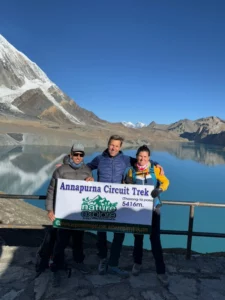
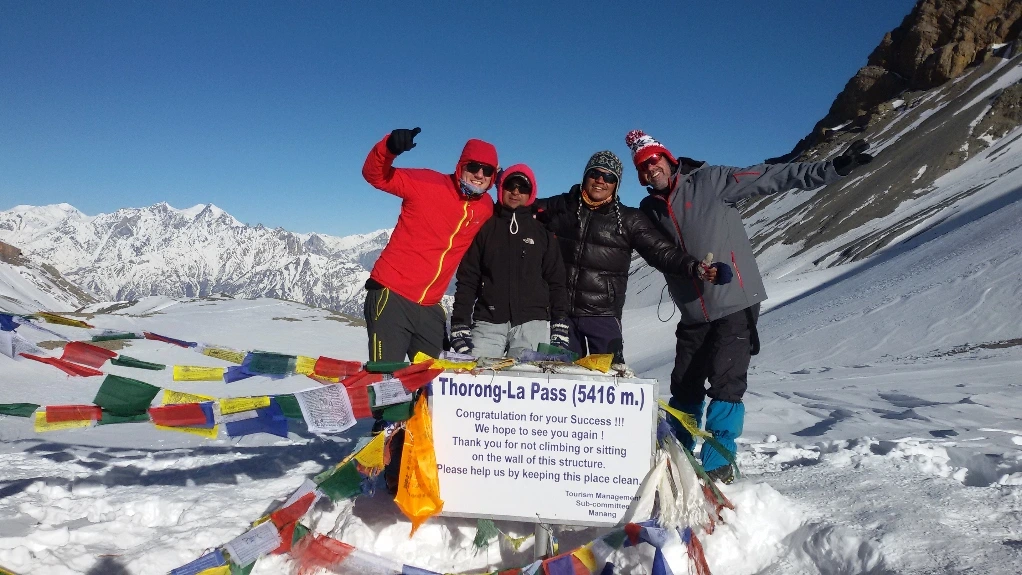
Congratulation Nature Explore Trek team for successfully reach on the top of the Thorong la pass
Winter trekking on the Annapurna Circuit
Winter trekking on the Annapurna Circuit comes with its unique gainful experiences, making it worthwhile and very memorable. The most overt benefit is fewer crowds. Being one of the most traversed trekking routes, not many trekkers head to Annapurna in December and January, allowing some peace and solitude to enjoy the mountains. The trails are quiet, tea houses sparsely populated, and long views of snowy peaks can be enjoyed without interruption.
Another benefit of trekking in winter is clear skies with gorgeous views. Winter in the Himalayas often brings in crispness, cold air, and little or no cloud cover, which ensures crystal clear views and stunning panorama views of the Annapurna and Dhaulagiri ranges. The snow-blanketed trees, frozen streams, and snow-draped villages add a picturesque charm to the winter landscape, which is a delight for the eyes.
Winter trekking can also be an opportunity to see a more genuine side of Nepal. Since winter involves festivals such as Tihar and New Year, you may also get a chance to witness some local celebrations in an atmosphere almost free of tourists. The locals living in the high-altitude regions often observe the celebrations with their own traditional rituals, and observing this can add to the cultural enrichment of your trek.
Challenges and Preparation
While winter trekking may be regarded as rewarding, the challenges along the way can be monumental and must be adhered to. Cold weather can be a severe threat, especially during the night when the temperature may drop to very low levels. The nighttime cold can be uncomfortable for sleeping, particularly if one is not properly outfitted in insulated gear and warm layers. You should have a proper sleeping bag rated for at least -15 to -20°C and layer up for warmth.
The snow and ice along the trail becomes a feast for the sight but perilous. Some of the harder portions of the trek, especially those up around Thorong La Pass, can prove challenging and dangerous because of heavy accumulations of snow. Ice patches are treacherous not only for trekking but also tend to increase the risk of injuries due to slipping and falling. Hence, microspikes and crampons would be a wise addition to your pack as they significantly enhance grip on icy surfaces.
Also shorter days during winter present another challenge. With limited daylight hours, it is advisable to be an early riser and to finish the day’s hike before nightfall. In the mountains, darkness comes quickly and it can be deadly to walk trails whose paths are unfamiliar in the dark, especially with snow and ice making navigating all the more difficult. You must have a functional headlamp in place and time your days accordingly to reach your destination during the daylight hours.
Altitude and Acclimatization
Trekking in high altitude is a true challenge on the Annapurna Circuit with altitude sickness being the major culprit, especially after crossing 3500 meters. The thinning air smoothens physical exertion and increases the tendency for altitude sickness. The chances get slimmer in winter because of freezing temperatures and heavy snow which take away your energy and spirit for trekking. Hence, acclimatization is of utmost importance. Taking frequent rest days, climbing slowly, and drinking adequate water can be handy. A good rule to follow is not to gain more than 300-500 meters of elevation per day after surpassing 3000 meters. Give altitude the respect it deserves; listen to your body and give it enough time to adjust this is major for having a safe and enjoyable trip.
Tea houses and Accommodation
Generally, many tea houses along the Annapurna Circuit stay open during winter; however, some of the distant or not-so-frequent places have their tea houses closed during that period of low activity. The tea houses that remain open are quite combed in delicious winter spoiling, with warm coziness to sleep within on hiking days in the freezing cold. But with trekking dwindling in number, websites available for room bookings may be fewer, hence early reservation of rooms would be wiser during the midwinter peak for trekkers. Basic accommodation must be expected since many tea houses will have quite simplified rooms with no to minimum heating, most would offer a warm meal and a relaxing stay by a stove.
Accommodation at the higher altitudes is relatively selective, with some tea houses being shut throughout the months, therefore adding with challenges to the trek. But trekking these months has its perks- fewer crowds, and fewer crowds- a sight of the mountains cloaked in snow imparts a pleasantly otherworldly view! However, the extremes might be quite harsh; these include, talking about winters, extreme cold and sudden occurrence of snowstorms, yet it is the pristine experience worth celebrating with joy by any well-prepared trekker on the Annapurna Circuit.
Guide and Porter Services
Independent trekking is possible along the Annapurna Circuit Trekbut trekking with a guide and porter during winter is strongly advised. The trail conditions will be able to tell the guide about the snow-covered sections of the trails and the activity done for your safety when trekking. Another advantage of having a guide is that he or she would be busy in keeping an eye on your health and acclimatization as they can easily identify the symptoms of altitude sickness and then make the itinerary change depending on the conditions. Having a porter makes the trek less burdensome because they will carry your big pack, focusing your energy on the trek itself. This becomes even more important in the winters as the cold weather gear and supplies add to the already heavy pack.
Flexibility and Prepare
Winter trekking requires a lot of flexibility. The weather in the mountains can change quite abruptly, and conditions like these can mean use of snowstorms or freezing rain with serious dislocations to plans. Passes such as Thorong La can be closed or even dangerous due to snow build-up, making a flexible itinerary imperative. If you’re trekking with a guide, they will be able to change up your schedule as needed, possibly avoiding high-risk areas or suggesting alternate routes. Contingency plans are also essential for emergencies or unintended delays.
Weather and Temperature
The Annapurna Circuit trek during December and January can offer an amazing experience with a few problems related mainly to weather and temperature. During this time, the area witnesses cold and dry weather and clear skies since it is the time for the dry season. Snow is also found at places of higher elevation, especially at Thorong La Pass, where nighttime temperatures might even fall to -20°C or even lower. The lower elevation places like Besisahar and Chame will have daytime temperatures between 5 and 18°C, while nighttime temperatures could fall much lower to maybe 3 or 8°C. Even while trekking in Manang and Thorong Phedi, a decrease in temperature will still be noticeable, with daytime highs averaging between -5°C and 0°C and nighttime temperatures dropping to anywhere from -10°C to lands of being colder at -20°C. The highest section, Thorong La Pass (5,416m), will be severely exposed to cold with temperatures dropping to -25°C and having chances of snowstorms too.
December generally assures clear skies and cold yet refreshing days; however, it may also be gainfully described as the cruellest month of January, which has still colder conditions and more likelihood of snowstorms at the higher reaches. Weather is unpredictable here; snow could fall at any time during the dry months, causing havoc with the trail.
This table summarizes the major locations on the Annapurna Circuit Trek, along with their elevations, average daytime and nighttime temperatures, and important trekking notes.
Location
Elevation
Avg. Day Temp (°C)
Avg. Night Temp (°C)
Notes
Besisahar
760m
10–18
3–8
Start of trek, pleasant
Chame
2,650m
5–10
-5 to -10
Cold mornings & evenings
Manang
3,540m
0–5
-10 to -15
Snow possible, crisp days
Thorong Phedi
4,540m
-5 to 0
-15 to -20
Harsh cold, acclimatization needed
Thorong La Pass
5,416m
-10 to -5
-20 to -25
Snowy, windy, very cold
Muktinath
3,800m
0–7
-10 to -15
Dry and windy
Jomsom
2,720m
5–12
-2 to -6
Windy afternoons
Outline Itinerary of the Trek
Day 01 Arrive in Kathmandu and transfer to your hotel. Day 02 Trek preparation day Day 03 Drive from Kathmandu to Besisahar – Dharapani (alt.1900m) 221 km Day 04 Trek from Dharapani to Chame , 2,710m ,5-6hrs Day 05 Trek from Chame to Upper Pisang, 3,300, 5-6 hrs Day 06 Trek from Pisang to Manang, 3,540m, 6-7hrs Day 07 Acclimatize in Manang (Hike to Chongkor viewpoint) Day 08 Trek from Manang to Yak Kharka, 4,110m, 3-4hrs Day 09 Trek from Yak Kharka to Thorong Phedi, 5,416m , 6-7 hrs Day 10 Trek to Muktinath through the Thorong La pass (alt.5416m), 5-6 hrs Day 11 Trek from Muktinath to Jomsom, 2,720m, 5-6hrs Day 12 Flight from Jomsom to Pokhara, 820m, 25 min Day 13 Drive back to Kathmandu by tourist bus,
Your arrival in Kathmandu paves the way for an entire day of preparation and exploring before this 13-day Annapurna Circuit trek. Thereon, on day three, you do a long scenic drive from Kathmandu to Dharapani via Besisahar. Thus, on day four, trek to Chame because trekking starts from Dharapani. The following two days will see you climbing Upper Pisang and Manang. Acclimatization is done at Manang, including a short hike to Chongkor viewpoint, before going along the trail to Yak Kharka, then Thorong Phedi. On the tenth day, the trek crosses the challenging yet beautiful Thorong La Pass (5,416m) down to Muktinath. For the next day, it will be a trek to Jomsom, from where a short flight will take you to Pokhara, after which you’ll be driven back to Kathmandu, the last stop in what will amount to be an unforgettable Himalayan adventure.
A day like
A winter day on the Annapurna Circuit starts with dead calm when the sun rises over the marble mountains, throwing its golden rays over the frost-covered landscape. A cold, sometimes even subzero morning, frozen tea houses, a quick hot tea and kleenex breakfast – and off into the trail that snakes through placid villages, several pine forests, and glacial way, all together crisp mountain air with brilliant clear blue skies above. The snow crunches underfoot as the sun brings some warmth to the day, though the cold lingers in shaded areas.
Around midday, a steaming plate of dal bhat or noodles offers comfort and energy..As the afternoon processes, the temperature drops again , and racing the next teahouse before dark becomes a priority. Evenings are spent huddling near the stove of the dining room, sharing stories with other trekkers while cooking and eating good food . Early tuck in under a warm sleeping bag, a sky full of stars above awaiting the next leg for a long journey through these quiet , magical winter mountains.
Annapurna Circuit Trek in December
Trekking the Annapurna Circuit Trek in December offers a unique and beautiful experience but it comes with certain challenges due to the winter season . At the lower elevation such as 1000m to the 2,500m temperature are mil rangug from the 5 degree to the 15 degree during the day though it can still drop to freezing or lower at night. As you ascend to higher altitudes temperature can get high especially around the Thorong La Pass(5,416m) where the daytime temperature goes around -5 degree to 5 degree and the night time temperature can drop well below – 10 degree. Snow is common in higher areas which can make the trail slippery and difficult particularly above 3,500m.
The shorter daylight hours in December mean that trekkers need to plan their hhikes carefully to avoid being on the trail after dark. While in winter means fewer trekkers , resulting in a more peaceful and serene experience, it also means some teahouse may be closed insulated jackets and trekking poles is essential for the cold and potentially icy conditions. Additionally , those trekking in winter must be cautious of the altitude sickness as acclimation can be more challenging in colder weather. Despite these challenges the reward of this trekking the Annapurna Circuit in December are clear breathtaking views of snow-capped peaks, fewer crowds, and serene , winter and that offers a truly memorable himalayan adventure.
Annapurna Circuit Trek in January
Walking the Annapurna Circuit in January is an adventure that only the adventurers can cherish, for it is one of the most beautiful and magical experiences. January coincides with peak winter in Nepal and ushers in serenity with beautiful snow-covered landscapes, creating real magic in the already beautiful Annapurna region. Oftentimes the skies would be very bright and clear, offering unhindered views of towering giants like Annapurna, Dhaulagiri, and Machapuchare.
Be prepared to feel extremely cold especially at high altitudes, with daily averages from about 5°C to 10°C, and the nights sometimes going well below freezing. Snow is a common occurrence above 3,000 meters with the major passes such as Thorong La (5,416 meters) having very thick snow, making the trek even more exciting. The best winter trekking gear, good planning, and occasionally a flexible itinerary are essential during January.
The best part about trekking at such times is that one gets a lot of peace and quiet along with scanty crowds. The trail is completely empty relative to its crowdedness during the very famous autumn and spring times. Most teahouses are operational, but those that are higher up may occasionally discourage guests or entertain them in bare hospitality.
The Annapurna Circuit in January is undoubtedly for trekkers who love solace, sceneries of dramatic white landscapes, and the pure thrill that comes with trekking in a very rough and wintry environment. It can be made into one unforgettable experience in the Himalayas with proper preparations and minds put into it.The Annapurna Circuit in January is undoubtedly for trekkers who love solace, sceneries of dramatic white landscapes and the pure thrill that comes with trekkering in a very rough and wintry environment. It can be made into one unforgettable experience in the himalaya with proper preparation and minds put into it
The Manaslu Circuit Trek in October is one of the most rewarding Himalayan treks in Nepal, offering an off-the-beaten-path trek through the isolated mountain villages, untouched forest, and spectacular high passes. The trek goes around the eighth-highest mountain in the world—Mount Manaslu (8,163m)—and offers the ideal combination of culture and nature.
Choosing the appropriate time of the year is crucial for a successful trek, and out of all the months, October is the optimum. Clear weather after monsoons presents breathtaking views of white-capped mountains, and the established climate gives amicable trekking conditions.
Trails are rich in flora and fauna, and local festivals like Dashain and Tihar add cultural richness to the trek. With cool air, flowering landscapes, and dry, sunny weather, the Manaslu Circuit Trek in October promises to be a memorable and visually impressive experience. For adventure and peace of mind, October is simply the best time to visit the Manaslu Circuit.
Overview of the Manaslu Circuit Trek:
Mt. Manaslu (alt.8163m). Picture taken by our guide last year in October from Lho Gaun.
Month of October to do the Manaslu Circuit Trek gives you one of the most unexplored and diverse trekking trails in Nepal. Located in the Gorkha District of western Nepal, the Manaslu Trek encircles the world’s eighth highest peak of 8,163 meters, known as Mount Manaslu.
This remote trek was opened for the first time to outsiders around the early 1990s and is less touristy in comparison to its more popular contemporaries like the Everest and Annapurna treks. The region is deeply saturated with Tibetan culture, with old monasteries, prayer wheels, mani walls, and chortens strewn along the trail.
Through picturesque villages like Samagaon and Lho, where you will come across traditional lifestyles not touched by modern life, you will get to experience unparalleled nature ranging from hills and terraced farms to mountain highlands and the majestic Larke La Pass at 5,106 meters if you do the Manaslu Circuit Trek in October.
The trek usually lasts for 14–18 days, depending on the itinerary and acclimatization days. The trek is of moderate difficulty due to the height and challenging routes. Trekkers must purchase a series of permits: the Manaslu Restricted Area Permit (MRAP), the Manaslu Conservation Area Permit (MCAP), and the Annapurna Conservation Area Permit (ACAP). The Manaslu Circuit Trek in October promises the optimal experience with sunny skies and wonderful trekking conditions.
Temperature in October during the Manaslu Trek:
Mountain magic view of the Manaslu region with a beautiful sunny day.
The Manaslu Circuit Trek in October has the best temperature conditions for trekking in Nepal. At low altitudes, daytime temperatures are about 10°C to 15°C, and it is very pleasant trekking. Temperatures drop as you ascend to high altitudes.
At mid-altitudes like Samagaon (3,530m), you can expect daytime temperatures to be about 5°C to 10°C and nighttime temperatures to drop down to 5°C to -8°C. At higher elevations close to Larke La Pass (5,106m), the daytime temperatures are between -2°C and 5°C and can fall as low as -6°C or even lower at night.
In comparison with the other months, the October Manaslu Circuit Trek is much more pleasant. November is very cold, with the temperature dipping even lower, especially in the evenings.
September is also still within the monsoon season, with rainy trails and high humidity, so October is the preferred month if looking at temperature and consistency of weather. The ideal temperature in October offers a great and comfortable trekking experience.
Weather Conditions on the Manaslu Circuit Trek in October :
Along the way to the Manaslu Circuit Trek, we also meet one of the traditional Nepalese houses.
The October Manaslu Circuit Trek is renowned for having ideal weather conditions as the dry season begins. The month offers clear skies, no rain, and ideal trekking conditions, making it one of the ideal times to undertake the adventure.
The dry conditions ensure that the trails are maintained clean and the chances of the trekker encountering muddy or slippery trails are minimal, particularly when traversing higher altitudes.
October, while Manaslu Circuit Trekking, has the best clarity. Clear, fresh air with sunshine provides magnificent views of snowy mountains circling the trail, including Mount Manaslu, Himalchuli, and Ganesh Himal. The sun, 8-10 hours of sunshine per day, provides the ideal hour-long trekking period.
Trekkers should prepare themselves for snow at higher elevations, particularly around Larke La Pass (5,106m). Although it is not guaranteed to have snow, it cannot be avoided because of the elevation, and it makes the trek interesting and challenging.
The Manaslu Circuit Trek in October has stable weather conditions and is therefore an ideal time to have a trouble-free, smooth trek. With dry conditions, clear visibility, and stable weather, October is the ideal time to go on this Himalayan trek.
Why October Is the Best Month for the Manaslu Circuit Trek ?
Waterfalls are always welcome to trekkers who are trekking the Manaslu circuit trek between Philim and Dyang village.
October is perhaps the best time to undertake the Manaslu Circuit Trek. The monsoon period comes to an end in October, and post-monsoon freshness begins on the trails. The forests along the way are green and dense, and the trails are neat and clean and devoid of any debris after the necessary repairs, making it a comfortable and safe trekking experience.
One of the top features of October’s Manaslu Circuit Trek is peak clarity. With a clear sky and minimal rain, the trekkers have the opportunity to take dramatically stunning panoramic images of the huge peaks, including Manaslu, Himalchuli, and Ganesh Himal. Visibility in October is unrivaled, with some of the best photo-shooting opportunities in the trek.
October weather is just perfect—not cold and not hot. The temperatures during the day are perfect for trekking, and nights at high altitudes are cold but tolerable. October is therefore an ideal month for trekkers who desire regular weather conditions without the extreme cold of later months like November.
October is culturally a very vibrant month due to the overlapping of Nepal’s Dashain and Tihar festivals. There are festivities held in the villages along the trek, giving the visitor an excellent opportunity to interact with the locals and understand their traditions. Overall, October offers the Manaslu Circuit Trek the best mix of weather, visibility, trail conditions, and cultural exposure and is therefore the optimal time to Everest base camp trek in Spring 2025/2026visit.
Advantages of Trekking the Manaslu in month of October
The Manaslu Circuit Trek in October has some advantages that make it an ideal choice for trekkers who want an offbeat Himalayan experience. Compared to the more popular trails such as the Everest Base Camp or Annapurna Circuit, the Manaslu region is comparatively less touristy, even during peak season.
This gives trekkers a serene, more genuine experience along remote mountain villages and serene landscapes.
October is also the perfect time for photography and movie-making. Blue skies, golden sunlight, and white summits of Manaslu (8,163m), Himalchuli, and Ganesh Himal provide wonderful settings. Whether shooting mountain vistas, fluttering prayer flags in the wind, or village cultural scenes, October’s Manaslu Circuit Trek is an eye feast.
Higher passes like Larke La Pass (5,106m) are more bearable in October, with settled weather and moderate snows. Temperatures that are not very cold reduce the chances of bad conditions halting the trek.
Another important advantage of trekking the Manaslu Circuit in October is the availability of teahouses. Due to the post-monsoon season being fully operational, most teahouses are open, well-stocked, and offer a greater variety of meals. This is an added facility for comfort and experience of travel.
Also, October falls at the time of grand Nepali celebrations such as Dashain and Tihar, when travelers can indulge in interaction with locals and watch celebrations in their traditional manner. The Manaslu Circuit Trek during October beautifully amalgamates adventure and culture and thus proves to be an experience in reality.
Scenery and Nature on the Manaslu Circuit Trek in October
A thirsty yak drinking fresh water from a cold river.
The Manaslu Circuit Trek in October offers some of the most beautiful natural landscapes in Nepal. October is part of autumn, coloring the landscapes with lush autumn colors in red, orange, and gold. The lower slopes are tinted with blooming wildflowers, adding a splash of color to the already gorgeous trails.
Trekkers on the Manaslu Circuit Trek in October can expect to find crystal-clear rivers and waterfalls plunging with fresh energy after the monsoon. The paddy fields on terraces, heavy with mature crops, provide a glimpse of conventional Himalayan agriculture and rural Nepali life.
Hidden further up are the glorious snowy summits of Mt.Manaslu I (alt. 8163 m), Himalchuli (alt. 7893 m), and Ganesh Himal (alt. 7422m), Nike Peak (alt. 6211 m), Larke Peak (alt. 6219 m), and Samdo Peak (alt. 5177 m), lightly draped in an elegant dusting of fresh snow, in vivid contrast to brilliant blue October skies. Altogether, rainbow-colored valleys with white-topped summits make the trek along the Manaslu Circuit Trek in October a visual spectacle from start to finish.
Trek Challenges of Manaslu Circuit Trek in October
Larke La Pass is 5130 m above sea level.
Although the Manaslu Circuit Trek in October is one of the best treks in Nepal, there are some challenges that the trekkers must face and overcome themselves. The greatest issue is the cold nights at the higher altitudes like Samdo (3,875m) and Dharamsala (4,460m). The temperature dips below freezing, and thus proper equipment and warm clothes are required.
Another challenge on the Manaslu Circuit Trek in October is possible sudden weather change near Larke La Pass (5,106m). Although October generally offers stable weather, high-altitude weather is always unpredictable, and sometimes it can snow or become windy. One has to monitor the forecast and be ready to alter the itinerary.
As it is becoming more popular, moderate crowds can mean that teahouse space becomes limited along the trail. It is recommended to reserve accommodation in advance to obtain a comfortable place for the Manaslu Circuit Trek in October.
Everest Base Camp Trek is one of the most beloved treks in the world. Every year, thousands of people appraise this formidable challenge to reach this iconic place. But a common question many trekkers have is : Do I need a guide for the Everest Base Camp? Here in this blog I hope you will find the answer to it.
Independent Trek vs. Hiring a Guide
1. Independent Trekking
Yes, EBC trek can be done on your own. In case you have experience trekking at high altitude , navigating competence using maps or GPS , and consider yourself fit to carry your own pack , you have an option for solo trekking.Nevertheless, one should prepare Nevertheless, one should prepare for sudden weather changes, altitude sickness, and the difficulty of finding lodges during the peak season. Going alone also implies the need for responsible management of your own itinerary, acquiring your permits, and arranging food and shelter for yourself along the way. Although the trail is very well marked, weather and landslide damage may render it temporarily unpassable, in which case some good navigation skills would help.
2. Hiring a guide
Hiring a guide can greatly enhance your trekking experience in terms of safety, cultural awareness, and logistical issues. This is not compulsory but may come in handy, especially if you are a beginner trekker or unfamiliar with the terrain.
One of the areas where a guide is beneficial is communication. Most local guides are fluent in English, which helps bridge the language gap between trekkers and locals. Therefore, asking for directions, ordering food, or haggling for accommodation becomes easier. They also provide opportunities for meaningful interactions between trekkers and villagers as trekkers learn a bit about their way of life, traditions, and customs. They can also assist you in monks and monasteries by explaining their religious and historical importance.
The guides will not stop at mere translation; they delve into the history, culture, and geography of the areas you visit. They will elevate the trek from a mere physical journey to a journey filled with folklore, festivals, and traditions. Knowledge of the hidden hills that provide scintillating views and the back lanes that are not often visited will put a fresh twist on your expedition.
When in tough times, a strong communication skill can be the deciding factor. Whether it is an emergency evacuation for a sick trekker or to seek aid with another trekker down with altitude sickness, a guide is able to communicate efficiently. For example, helicopter evacuations, medical assistance, accommodation issues, etc., can all be solved with proper communication skills; this goes a long way in ensuring your safety and comfort.
Should You Hire a Porter?
A porter carries your heavy backpack, allowing you to trek with just a light daypack. If you dont want to carry all your gear, hiring a porter can make your journey easier. Some guides double asporter and guide you while carrying their own light load. Porter are especially useful if you are unaccustomed to carrying heavy loads in high altitude.This can greatly minimize fatigue and enhance your trekking experience.
Cost of Hiring a Guide
The guide fee follows the same logic, varying according to trekking routes and seasons as well as depends on the guide’s experience. Hiring fees usually range between $25 to $40 per day. Should you hire a porter for carrying your luggage, it normally takes from $15 to $25 per day. While it may be an additional cost, trekkers consider it a worthwhile expense for the extra help, safety, comfort, and enhancement of experience.
A reputable trekking agency hiring a guide takes care that he is licensed, insured, and experienced, so you can be relaxed during the whole journey. The agency also takes care of your logistics; hence it is a hassle-free path. Some independent guides are sometimes cheaper by some bucks, but you need to ensure extensive research in order to make sure your guide is reliable, knowledgeable, and qualified.
You will need to factor in more than just the basic price of hiring a guide in your trek budgeting. Important considerations are the guide’s experience, language fluency, and familiarity with the area. Although high experience level may come with increased costs, a good guide will facilitate and ensure smoother logistics and emergencies. Tips are a common practice and are well appreciated, especially when good work has been done.
It can be said that the price of a guide and/or porter should form part of the entire trekking experience. A good guide offers safety, provides navigation, and lets you understand and appreciate the culture, history, and landscape, all of which will certainly enrich your trip.
Trekking without a guide:
Despite the fact that numerous trekkers have been completing the trek to Everest Base Camp (EBC) without hiring a guide, solo trekking demands meticulous planning, rehearsed experience, and self-sufficiency. Independent trekking offers freedom and flexibility but has a little twist in the tale with different dangerous situations and challenges.
Is It Safe?
Unfortunately, an individual trek to EBC is not possible because of certain dangerous elements. The paths have been marked out very clearly for trekkers as it is indeed well provided with teahouses along the route; thus, this is all well and indeed good for self-supported trekkers. However, and it does not take too much thought to imagine the possible hazards, such as altitude sickness, injuries, and navigation disasters, transforming this solitary adventure into a very dangerous situation.
Altitude sickness: The level of oxygen has almost depleted by 5,364 meters (17,598 ft) at EBC whereby increasing the risk of Acute Mountain Sickness (AMS), High Altitude Pumonary Edema (HAPE), and High Altitude Cerebral Edema (HACE). Without a guide to check symptoms, solo trekkers must recognize early warning signs and take the necessary precautions as per their own judgment
Injuries: Slippery paths, rocky terrains, and extreme weather conditions contribute to producing falls, sprains, or even a bone fracture. Medical attention will be challenging to reach without assistance from a guide in remote areas.
Getting Lost: The trajectory may be well defined, but bad visibility can occur due to fog, snowfall, or sudden changes in weather, therefore disorienting trekkers.To be safe, anyone trekking solo should have a detailed set of maps, GPS devices, emergency contacts, and a solid draft itinerary shared with friends or family.
For Experienced Trekkers only
This solo trek is fully recommended for those who have done high-altitude trekking before; if you have trekked above 4,000 meters (13,000 ft) before and can acclimatize to high altitudes, the chances for you to have an enjoyable and safe trek are higher.
You should be:
Comfortable reading maps, using GPS, and following trail markers
Capable of handling altitude sickness symptoms and knowing when to descend
Physically and mentally prepared for long days of hiking in varying weather conditions
Experienced in managing your own logistics, including finding accommodations and arranging meals
Key Challenges
Altitude:
Proper acclimatization is crucial-follow the rule of not ascending more than 500 meters per day above 3,000 meters and include rest days.Particularly for solo trekkers, pay attention to the symptoms in cases of AMS, such as headaches, dizziness, nausea, and difficulty in breathing.
Navigation:
The Everest Base Camp trail is quite busy, although finding the way may be tough due to bad weather, snows along the trail, or if the time is out of season.Bring a thorough trekking map, compass, or a GPS app like Maps.me or AllTrails.
Logistics:
Without a guide, you will need to work hard to find accommodation and supplies for the trek. During those peak seasons, the teahouses quickly fill up and solo trekkers may have trouble finding rooms in Namche Bazaar, Dingboche, and Gorak Shep, among others. You will have to bargain the prices, take food orders, carry first aid kits, the extra cloth, and travel snacks high in energy.
Necessary Permits
Depending on whether you trek on your own or with a guide, you need to secure certain permits prior to your journey. The two most significant permits you will need are :
Sagarmatha National Park Entry Permit-Required for an entrance to the Everest area.
Khumbu Pasang Lhamu Rural Municipality Permit-Mandatory for all trekkers arriving in the area.
These permits may be obtained in Kathmandu or Monjo, a small village along the route. If a guide is hired, they generally organize these permits on your behalf.
Best Time for Trekking
A glorious site for an Everest Base Camp trek during the months of spring would be facing favorable weather and conditions, bright sunny skies and gentle warmth. Day temperatures throughout the trek average between 5°C and 10°C, with nighttime minimums of -10°C to -5°C. With a lovely combination of green vegetation and blooms of rhododendrons contrasting against the white-eaved summit, this springtime offers fabulous views. The weather conditions are more or less dry, while views of the mountains are a feast to behold! Well, it is a peak season, so do expect a decent number of other trekkers on the Everest trail.
Autumn (September to November)
This period is characterized by crystal-clear skies, dry weather, and lovely mountain sights; thus, the second-best time for an Everest Base Camp trek. The daytime average temperature is pleasant (10°C to 15°C), and it could really turn cold during the nights, especially at higher altitudes where the temperature could dip to -10°C or -5°C. Firm trails make views unto the neighboring peaks unabstr-ucted, with some of the best views ever of Everest and adjoining peaks. This relatively quiet time of trekking with fewer trekkers makes it all worth the while compared to the hustle and bustle of spring trekking.
Winter (December to February)
Very cold conditions prevail at Everest Base Camp in winter, with nighttime temperatures often plunging to -15 degree celsius or – 20 degree celsius . Crisp and clear days are beautiful for views but severe cold and probable heavy snowfall hamper any trekking experience . The higher up the mountains, the tougher these months turn out to be on the few brave trekkers daring during this season. So the winter can be for those few of you who consider yourself backcountry warriors and can handle the challenges of trekking in solitude. Planning ahead with the warmest gear is essential as well so make sure to pack the clothes accordingly.
Monsoon (June to August)
June to August are the monsoon months during which heavy rains make the trails extremely slippery and muddy and increase the chances of falls and injuries. Landslides happen frequently, blocking the paths and rendering the trip treacherous. Rivers and streams fill up quickly, thereby making the crossing tougher and riskier. Humid air tires the trekkers, thus compounding the trouble. Another big issue is leeches, which love the wet environment, often cling to the skin, and put a dampener on the whole trekking experience. However, an upside to monsoon trekking is that the scenery is at its most beautiful: with lush greenery and foggy hills, the views are breathtaking. Waterfalls overflow, adding beauty to the entire trip. The fewer the trekkers, the more peaceful and quiet the experience will be, with accommodations being easy to come by—sometimes even at discounted rates.
Spring (March-May)
Spring, which is another favored time for an Everest Base Camp trek, is characterized by mild temperatures, stable atmospheric conditions, and glorious mountain scenery. Daytime temperatures are ideal with ranges of 10-20°C, making for pleasant trekking, although nighttime at higher altitude can drop down to -5°C or -10°C. The trails are more or less hardened and dry with best available panoramic visibility of Everest and adjoining peaks.
One of the splendors during trekking in spring is the magnificent blossoms of rhododendron, which turn the lower hillsides red, pink, and white. The greenery of the forest and wildflowers burst open, beautifying the entire journey. It is the season for peak mountaineering expeditions, so many climbers are attempting to reach the summit of Everest, enriching the atmosphere with excitement and energy.
Though spring attracts a lot of trekkers, and though the trails have a load of trekkers they really aren’t heavy at all, the weather in early spring is normally fair with little risk of heavy snowfall and landslides. Spring offers a fine mix of gentle temperatures, clear skies, and spectacular scenery, making it the perfect time to visit the Everest region.
Conclusion
Whether you will go with a guide for your Everest Base Camp trek or not depends on how experienced and confident you are and what your trekking style is. Independent trekking may give you all the freedom, but it comes with the disadvantage of likely getting high altitude sickness, getting lost, or having trouble with logistics. Hiring a guide, on the other hand, guarantees a greater safety and comfort aspect: cultural immersion and making the journey itself smoother and more enjoyable.
If you want to trek without the stress and have everything well organized, with put-your-mind-at-ease expertise, Nature Explore Trek is the one. Established in 2015 by a very experienced guide born in the Everest region himself, this trekking company ensures first-hand, authentic, knowledgeable, and high-quality services for the clients. Their team knows the mountains inside and out and is thus able to have you experience the Himalayas with confidence and ease. Nature Explore Trek will ensure that whether you travel solo or in a group, your adventure to Everest Base Camp is unforgettable and safe.
Nepal is considered a paradise place when it comes to majestic mountains, stunning landscapes, and diverse ecosystems. The country is nestled with 1,310 peaks that are over 6,000 meters tall. The country is not only limited to mountain vistas but equally significant for cultural richness, spiritual importance, and adventure opportunities.
In this topic, we’ll discuss Island Peak vs. Mera Peak: Which Trekking Peak is right for you to visit in 2025? Both are considered trekking peaks in Nepal. Mera is significantly higher in altitude, whereas Island Peak is a bit tougher due to steeper abrupt ice ascents and a narrow rocky ridge to reach the summit. In 2025, both will be favourites among mountaineers and trekkers. If you are an adventure lover and passionate about trekking but in dilemma which one to choose? Stay with us to know everything about Mera Peak and Island Peak.
Introduction to Mera Peak and Island Peak
summit mera peak
Mera Peak
Mera Peak has a standing height of 6,476 meters which is located in the Mahalangur Himalayas within Nepal’s Everest Range. It is popular among the trekkers for the distinct of being the highest trekking peak in Nepal. Mera Peak comprises three principal summits: Mera South (6,065m), Mera Central (6,461m), and Mera North (6,476m). Mera Peak is considered a premier summit among trekkers.You do not need technical skills to reach the summit of this peak. In addition, it also provides you with 360-degree views of the popular Himalayas of Nepal like Mount Everest, Mt. Makalu, Lhotse, Kanchenjunga, and Cho Oyu. It is regarded as premier summit among trekkers. J.O.M. Roberts and Sen Tenzing were the first climbers to summit this mountain on May 20, 1953. Later this mountain has been climbed by popular mountaineers like Edmund Hillary, Tenzing Norgay and Several others.
Highlights and Facts of the Mera Peak
• Panoramic views of mountains like Mount Everest, Mt. Makalu, Lhotse, Kanchenjunga, and Cho Oyu • It is not as easy as Annapurna Circuit and Madri Himal Trekking. • Interact and socialize with people of Sherpa, Rai and Limbu communities. • It is appropriate for those trekkers who have basic trekking skills. • Offers an authentic trekking experience in the Khumbu Region.
Island Peak
Island Peak aka Imja Tse is most renowned trekking destinations among the trekkers. This place lies in the Solukhumbu region of eastern Nepal. It has an elevation of 6,189 meters. Island Peak, also known as Imja Tse, is lies within the UNESCO World Heritage Site of Sagarmatha National Park. In addition, this place offers you impeccable views of glaciers, landscapes and other mountains. Island Peak is challenging and bit tough among the trekkers compare to Mera due to high altitude, long days of trekking, challenging paths, rough landscape, severe weather, and parts covered in snow. The southwest summit of Island Peak was first ascended by a prominent British expedition group in 1953. This ascent constituted an aspect of their training and acclimatization strategy. The courageous and mountaineer climbers were Tenzing Norgay, Charles Wylie, and Charles Evans.
Highlights and Facts of Island Peak
• Know the cultures, customs & traditions of Sherpa’s. • The trekkers can explore rhododendron forests and varieties of flora & fauna • Offers stunning views of Everest region • Able to see wildlife and animals like musk deer, thar, deer and many other inhabitants • Stunning views of the highest mountain in the world, Mt. Everest (8848 m).
Best Season for the trekking: Mera Peak vs. Island Peak
The promising time for ascending Mera Peak is autumn and spring. During these times climbers can expect a relatively clear and stable climate, significantly improving the probability of a successful summit. Depending of your chosen time for the ascent, it is essential to acknowledge that temperatures at higher levels remain chilly, though tolerable Conditions at elevated elevations can become risky, requiring climbers to maintain attention and consciousness. Sometimes the weather becomes harsh; so, it is advisable to await calm and ideal weather for the summit ascent. In contrast, Island Peak offers a wide climbing window year-round, except during monsoon months. Ideal times are spring (March-June) and autumn (September-November), with stable weather, clear skies, and lower precipitation. Winter ascents can be challenging, especially for beginners.
The Permits you Required: Mera Peak vs. Island Peak
If you are planning for Mera Peak trekking you need to require several permits which are written below: Permits from Makalu Barun National Park: The permit is compulsory to enter in the Makalu Barun National Park. It costs around 3000-3500 approx for foreign nationals and 1500 for the SAARC nationals and Nepalese. You may acquire the permissions from Nepal Tourism Board (located at Bhrikutimandap Kathmandu). Permits and Fees to Mera National Peak: Apart from Makalu Barun; you also need local area permit. The costs are • $250-300 per person (Summer or Pre-Monsoon) • $125 for person during autumn (Sep-November) • $75-100 per person during off seasons. (Note: the price or costs may vary).
Costs & Permits Visitors needs for Island Peak trekking:
Here are the permissions needed for trekking Island Peak. Entrance permit at Khumbu Rural Municipality: You need to pay approx 2000-2500 NPR for entry in the Khumbu Rural Municipality. You can take this permit from Kathmandu. You can acquire it from Lukla or Monjo. Sagarmatha National Park Permit: Apart from Khumbu Municipality, you also need to permit from Jorsalle to enter in the Sagarmatha National Park. It costs around 3000-3500 approx per person. However, the costs also vary depends on which season you wants to travel.
Here are the documents you need to submit regarding Mera Peak and Island Peak trekking
• Details of Passport or Citizenship for Nepalese • Two Passport sized photos • Application forms • Payment of permit in Nepali rupees • Travel Insurance
on the way to islandpeak summit
Which one is easier to climb? Mera or Island Peak
Mera and Island Peak are the ideal trekking destinations. You do not need special mountaineering skills, experiences, or expertise to climb both mountains. However, compared to Island Peak, Mera Peak is less difficult.
Mera Peak has a slightly higher summit but faces steeper ice climbs, demanding sections, and a formidable headwall. It offers a more straightforward climb with fewer obstacles. Island Peak’s ascent is more challenging due to narrow rocky ridge, glacier traverse, and icefalls. Mera Peak is generally easier to climb, but trekking to its Base Camp presents unique challenges.
Difficulty Level of Mera Peak and Island Peak
Island Peak Climbing
Mera Peak Difficulty
Mera Peak, classified as a trekking peak by the Nepalese Mountaineering Association, is an ideal choice for beginners with minimal technical challenges. It is a relatively easy climb that can be successfully attempted by individuals with basic climbing training and good physical endurance. Previous climbing experience is not required for Mera Peak, considering it less technical than Island Peak. It entails ice trekking and climbing without of the intricacies of crevasses or narrow ridges. The ascent entails various challenges, such as elevated heights, steep inclines, rugged terrain, glacial and icy routes, prolonged hiking days, and isolated situations.
Difficulty Level of Island Peak
Ascending Island Peak demands basic climbing proficiency, as the path requires traversing a combination of rocks, ridges, and glaciers. One need to climb the steep stretch to attain the top, which offers glimpses of Lhotse, Ama Dablam, and other adjacent peaks and summits.
The climb of Island Peak is not harder one. It is classified as Alpine PD+. The ascent predominantly involves glacial terrain or 45-degree snow slopes, featuring some steeper segments and a narrow summit ridge in several areas. Fixed lines are employed to safeguard climbers on any steep or exposed areas; yet, ascending the steep segment and tapered summit ridge necessitates superior physical power.
Food & Accommodation: Island Peak vs. Mera Peak
During your Island Peak tour, the route provides additional accommodation options, particularly up to Dingboche valley, with teahouses up to Chukhung village, followed by tented camps for one or two nights. The Island Peak trail offers similar food options as the Mera Peak route, with teahouses typically having their own menus, but may become more limited as you ascend. You can enjoy mouthwatering Nepali cuisine like Daal Bhat, Tarkari and some other dishes like momo dumplings, soups, bread, chapatti, chow mien, and spaghetti. Both climbing adventures offer appropriate lodgings and a varied selection of substantial meals to sustain your journey in the Himalayas.
During a Mera Peak trekking, teahouses for accommodation are accessible until the town of Khare. Nevertheless, for the final 2 to 3 nights preceding the summit attempt, you will be depending on camping tents. In addition, the teahouses along the trekking route provide basic amenities like clean and hygienic rooms, shared bathrooms, hot water facilities, warm blankets, and meals (dinner and breakfast) at the same location where you will stay. In terms of cuisine, you will find a variety of Nepalese meals as well as a few international options. Popular options include Daal Bhat (a dish made with lentils, rice, veggies, and pickles), momo dumplings, and a variety of soups, chapatti, chow mien, spaghetti, and Tibetan bread.
Similarities of Island Peak vs Mera Peak
Mera Peak and Island Peak have numerous significant similarities. Both are situated in the Barun sub-part of the Mahalangur section in the Nepalese Himalayas. Secondly, these summits have close elevations, with Island Peak at 6,189 meters (20,305 feet) and Mera Peak at 6,461 meters (21,190 feet). Furthermore, these two peaks are situated in close district within the same region. Moreover, both Mera and Island Peaks are classified as trekking peaks, indicating that climbers do not necessitate specialist technical climbing abilities to undertake their ascents. Notwithstanding these similarities, it is essential to recognize that each of these summits presents a unique adventure and experience for travelers, accompanied by specific challenges and picturesque rewards.
Island Peak vs. Mera Peak: Trekking Route
Island Peak’s climbing route, which combines trekking and mountaineering, typically takes around 15 days to complete. The route ascends to High Camp and then the peak by following the traditional route to Everest Base Camp.. Despite being a little shorter than Mera Peak, the ascent of Island Peak is notoriously difficult, including challenging slopes. Climbers have the option to spend an extra four to five days at Everest Base Camp and Kala Patthar. Yet this route is bit harder than Mera Peak. The Island Peak Climbing route starts in Kathmandu and covers Lukla, Phakding, Namche Bazaar, Tengboche, Dingboche, Chukhung Ri, Island Peak Base Camp, Island Peak Summit, Chukhung, Namche Bazaar, Lukla, and eventually back to Kathmandu.
The expedition to Mera Peak commences with a scenic flight to Lukla, succeeded by a hike through lush forests and secluded valleys that concludes in the Hinku Valley, from which the ascent to Mera Peak starts. The climbing itinerary generally extends approx 18 days, incorporating crucial overnight halts in Paiya, Kothe, Panggom, Thankak, and Khare prior to arriving at Mera High Camp at an elevation of 5,780 meters. The ultimate climb to the peak necessitates the utilization of fixed ropes and jumars. Trekkers should anticipate weather-related delays, requiring an additional 2-3 days in the schedule. The Mera Peak climbing itinerary encompasses a journey from Kathmandu to Lukla, followed by Chutanga, Zatra La, Thuli Kharka, Kothe, Thangnag, Khare, Mera Peak Base Camp, Mera High Camp, Mera Summit, and then retracing the route back through Mera High Camp, Mera Base Camp, Khare, Kothe, Thuli Kharka, Lukla, and concluding in Kathmandu.
Mera Peak offers a more technical climb, while Island Peak’s route is shorter and more challenging, featuring iconic Everest landmarks, offering incredible trekking and climbing experiences.
Cultural Immersions during trek of Island and Mera Peak
You will have tour to Mera Peak and Island Peak in the remote Himalayan regions. You will experience distinct and unique Sherpa and Tibetan culture. Tibetan Buddhism massively resides in the higher regions. You will experience their culture and friendly hospitality. In addition, you will have the chance to interact with the people and gain a greater understanding of their customs, cultures & traditions.
Tourism supports the region’s local economy. So travelers should hire the local porters and guiders to support them. In addition, trekkers should admire and respect their cultural & traditions. Aside this, sustainable tourism and preserving the region’s cultural heritage and environment are crucial aspects to consider during your tour.
Things you need during Mera Peak Trek
• Climbing Slings • Waterproof Shell Jacket • 40 liters day packs • Trousers, shorts and fleece • Woolen tops • Small size towel • Small Size Pillow • Toiletries • Wet Wipes • Ear Plugs • Head torch with extra batteries • Sun Glasses • Head Gears • Sleeping bag with compression sack • Footwear’s and trekking shocks • Snow Gaiters • Pee Bottle • First Aid Kit • Accessories like Camera, Phone, Ear Pods
Frequently asked questions (FAQ)
What are the height of Island Peak and Mera Peak?
The height of Island Peak and Mera Peak are 6,189 meters and 6,461 respectively.
Are Island Peak and Mera Peak requires technical mountaineering skills?
Both Mera Peak and Island not regarded as technical mountaineering skills. However, you should have basic trekking skills or previous trek experiences to conquer both.
What is the minimum age needed to summit Island Peak and Mera Peak?
As per rules by Government of Nepal, climbers must be 18 years of his/her age. Therefore people under of 18 ages are not allowed for this trek.
Do I need travel insurance during Mera and Island Peak trek?
A Big Yes!! Climbers must acquire travel insurance that includes emergency rescue coverage when ascending summits such as Mera Peak and Island Peak. In the event of an emergency, your travel insurance will cover the costs of helicopter rescue or any other medical treatment.
The primary recommendation is to acquire the necessary expertise and climbing skills as directed. Acclimatization is essential. We strongly recommend allocating sufficient time along the trip. Prior to commencing your trekking training at home, it is essential to develop strength and endurance through physical training, gain multi-day hiking experience and we recommend prior trekking experience at altitudes over 4000 meters for Island Peak. Appropriate gears and equipment are essential. We will offer optimal logistics and assistance during your journey; our skilled, knowledgeable, and amiable guides will ensure you have the greatest opportunity to reach the summits of both Mera and Island Peak.
Conclusion of Island Peak vs Mera Peak: Which Trekking Peak is Right for you to visit in 2025?
While both Island Peak and Mera Peak are impeccable for the trekkers. They both are the premier trekking peaks in Nepal which are worth to conquer. Both are providing remarkable and unique experiences to the trekkers.
Why Travel with Nature Explore Treks?
We are committed to delivering exceptional services to our clients. From your booking and first email, we ensure about comfortable and stress free tour. Our travel experts consistently strive for superior standards of excellence for their visitors. Our team is exceptionally qualified to guide you in mountaineering, trekking, hiking, and various other activities. If you seek an ideal trip and vacation, we are undoubtedly best in this field. Our team is always glad to assist you with your tour activities. You will be satisfied with our tour services at reasonable prices.
If you are one of the adventure lovers, trekking in Nepal is your dream come true. Among all the peaks in the world, Nepal has the eighth-highest mountains, with both easygoing hikes and difficult climbs.
There are various treks to go on, even in Nepal, but I’ve picked up the best for 2025/2026. There’s something for everyone, whether you’re a beginner or an experienced trekker.
The popular Everest Base Camp Trek is iconic and offers views of Mount Everest (8,848 m), the world’s tallest mountain. For something more challenging, the Everest Three High Pass Trek won’t disappoint.
If you are interested in mountaineering, Mera Peak climbing can be your go-to. In contrast, the Annapurna Base Camp Trek via Poon Hill is a popular trek with golden sunrise views on the Annapurna.
The Manaslu Circuit Trek is one of Nepal’s hidden gems, taking you away from the more crowded trails. The Island Peak Climbing Trek has an exciting adventurous climb that provides the best introduction to mountaineering. In the Gokyo Lake with Renjo La Pass Trek, you can enjoy serene glacial lakes and views of Mount Everest.
If you are looking for a short trek with lots of rewards, dense forests, and Tibetan villages, then the Langtang Valley Trek is for you. For even better remote hikes, Tibetan-influenced regions found on the Upper Dolpo Trek offer a taste of solitude and natural beauty.
Khopra Ridge Trek is a quieter trail with incredible views of the Annapurna and Dhaulagiri ranges. The Kailash Mansarovar Yatra from Nepal is a spiritual walk to Mount Kailash, one of the most sacred peaks in the Himalayas.
In this blog, I will share the top 10 treks in Nepal to do in 2025 and 2026 and essential details, including history, trails, days needed, pricing, gear, and accommodations.
Here are the Top 10 Treks in Nepal for Adventure Seekers in 2025&2026 Packages
1.Everest Base Camp Trek
Our client successfully completed Everest Base Camp (5,364m)
The Everest Base Camp Trek is a very popular trek in the world that takes you to the base of the tallest mountain on earth, Mount Everest (8,848.86 meters). The scenery is rugged, climbs are steep and long, and trek through Sherpa villages like Tengboche, Dingboche, and ancient Tengboche monastery, past picture perfect, and awe inspiring landscapes.
The trek usually takes 12 to 14 days, gains 5,364 meters to Everest Base Camp, and is steady. You begin with the lively city of Kathmandu, continue with a flight to Lukla, and then trek to Namche Bazaar, Tengboche, Dingboche, and Gorak Shep.
An acclimatization day on the route allows you to reach to high altitudes and meet the base camp. The packages usually cost $1,200 to $1,800 per person, including permits, guides and porters, and accommodation.
History of Everest Base Camp Trek
The Everest Base Camp Trek has been a famous route for mountaineers and trekkers alike since the 1950s. This trek is the only opportunity to meet the amazing flora and fauna of Sagarmatha National Park, a UNESCO World Heritage Site. Endangered animals such as red pandas and snow leopards live in this area.
Along the way, you’ll encounter the Sherpa culture, which Tibetan Buddhism strongly colors, as you hike from such Sherpa villages as Namche Bazaar. You can visit ancient monasteries such as Tengboche Monastery, the spiritual hub of the locals.
You’ll pass rivers like the Dudh Koshi along the way and witness the Lhosar festival (Tibetan New Year) in the monasteries.
Highlights on the Everest Base Camp Trek
● A relaxing flight to Lukla, an incredible 35-minute flight from Kathmandu, which is also known as the gateway to Everest. ● Namche Bazaar, a lively hub and acclimatization stop with views of Everest, Lhotse, and Ama Dablam. ● Tengboche Monastery, the largest and oldest monastery in the region. ● Witnessing Khumbu Glacier as you approach Everest Base Camp. ● Hike to Kala Patthar and get the magnificent sunrise above Everest and the surrounding peaks. ● Reach the popular Everest Base Camp, where climbers prepare for the summit of Everest. ● Experience the warm hospitality of Sherpa culture and Buddhist traditions.
What makes Everest Base Camp Trek stand out Being adventurous and part of the culture, this Everest Base Camp Trek is a special adventure. In Sagarmatha National Park, you travel through the beauty of rare wildlife and beautiful landscapes.
As you travel along, you visit Sherpa villages, meet the locals, and learn about their traditions. The trek’s views include mountains such as Mount Everest, Lhotse, and Ama Dablam.
Seeing the world’s tallest mountain at the Base Camp struck a sense of charm within me. This trek is a once in a lifetime experience for anyone wanting to explore all around the world.
2. Annapurna Base Camp trek via PoonHill
Admiring the view of Annapurna region
The Annapurna Base Camp trek via Poon Hill is usually a 10 days trip in the Annapurna region, costing around $700. The views in this renowned trek are insane, especially at the Annapurna Base camp, which is at 4,130 meters.
It’s famous for its sunrise view at Poon Hill (3,210 m), striking golden hues on the Annapurna. You’ll experience charming villages like Ghorepani and Chomrong, wander through forests, and see the lively culture of the local Magar and Gurung people.
It is a moderate trek with some steep climbs and some gradual walks. The 10-day trek begins and ends in Pokhara, with a drive to the trailhead at Nayapul.
History of Annapurna Base Camp trek via PoonHill
Rhododendron forests, magnolia trees, pine groves, Musk deer, red panda, and snow leopard are the dominant features of the Annapurna region, which is home to diverse wildlife and a great variety of flora.
It is a trek in which you will cross traditional villages of Nepal’s Magar and Gurung communities and experience their rich cultural heritage. You’ll also find interesting and engaging the local festivals like Tihar and Dashain, which add colour to the region.
It also crosses rivers like the Modi River, and while trekking, it’s possible to visit ancient Buddhist monasteries, like the famous Tenghoche Monastery. The sacred Tengboche monastery celebrates famous festivals like Lhosar (Tibetan New Year), Maghe Sankranti, and Buddha Jayanti.
The diverse ecosystem and rich culture of Gurung and Magar make this trek no less than a trip to a different place.
Highlights on the Annapurna Base Camp trek via PoonHill
● See the incredible sunrise at Poom Hill with views of Annapurna, Dhaulagiri, and Manaslu. ● Trek through a forest of rhododendrons, magnolia, and pine forests, scenic. ● Insights into traditional farming and cultural traditions of the Magar and Gurung communities. ● Views of the famous Machhapuchhre (Fish Tail) and Annapurna South. ● Relax at the natural hot springs of Jhinu village.
What makes Annapurna Base Camp trek via PoonHill stand out
On the Annapurna Base Camp trek via Poonhill, you get the best view of diverse terrains and a chance for cultural immersion.
Beyond seeing incredible sunrise views from Poon Hill, and having a chance to climb up a little further to the famous base camp, the trek gets you into some of the most beautiful rhododendron forests, and you will feel the warmth of local hospitality too.
With its natural beauty and cultural richness, the trek is a must experience for those who want to make the best trek in the Himalayas.
3.Langtang Valley Trek 7 days
Eagle flying with the stunning backdrop view of Langtang .
Situated only 51 km from Kathmandu, the Langtang Valley Trek is a joyous seven-day adventure through one of Nepal’s most beautiful and accessible trekking areas. Your permit, accommodations, and meals are all covered, and the typical cost is around $800.
We saw the amazing snow peaks, like Langtang Lirung, Dorje Lakpa, and Langtang Ri, and ancient monasteries like Kyanjin Gompa. It is a great route rich in natural beauty, and cultural experiences along the way, following the Langtang River.
The trek begins in Syabrubesi with a drive through a forest of rhododendron and oak and several Tamang villages influenced by Tibet. Kyanjin Ri, at 3,850 meters, is the highest point, and the surrounding peaks are visible from here.
History of Langtang Valley Trek 7 Days
Langtang Valley has been historically and culturally significant for centuries. For centuries, this valley has been populated by the Tamang people, who are under the influence of Tibetan Buddhism.
Nepal’s first Himalayan park, Langtang National Park guards a diverse ecosystem that includes a variety of endangered species endemic to the region, including the red panda, Himalayan black bear, and the snow leopard.
Rhododendron, oak, and pine trees make up the flora. Monasteries such as Kyanjin Gompa provide religious significance to the region. However, the 2015 earthquake caused serious damage to that area, which is now recovering. Tea houses and cultural sites have been rebuilt, attracting trekkers and pilgrims.
Highlights on the Langtang Valley Trek
● Beautiful mountain peaks like Langtang Lirung and Dorje Lakpa can be seen. ● Cultural immersion with the Tibetan Tamang Culture and Lifestyle. ● Wildlife encounters such as the red pandas and Himalayan Monal. ● Golden sunrise at Kyanjin Ri with a panorama of the Himalayas. ● Wander through rhododendron forests, oak and pine. ● Try fresh cheese at Yak Cheese Factory of Kyanjin Gompa. ● Hike to Buddhist Monasteries like the Kyanjin Gompa.
What makes Langtang Valley Trek 7 Days stand out
Trekking Langtang Valley is unique for its accessibility and the variety of landscapes you see. This trek seems suitable for trekkers who are short on time but still want an amazing immersive experience.
The trek takes place in one of Nepal’s first national parks and allows the chance to see rich biodiversity, Tamang villages as Tibetan-influenced including rare wildlife like the red panda. The trek is as much cultural as it is physical, with tamang villages as Tibetan influenced as they are and ancient Kyanjin Gompa.
Among all the treks to choose from, Langtang is a relatively moderate option in terms of altitude. Its stunning mountain vistas make it also a great choice for trekkers looking to explore the cultural side of the Himalayas.
4. 14 days Manaslu circuit trek
Mt. Manaslu (8,163m)
The Manaslu Circuit Trek offers mesmerizing views of the world’s eighth highest mountain, Mount Manaslu (8,163 m). It is a renowned trek off the beaten path in Nepal.
The trek is usually 12 to 18 days long and passes through a wide range of landscapes, including dense forests, high mountain meadows, and challenging high-altitude passes like the Larkya La Pass (5,106m).
The trek is arduous and passes through traditional villages like Sama Gaun, Dharapani, and Lho, monasteries like Pungyen Gompa and Mu Gompa, and cultural landmarks. The sacred Pungyen Monastery is the site of religious celebrations like Holi, Dashain, Tihar, and Buddha Jayanti.
Going to Manaslu Circuit Trek was a peaceful place to be, unlike the populated trek like Annapurna and Everest. You will require three main permits, Annapurna Conservation Area Permit, Manaslu Conservation Area Permit, and Manaslu Restricted Area Permit. Package prices typically range from $900 to $1,800 depending on rate options. History of Manaslu Circuit Trek The Manaslu region has rich cultural heritage, Gurung, Sherpa, and and Tibetan Buddhist local communities. In these remote villages, livelihoods depend on traditional ways of life and deeply rooted practices and customs that are still enacted.
The trail follows the Budi Gandaki River and passes several monasteries, including Pungyen Monastery, reflecting the Tibetan Buddhist influence in that area.
You’ll see diverse wildlife, including rare species such as snow leopards, Himalayan tahr, and red pandas. Manaslu is a thrilling place to trek, with culture and nature making up for the region’s overall beauty.
Highlights on the Manaslu circuit trek
● Stunning views of the world’s eighth-highest peak, Mount Manaslu (8,163m. ● A challenging, adventurous, and rewarding high altitude pass, the Larkya La Pass (5,160m). ● Trek through the diverse ecosystems, subtropical forests, alpine meadows, snow covered landscapes. ● Cultural experience of the traditional Tibetan Buddhist villages, monasteries like Pungyen Gompa, and interacting with the locals. ● Witness wildlife, flora, red pandas, and such as Himalayan tahr and red pandas, along with some high mountain areas. ● Breathtaking views of towering peaks including Annapurna, Shringi, and Ganesh Himal. ● Calm walk along the Budi Gandaki River.
What makes the Manaslu Circuit Trek stand out
Manaslu Circuit Trek is unique by its genuineness with the authentic and natural core of the Himalayas. You will have a quieter trek, more secluded than the well known treks like Annapurna and Everest.
The trail passes through remote villages like Lho and Sho, where the traditional lifestyle can be seen. The Larkya La Pass of Manaslu Circuit Trek is a thrilling challenge for trekkers and the variety of landscapes ranging from thick forest to high altitude desert, ensure that the trek keeps it exciting.
The trek itself is also relatively uncrowded, meaning trekkers can get a closer up-close and personal experience of the region’s natural and cultural wonders.
5. Mera peak Climbing Alt. 6,467 meters.
At 6,467 meters, Mera Peak is the tallest trekking peak in Nepal and a good climb for people new to peak climbing. It lies in the Everest region’s (Solukhumbu) district and provides an exciting but achievable challenge.
A trek itinerary can last 16 to 20 days and cost around $1,500 to $3,000, depending on the route, choices, and inclusions.
Although not super difficult, a few sections thatt require preparation and technical skills to climb. From the climb, you get a sweeping panorama of Mount Everest, Lhotse, and Nuptse, where you see red pandas and snow leopards.
Passing through becomes memorable with sherpa villages and the rich cultural experience along the treks are being passed through.
History of Mera Peak Climbing
Climbers have the Mahalangur section. Along found Mera Peak an attractive peak because it provides beginners with a good challenge, with some steep sections. Mera Peak is located in the Everest region of Mahalangur section, which was the first summit in 1953 by a British team of Army officer Jim Roberts and Sherpa Sen Tenzing summited it in 1953.
Since then, it has become a popular destination for adventurers chasing a high-altitude trip that’s not quite as extreme as the other peaks. The trek is surrounded by villages where the Sherpa people live. Their rich Tibetan-influenced culture creates a unique cultural insight as well as natural beauty for trekkers.
Highlights on the Mera Peak Climbing
● Stunning views of Everest, Lhotse, and Makalu. ● Trek to Mera Peak Summit at 6,461 meters, the highest trekking peak in Nepal. ● Cultural Immersion in the remote Sherpa village places such as Panguam and Khare. ● Traverse the Makalu Barun National Park and enjoy multiple landscapes and rich wildlife forests. ● Less popular treks with more opportunities for serene trek. ● Climb to glaciers and steep sections, perfect for adventurers seeking some demanding climb.
What makes Mera Peak Climbing stand out
Mera Peak climbing is distinct because it combines adventure, cultural immersion, and astonishing views. Nepal’s tallest trekking peak is a great choice for climbers who would like to climb high altitudes without attempting a technically demanding route.
Compared to Island Peak which is much more popular, Mera Peak is less crowded, which means you have a closer encounter with nature and the beautiful Sherpa community.
The trek charters green forests, remote villages, and spectacular views of the Himalayas including Mount Everest.
What I love about this trek is that, even though it is the highest trekking peak, it isn’t the most strenuous. I’ve seen even beginners complete this high altitude trek with proper preparation, allowing all level trekkers to enjoy the views.
6. Everest Base Camp trek with Island peak climbing
Everest Base Camp Trek with Island Peak climbing is a thrilling adventure of two world renowned expeditions. The trek starts in Kathmandu and includes Sherpa villages, ancient monasteries, and great mountain views through classic Everest routes.
When you reach Everest Base Camp, you will try the challenging climb of Island Peak (6,189m). Typically, this trek lasts 16 days, including days for acclimatization to have proper rest and make a successful summit. The price can be varied but is usually $2,500 to $3,000 depending on the provider and what is on the package. History of Everest Base Camp trek with Island peak climbing The Everest region is filled with culture, wildlife, and history. For centuries, this place has been home to the Sherpas, known for its rugged terrain and breathtaking peaks. Namche Bazaar and Dingboche are villages that give you a view of the Sherpa lifestyle.
You can visit popular religious monasteries like Tengboche. The region is renowned for its wildlife, including snow leopards, musk deer, and colorful pheasants. Most parts of the trek pass rivers like Dudh Koshi.
The Mani Rimdu festival, which honors Guru Rinpoche, is a Sherpa festival that showcases their traditions and is mostly celebrated in monasteries.
Highlights on the Everest Base Camp trek with Island peak climbing
● A scenic flight to Lukla, the most thrilling airport in the world. ● Summit to the challenging and rewarding Island Peak (6,189m). ● Stunning views of famous mountains such as Mount Everest, Lhotse, Nuptse, Makalu, and Ama Dablam. ● Visit the Base Camp of the world’s tallest mountain, Everest Base Camp. ● Golden sunrise views of the surrounding mountains from Kala Patthar (5,545m). ● Witness the way of living, culture, and religion of the Sherpa in Namche Bazaar and Tengboche. ● Various wildlife, including endangered ones like snow leopards and red pandas. ● Acclimatization and exploration days in the lively Namche Bazaar.
What makes the Everest Base Camp trek with Island peak climbing stand out
Everest Base Camp Trek with Island Peak climbing perfectly combines trekking and mountaineering. It stands out because it’s appropriate for beginners and more experienced climbers, who are beginning their first Himalayan peak.
While the altitude of Island Peak, 6,189m sounds challenging, the reward on top makes most trekkers push to their limit. You don’t have to go through strenuous trekking like Manaslu, Lhotse, or Everest’s higher altitude.
It’s also great with rest and acclimatization days, making it more accessible for people with moderate climbing skills.
7. 13 days Annapurna Circuit Trek
Those simle after completing Thorong La Pass alt.5416m
The 13 days Annapurna Circuit Trekis one of the most famous trekking routes in Nepal. It includes the wonderful sight of Annapurna, Dhaulagiri, and the Machhapuchhre massif. This 13-day challenging but rewarding trek leads you through different landscapes, from subtropical forests to high mountain meadows and high-altitude deserts.
The highlight is crossing one of the highest trekking passes in the world, the Thorong La Pass (5,416m). From start to finish, you’ll pass through quaint villages, experience the local culture, and see some of the most gorgeous views of the Himalayas.
It costs between $800 and $1,000, based on services, meals, transportation, and accommodations.
History of 13 days Annapurna Circuit trek
Since the opening of the Annapurna region in the 1970s, the Annapurna Circuit has been a popular trekking route. This trek passes through the Annapurna Conservation Area, which is filled with diverse ecosystems and rich cultural heritage.
Historically, the region was an important trade route between the villages of Nepal and Tibet and the Himalayas to the lowland regions. For many years now, it has become a famous trekking destination, attracting trekkers from everywhere.
On the trek, you will pass through Gurung and Magar traditional villages, such as Manang and Phedi, which illustrate an important component of local culture.
Highlights on the 13 days Annapurna Circuit Trek
● The trek crosses the Thorong La Pass (5,416m), the highest point of the trek with amazing, rewarding views. ● Views of tall and popular mountain range like Annapurna, Dhaulagiri, and Machapuchhre. ● Walk through traditional villages like Manang, Marpha, and Ghorepani. ● Hike to the sacred Muktinath Temple. ● Culture and tradition of local communities like Sherpa and Gurung.
What makes 13 days Annapurna Circuit trek stand out
Annapurna Circuit Trek is special for providing a range of landscapes, challenging terrain, and cultural experiences. Crossing the Thorong La Pass on the trek is one of the more notable features, as you get to see the area’s surrounding peaks from an angle not many get to enjoy.
Rich cultural heritage combined with rich natural beauty offering a unique adventure makes the route so special.
The chance to visit the religious Muktinath Temple, trek through traditional villages like Manag and Phedi, and witness wonderful mountain views of Dhaulagiri and Machhapuchhre make this trek a once-in-a-lifetime experience.
8. Gokyo Lake with Renjola Pass trek
Walking through the Gokyo Lake feels surreal
Gokyo lake with Renjo La Pass Trek is a stunning exploration of remote valleys in the Khumbu region of Nepal. From Kathmandu, you’ll start your flight to Lukla before setting off through the beautiful villages of Namche Bazaar, Dole, and Gokyo.
The Gokyo Lake with Renjola Pass Trek lasts about 15 days and costs around $1650. The cost can vary depending on how many trekkers you are going with and what accommodations and meals you choose.
At 5,340m, the dangerously exposed Renjo La Pass marks the end of the trek, with incredible views of Everest, Lhotse, Makalu, and Cho Oyu.
The trek includes a stop at serene and sacred Gokyo Lakes and a trek upward to the top of Gokyo Ri for sweeping views of the Himalayan giants standing before you. This is a quieter alternative unlike more crowded treks like Everest base camp trek.
History of Gokyo Lake with Renjola Pass trek
Sherpa people’s culture and spirituality have been long associated with the Gokyo Lakes. Of these six sacred lakes, Gokyo Cho (Dudh Pokhari), especially, is revered by Hindus and Buddhists and is visited for pilgrimage, especially during the Janai Purnima festival. The lake is famous for worshipping the Nag Devta, known as the Snake God.
Traditionally recognized as important for trade and exploration, Sherpa mountaineers first successfully submitted the Renjo La Pass in the early 1800s. In the 19th century, it became a chief route for British and German explorers to Mount Everest.
Highlights on the Gokyo Lake with Renjola Pass trek
● Scenic flight to Lukla, then a trek to the wonderful small villages of the Khumbu region. ● Wide views across Everest, Lhotse, Makalu, and Cho Oyu, then climb over the beautiful Renjo La Pass (5,340m). ● Attractive and religious Gokyo Lake with turquoise water. ● Sunrise views from the summit of Gokyo Ri (5,483m). ● Visit the Ngozumpa Glacier, the largest glacier in the Himalayas. ● See the Sherpa villages, as well as their culture and traditions.
What makes the Gokyo with Renjo La Pass Trek stand out
The Gokyo with Renjo La Pass Trek is different because it provides a lot of natural beauty and cultural exploration outside of the usual crowd.
On the trek, you gain access to incredible views of Everest and its neighbouring peaks. You also have the chance to visit Gokyo Lakes and hike up Gokyo Ri for fantastic broad views from the top.
You will have the additional challenge of hiking to the Renjo La Pass, which offers amazing views of the Himalayas. You will also be introduced to the Sherpa culture, experiencing warm hospitality and learning about the area’s humble native people.
9. Everest Three High Pass trek
Completing Three High Pass ✔️
The Everest Three High Pass Trek is a thrilling adventure that crosses three of the highest passes in the Everest region, Cho La Pass (5,420 m), Kongma La Pass (5,535 m), and Renjo La Pass (5,465 m).
You will have views of towering peaks, providing unparalleled vistas of Mount Everest, Lhotse, Makalu, and Ama Dablam. This challenging trek includes glaciers, high-altitude passes, and Sherpa villages.
The trek begins and ends in Lukla, and $2200. It allowslasts about 17 days, and costs between $1400 to $2200, allowing you to get close-up views of the Khumbu Region.
On the way, you’ll also make it to Everest Base Camp, Kala Patthar, and Gokyo Lakes. This trek is most suitable for experienced trekkers who want to experience a physically challenging trek and push their limits. History of Everest Three High Pass History The Everest Three High Pass Trek is not new, but one that has evolved over the years to appeal to the wide variety of trekkers who visit the region for the combination of high altitude challenges and cultural experiences.
The British expeditions, which included George Mallory and Andrew Irvine, attempted the summit in 1924, inspiring interest in the Everest region in the early 20th century.
In the 1980s and 1990s, adventure-minded trekkers flocked to the Three High Pass Trek for the wonderful views of the Himalayas and encounters with Sherpa villages.
Today, it is a much wanted adventure, though concerns for the environment have stimulated an effort to encourage responsible trekking.
Highlights on the Everest Three High Pass Trek
● Trek to three famous high passes, Cho La, Renjo La, and Kongma La, which have extensive views of the Everest region. ● Witness the culture, tradition, and life of the Himalayan Sherpa people. ● Chance to visit the famous and sacred Tengboche monastery. ● Hike to the highest glacier in the world, Khumbu Glacier.
What makes the Everest Three High Pass trek stand out
Everest Three High Pass Trek is especially distinctive because it combines high altitude challenges, breathtaking views, and cultural exploration.
Since it’s challenging, it’s the best choice for seasoned trekkers who want an overall thrilling experience of the Everest region. The trek combines the signatures of Everest Base Camp, Kala Patthar, and Gokyo Lakes and offers the chance to navigate across three challenging passes.
More importantly, you’ll trek through less explored paths and see a lot of diverse flora, fauna, and Sherpa culture, making it the most comprehensive trekking route in the region.
10. Kailash Mansarovar yatra from Nepal.
Mount Kailash north face
Kailash Mansarovar Yatra from Nepal takes you to Mount Kailash, the holiest mountain of South Asia, and Lake Manasarovar, a sacred freshwater lake. Mount Kailash is considered the abode of Lord Shiva and is an important pilgrimage for Hindus and Buddhist as well as Jainism, and Bon.
Typically a tour of 10 to 17 days, this includes a scenic drive from Kathmandu to Tibet, a visit to Kyirung, Saga, Mansarovar, Darchen, the Mt. Kailash trek, and others. This trek is quite expensive, starting from $2,500 to as high as $5,000.
This trek offers breathtaking views, remote Tibetan villages, and religiously important sites such as Gauri Kund, Chiu Monastery, and Dolma La Pass.
Depending on the group size and the level of customization and inclusion, the price for this yatra varies and deserves a group visa for entry into Tibet. Trekking in a group can also decrease the expensive price you need to pay for the trek.
History of Kailash Mansarovar yatra from Nepal.
Mount Kailash (6,638m) is deeply religious and is the spiritual center for Hindus, Buddhists, Jains, and Bon followers.
It’s a Hindu belief that Lord Shiva lives there, along with Goddess Parvati and other divine beings. To Tibetans, the peak is named Kang Rimpoche, “The Jewel of the Snow,” and is regarded as the place where Rishabanatha attained liberation, according to Jain tradition.
For the Bon religion, Mount Kailash is the soul of Tibet. The base of Mount Kailash, where Lake Mansarovar is situated, is where many believe the source of all life and energy is. According to mythology, taking a holy dip in the lake washes sins away, and walking around Kailash purifies the soul.
The surrounding flora and fauna include unique Tibetan species like blue sheep, snow leopards, and yaks. Insights from Tibetan villages tell us about the culture and lifestyle of the Tibetan people, who are known for their warmth and hospitality.
Sacred monasteries like Dirapuk Monastery are spots for prayer and reflection. Great festivals such as Lhosar (Tibetan New Year), Maghe Sankranti, Dashain, and Tihar are celebrated here.
Highlights on the Kailash Mansarovar yatra from Nepal
Drive from Kathmandu to Kyirung, a thrilling trip over the Nepal-Tibet border.
Visit Lake Mansarovar, a spiritually significant site of the region.
Hike to Mount Kailash Parikrama believed to purify the soul.
Enjoy your time at GauriKund, the sacred Lake at the foot of Kailash.
Walk around Chiu Monastery, where you will be rewarded with great views of Lake Mansarovar.
Experience the spiritual energy at spots like tradistional Monastery in Keyirung, Saga, Manasarovar , Darchen, Dirapuk and Zutulpuk
See the native Tibetans of remote villages and be fully immersed in their lifestyle and culture.
Dolma La Pass (5,600m), is one of the highest points of the trek to cross.
Enjoy a trip to Lhasa, the spiritual heart of Tibet.
What makes the Kailash Mansarovar yatra from Nepal stand out
Kailash Mansarovar Yatra from Nepal is a spiritual adventure of once in a lifetime, a blend of religious importance, natural beauty, and cultural hothouse.
Mount Kailash is revered by four major religions, Hindus, Buddhists, Janaism, and Bon. It provides opportunities for personal reflection and spiritual renewal. The hike is physically challenging due to the high altitude but also rewarding physically and spiritually, in a way different from treks.
This pilgrimage route attracts fewer crowds than some of the other most popular routes, meaning you can see untouched nature and deeply rooted local culture.
You will go around the Kailash Parikrama, which is accompanied by its sacred lake, monasteries, and Tibetan villages. All of this creates a deeply transformational experience.
Final Say
Nepal is a paradise for those who want to enjoy adventure. You can choose from various treks according to your preferences, from rugged landscapes to easy and breathtaking treks with colorful cultures.
Nepal’s trekking routes are unparalleled, from enjoying the trip from the high Himalayan peaks such as Everest, Lhotse, Annapurna, and Manaslu to taking a break at peaceful and sacred mountain lakes like Gokyo Lake.
While you explore these trails, you’ll see the stark beauty of nature and experience the traditions that have entrenched themselves into these faithful places for generations.
If you’re planning your adventure for 2025 and 2026 or if you’re simply looking to make the most of your Nepalese adventure, the curated trekking packages ensure that you don’t miss out on any of Nepal’s hidden treasures.
So, whether you want to reach the world famous Everest Base Camp, the mystical Langtang Gosaikunda Trek, or the lesser, off the beaten track Khopra Danda Trek, you are guaranteed to meet unique challenges and unique rewards.
You can have various sunrise views from Poon Hill and Kala Patthar, striking golden hues to various mountains like Annapurna and Everest.
I regularly trek to amazing spots, and I can tell you one thing, the Nepalese trekking experience stays with you even long after you’ve left. The difficulties of trekking, whether acclimatizing or the steep sections, and the camaraderie are what make these treks special.
The sense of accomplishment at each new milestone motivates you to go higher and continue trekking in various other treks in Nepal. A trek in Nepal provides both a short trek like the Langtang Valley Trek (7 days) and a challenging multi-week adventure such as the Everest Three High Pass Trek.
Finally, our top treks of 2025 and 2026 are perfect for someone who wants to push their limits, meet nature, and make those everlasting memories.
Ultimate Guide to Everest Base Camp Trekking in 2025/2026((the highest point on Earth at 8,848.86 meters (29,031.7 feet) is one of the toughest and most iconic trekking adventures in the world, returning participants to the base of Mount Everest (the highest point on Earth at 8,848.86 meters (29,031.7 feet)).
The trek is a stunning Himalayan ride with cultural immersion and an intense feeling of personal achievement.
The trail starts in Lukla, crossing green rhododendron forests, quaint Sherpa villages, and suspension bridges all plastered with prayer flags. Along the way, trekkers are rewarded with wide views of several of the world’s tallest and most famous peaks:
Mt. Everest, Lhotse and Nuptse view from Kalapatther viewpoint.
● Mount Everest (8,848.86 m): An obvious View ● Lhotse (8,516 m): Listed fourth on the tallest mountain, it stands prominently beside Everest. ● Nuptse (7,861 m): Dramatic ridge and near Everest. ● Ama Dablam (6,812 m): Often called one of the most beautiful peaks in the Himalayas for its unique, symmetrical structure. ● Thamserku (6,608 m): Visible from Namche Bazaar, this is a striking peak. ● Kongde Ri (6,187 m) and Tawache (6,495 m): Lesser known but equally awe-inspiring peaks on either side of the trail.
At the Trek to Everest Base Camp (5,364 meters/17,598 feet), stage to mountaineering expeditions attempting a summit of Everest. There is an optional ascent of Kala Patthar (5,545 meters/18,192 feet) for the best, 360-degree views of Everest, and other peaks.
It’s about much more than getting to the endpoint, it’s about experiencing the spiritual and cultural richness of the region on the way.
You pass through villages like Namche Bazaar, the lively gateway to Everest, stop at the sacred Tengboche Monastery, and make pilgrimages to Everest base camp, meeting traditional Sherpa communities Along the way.
EBC Trek Distance, Altitude, and Duration.
You trek about 130 kilometers (around 80 miles) round trip, starting and ending at Lukla.
Everest Base Camp Trek, at a height of 5,364 meters, is the highest point. Kala Patthar (5,545 meters/18,192 feet) is just as popular with a number of trekkers who climb it for the spectacular views of Mount Everest.
It normally takes 12 to 14 days to trek with 8 to 9 days to get to Everest base camp and 3-4 days to come back down to Lukla. Dingboche, a traditional village has an altitude of 3,440 meters and the popular acclimatization spot, Namche Bazaar at 3,440 meters.
Why 2025/2026 is the Perfect Time for Everest Base Camp Trek ?
Highlighted pictures of Everest basecamp trek.
Expect the Everest Base Camp Trek 2025/26 to be a great experience due to various attempts at improving infrastructure, maintaining sustainability, and commemorating Nepalese mountaineering history.
Enhanced Infrastructure
Nepal has significantly upgraded its trekking infrastructure to provide a safer, smoother, and more comfortable experience for adventurers.
Improved Lukla Airport Operations:
Better air traffic management and extended operating hours at Tenzing-Hillary Airport (Lukla) means flights are more reliable than they were in the past and are less disrupted by delays that were the norm.
Upgraded Accommodation
Better heating systems, more comfortable sleeping arrangements, modernized tea houses across the trail, and lodges to cater to trekkers’ needs are far better than what the trail used to have.
Trail Maintenance
Suspension bridges and steep passes that make up key sections of the trekking routes have been repaired and fortified to make sure no one is caught in a landslide or erosion.
Better Connectivity
WiFi and mobile network access along the route has been expanded, improving trekkers’ access to emergency services and connectivity.
Medical Facilities
Given that the trek is 23 kilometers long, the increased usage of its route over the past couple of years has necessitated that enhanced health outposts and first aid centers at strategic points such as Dingboche and Namche Bazaar be set up to provide quick medical attention for altitude associated issues. Environmental Conservation.
Nepal has introduced several eco-friendly measures and regulations, which make trekking in 2025/2026 particularly significant:
Plastic-Free Initiative
Plastic pollution on the mountain made the Nepalese government impose a ban on single use plastic in the Everest region as a means of reducing pollution and protection of fragile ecosystems.
Refillable water bottles are encouraged and only clean water stations on the trail are requested by trekkers.
Waste Management Programs.
Villages and at base camps have implemented waste segregation and collection systems. All trekking groups must follow a ‘pack in, pack out’ policy and leave no litter at all.
Permits and Limits on Trekker Numbers
Sagarmatha National Park Permit, being a restricted area, helps this area from being crowded by trek groups, protecting its natural beauty and minimizing the impact we put on the land.
Renewable Energy Initiatives
Solar power is now employed by a number of tea houses and lodges to heat and light their buildings, thereby reducing dependence on nonrenewable resources.
Community-Led Conservation Projects
The so far government funded and international partnerships have empowered the local Sherpa communities and given it an active role in managing the region’s environment. Historical and Cultural Significance as of 2026
70th Anniversary of the First Everest Ascent
It has been seven decades since Sir Edmund Hillary together with Tenzing Norgay reached the top of Mount Everest. It will be celebrated with special events, exhibitions and cultural programs in Kathmandu, Namche Bazaar and in other places on the trek to Nepal.
Promotion of Sherpa Heritage
As the anniversary spotlights the role of the astoundingly hardworking Sherpa people in mountaineering history, storytelling events, photo exhibitions and documentaries will recall their contribution to history.
Tourism Recovery Post-Pandemic
With the complete recovery of Nepal’s tourism, the government of Nepal is passionately advocating responsible trekking practices and inviting the trekkers to join this revived momentum.
These enhancements in infrastructure, sustainability efforts, and cultural celebrations make 2025/2026 the ideal time to go on the Everest Base Camp Trek. By trekking during this period, you’ll benefit from modern amenities, contribute to eco-friendly tourism, and become part of a historic moment in mountaineering legacy.
Highlights of the Everest Base Camp Trek 2025/2026.
Lukla airport, Getway of the Everest Base Camp Trek.
Our trek begins at Lukla. Trekkers then head out from here into the Khumbu region. Many trekkers spend their first night at Phakding, at 2,610 meters (8,563 feet), the first significant stop.
Namche Bazaar, at 3,440 meters (11,286 feet), perches at the end of the trek as trekkers head up. Cafes, shops and internet are available in Namche, making it a good place to buy basic supplies in a central trading hub for the region.
This acclimatization point is also a colorful Sherpa town where we take an extra day to get acclimatized to the rising altitude of the trek.
After that, we travel up to the Tengboche Monastery, situated at 3,867 metres (12,687 feet). The unobstructed views of Ama Dablam, Everest, and Lhotse, from this spiritual landmark, are a hallmark of the entire climb.
The monastery also gives you a cultural peek into Buddhist culture of the region adding to the cultural dimension of the trek.
Dingboche is a village at 4,410 meters (14,468 feet) on the trip. Another acclimatization stop, the trekkers will be blessed with charming views of Island Peak and Makalu.
Lobuche (4,940 m / 16045 ft), Gorak Shep (5,164 m / 17000 ft) come before Everest Base Camp. The final stop of the trek is Gorak Shep. This is where we take in at last the launch site of the last leg to Everest Base Camp (5,364 meters/17,598 feet).
However, the highlight of the itinerary is reaching the epic legendary Everest Base Camp, where you get to marvel at the presence of the awesome Mount Everest, the Khumbu Glacier and famous Icefall.
Plus a hike to Kala Patthar? I must say that it is a very thrilling experience as a side-dish. A viewpoint located at a height of 5,545 meters (18,192 feet) with amazing views of Everest, Nuptse and Pumori which makes the place a ‘must visit’ for any trekker seeking awe inspiring views.
Everest Base Camp Trek itinerary for 2025 and 2026.
Group of trekkers enjoying the views of mountains
Everest Base Camp Trek Itinerary for 2025, and 2026, here we suggest among the adventure lovers from around the globe. The Everest Base Camp Trek itinerary can be customized based on your schedule and interest to explore the Mount Everest region. The general itinerary of the Everest Base Camp trek is 14 days including the 2 overnights stay in kathmandu on arrive in Kathmandu before trek begins, extra days used for trek preparation, If someone has a tight schedule but still wants to do the Everest Base Camp Trek then the itinerary can be customized to fit into 10,11,12 or 13 days. However , if you trekking with kids or senior citizens a 14 to 16 days itinerary must be included including your arrival in Kathmandu and it would be more comfortable and enjoyable.
Short everst base camp trek itineray like 10/11 days is more rush, and involves covering the longer distances than usual itinerary. This option is suitable for experince trekkers who are well-prepared bith physically as well as mentally with the strong stamins and record of doing the trekking previously. If you are a first timer trekker in Nepal ,a beginner level trekkers then you should consider the 14 to 16 days itinerary.
Here is general suggested itinerary for Everest base camp trek for all age group, but you can still customize as per your timetable and interest:
Day 1: Arrive in Kathmandu and transfer to your Hotel – Alt. 1300m.
Day 2: Trek preparation day.
Day 3: Fly to Lukla (30 minutes), and Trek to Phakding village alt.2610m. 3 hrs. trek.
Day 4: Trek to Namche Bazaar, 6 hrs. trek , alt. 3410m.
Day 5: Acclimatization day (Visit Everest view Hotel) 3-4 hours.
Day 6: Trek to Tengboche Monastery, 5 hours, alt. 3880m.
Day 7: Trek to Dingboche village, alt. 4410m. 5 hours trek.
Day 8: Acclimatization day (Hike to Nagkarjung hill – 3 hrs)
Day 9: Trek to Lobuche , alt.4900m , 5 hrs trek.
Day 10: Trek to Everest Base Camp alt.5364 m and return to Gorekshep alt. 5120m, 8/9 hrs.
Day 11: Hike to Kalapatther viewpoint (alt.5550m) and trek back to Pheriche alt. 4130m, 6-7 hrs
Day 12: Trek back to Namche Bazaar , 6 hrs. trek, alt.3410m.
Day 13: Trek back to Lukla . Alt 2880m, 6-7 hrs.
Day 14: Fly back to Kathmandu, 30 minutes from Lukla. Your trek is ended.
Everest Base camp Trek Cost 2025, 2026
Everest base Camp trek cost for 2025 and 2026 depends on your plan, interest and what types of service you want to take from us? If you want to take a luxury service cost will be higher and if you want to take normal basic service cost will be cheaper. As the past experienced we have most of the travelers used to take full board packages which includes the accommodation, food, guide , domestic flights to Lukla both way, professional guide , supporting staff (porter) permits etc and some people only hire a guide and porters too and pay their food and accommodation by themself.
You can choose the trek package whatever you feel comfortable with us, but we suggest anyone those who are planning to trek to Everest base camp in 2025/2026 book a your trek in full board packages for hassle free , more comfort for you to go your trek plan smoothly and enjoyable always and which give you the best trek experience and good memorise of Everest Base Camp trek.
What is the Luxury service Everest Base Camp Trek package ?
Luxury Everest Base camp trek packages give you more luxury service during the trek such as comfortable best place in town, attached toilets with nice rooms every day as per available in town , specially in the lower section of trek , unlimited foods and hot drinks , considering customized itinerary for your comfort and safety during the trek. Additionally, you can also hire helicopter services to kathmandu – Lukla or return to kathmandu from any trek spot as you wish to end the trek after accomplishing your goal to reach Everest base camp.
What is the budget friendly service Everest Base camp Trek package
Budget friendly Everest Base camp trek package service also available for you as per your budget limit for the trek, basically will provide normal twine sharing accommodation, limited choice foods , and limited drinks. If you want any extra service then the mention is included and then you have to extra in the budget friendly package for Everest Base camp trek. As per your preferences we are happy to organize your trek with our good service and warm hospitality.
What is the guide hire and porter hire service Everest Base camp trek
Yes , you can only hire a guide and porter for Everest base camp trek instead of buying a full board packages, and rest of the trek expenses you can pay by yourself such as food, accommodations , permits , transportation, Lukla airfare etc , Hotel in kathmandu you can pay yourself, but still guide will help you to arrange for you.Hiring a guide for the Everest Base Camp Trek ensure your safety as well as enhances your trekking experiences. A guide will help you with the navigation, handles emergencies like altitude sickness, injuries or falling rocks and even ensures you have the secure accommodation , proper documents , transportation , lukla flights and even the best porters.
If you want to have the best experience on your Everest Base Camp Trek then we will recommend you hiring a professional guide who will take care of everything and make your journey memorable. We provide the best professional guides and porters for the trek. Let us know if you need one. We are happy to make your trek best possible from our side.
What is guide cum porter service during the Everest Base camp Trek ?
It is possible to hire a guide cum porter from Kathmandu or Lukla, the person who helps you to carry your goods and speaks basic english with you during the trek called porter cum guide. Guide cum porter is more experienced than the porter who has done many treks and well experience about trails, as well can book the accommodation for you in advance by phone call or send a message. If you are not able to hire both a guide and porter and then it is better to hire a porter cum guide who will do both jobs as guide and porter at the same time, but remember he will not carry your more then 8 to 10 kg weight along the trek.
What is the difference between porter cum guide ,and only porter ?
Guide cum porter : A guide-cum porter is a person who helps you to carry your bags, usually weighing 8 to 10 kg and also acts as a guide. They have pretty basic English-speaking skills with lots of experience and strong knowledge about the trails.
Moreover , this person has worked as a porter for many years and is learning more basic knowledge and skills to become a full professional guide. They are experienced in taking care of customers, responsible and reliable during the trek.
Porter : A person who is still learning to become a guide and knows limited english language and knowledge of trails and regions cannot work as a guide -cum porter. Porter usually carries the heavier loads around 20 to 25 kg .
Everest Base Camp Trek Cost list for 2025 and 2026.
S.N
Particulars
Luxury Service
Budget Friendly Service
Only Guide Hire
Only Porter Cost
Guide Cum Porter Service
1
14 days Everest Base Camp trek
USD 1850
USD 1550
USD 30-35 per day
USD 24-26 per day
USD 25-28 per day
2
13 days Everest Base Camp trek
USD 1780
USD 1480
USD 30-35 per day
USD 24-26 per day
USD 25-28 per day
3
12 days Everest Base Camp trek
USD 1680
USD 1360
USD 30-35 per day
USD 24-26 per day
USD 25-28 per day
4
11 days Everest Base Camp trek
USD 1550
USD 1300
USD 30-35 per day
USD 24-26 per day
USD 25-28 per day
5
10 days Everest Base Camp trek
USD 1450
USD 1200
USD 30-35 per day
USD 24-26 per day
USD 25-28 per day
6
9 days Everest Base Camp trek (with helicopter service)
USD 1350 + additional helicopter service
USD 1150 + additional helicopter service
USD 30-35 per day
USD 24 per day
USD 28 per day
7
7 days Everest Base View trek
USD 1230
USD 1050
USD 30 per day
USD 24 per day
USD 28 per day
8
18 days Everest Three High Pass trek
USD 2250
USD 1840
USD 35-38 per day
USD 27 per day
USD 30 per day
9
15 days Everest Base Camp with Gokyo Lake trek
USD 1960
USD 1660
USD 32 per day
USD 25 per day
USD 27 per day
10
11 days Gokyo Lake trek
USD 1680
USD 1400
USD 30 per day
USD 25 per day
USD 27 per day
11
14 days Gokyo Lake and Renjo La Pass trek
USD 1750
USD 1450
USD 32 per day
USD 25 per day
USD 27 per day
12
Ama Dablam Base Camp trek
USD 1360
USD 1100
USD 34 per day
USD 25 per day
USD 27 per day
13
Island Peak Climbing
USD 2750
USD 2350
USD 35-40 per day
USD 28 per day
USD 28 per day
14
Mera Peak Climbing
USD 2750
USD 2350
USD 35-40 per day
USD 30 per day
USD 35 per day
Note: For group leaders, the cost will be reduced with a special offer. Do not hesitate to contact us. Contact
Trekking Maps of Everest Base Camp Trek
Route map of Everest Base Camp Trek
This is the general map for the 14 days Everest Base Camp Trek , which can be customized as per your preference itinerary. The journey typically begins with the scenic flight to Lukla which takes like 30 minutes then you will trek for like 3 hours to reach to peaceful village of Phakding (2,610m) which is located along the Dudh Koshi River. Then in the next day you’ll trek for 6 hrs to reach Namche Bazaar (3,410m) which is the bustling hub of the Khumbu region and is known for its vibrant atmosphere and the stunning views of the himalayas. Then you will have your first acclimatization day , where you can hike up to the Everest view Hotel to catch your first glimpses of Mount Everest. Next day you will trek like 5 hrs to reach Tengboche (3,880m) which is home to a famous monastery and is surrounded by the breathtaking views . Then the journey continues to embark towards the Dingboche (4,440 m ) where you can see the incredible view of the Lhotse as well as the Nuptse. Here you will have another acclimatization day. You will hike up to Nagarjun Hill for the panoramic view of Mount Makalu and its surrounding peaks. Passing through the Khumbu glacier moraine you will trek like 5 hours to reach Lobuche (4,900m). The highlight of the trek awaits as you trek on day 10 to the Everest Base Camp (5,364m) . This day will be long as well as a rewarding day . After exploring the base camp you’ll return to the Gorak Shep (5,120m) for the night . The next morning you’ll hike to the Kala Patthar (5550m) for the best view of the Mount Everest at sunrise and eventually descend to the pheriche
Historical, Geological and Geographical Significance of EBC.
Mt. Twache view from Nagarzung viewpoint.
Historical Significance :
Since the beginning of nearly a century of mountaineering and exploration at Everest Base Camp (EBC) has been steeped in history.
The attempts to climb Mount Everest (8, 848.86 meters/29, 031.7 feet) were documented since the 1920s and then paraded to be attempted by British expeditions.
It is these early efforts that served to establish the foundations of contemporary high altitude climbing techniques, utilizing EBC as a departure point for expeditions ascending from the south.
In 1953, Sir Edmund Hillary of New Zealand, and our Nepali Sherpa, Tenzing Norgay were the first people ever to actually successfully accomplish the summit of Everest. Starting from the south EBC in Nepal, it has been marked as a mountaineering history landmark.
Everest is also closely linked to the Sherpa people’s legacy, one of the people the Sherpa have been integral to Everest Expeditions as porters and guides. Indispensable to the success of climbers, their unmatched skills and deep knowledge of the mountains are just that.
Culturally significant landmarks like Tengboche Monastery, the spiritual face of the region’s Buddhism with a cultural heritage of the Himalayas will be passed through on the trek to EBC.
Geological Significance:
Everest Base camp (EBC) is a geological site of very high importance, offering us a window to the Earth’s dynamic past and present tectonic activity.
EBC is located in a region first formed about 50 million years before due to collision between the Indian Plate and the Eurasian Plate in the Himalayan range.
The Himalayas, including Mount Everest, were formed by this monumental event (which is still going on) as the tectonic pressure on the Earth continues to raise it by 4 millimetres per year.
The rocks around EBC are part of the Tethys Himalaya Sequence made up of sedimentary and metamorphic rocks.
The summit of Everest is actually carpeted with marine fossils, evidence that long ago, the area was part of a large ocean known as the ancient Tethys Ocean.
The Khumbu Glacier is one of the largest glaciers in the Himalayas, and lies adjacent to EBC, and has a major effect on the geographies of the region.
The glacier’s carriage of valleys, the deposition of moraines, the formation of the Khumbu Icefall’s presumptuous ice columns and crevasses among dramatic features. But the glacier also has important implications for climate change.
Science suggests that the retreat of the glacier has accelerated in recent years with global warming. Furthermore, the region’s permafrost and ancient ice provide us with valuable records from which past climatic conditions can be studied and Earth’s environmental history further understood.
Geological hazards in the area around EBC include frequent earthquakes due to tectonic activity of the Himalayan collision zone. For instance, the 2015 Nepal earthquake had a large impact on the region, trekking routes and making it doubtlessly geologically unstable.
The glaciers have also melted, there are now high altitude glacial lakes created by the glaciers, which create a risk of Glacial Lake Outburst Floods (GLOFs), which threaten downstream communities.
Geographical Significance:
Tengboche Monastery, one of the old monastery in the everest base camp trek routes.
Everest Base Camp Trek goes 5,364 meters (17,598 feet) high in geographical terms along a route through Khumbu, Nepal inside Sagarmatha National Park, a World Heritage Site. It’s an incredibly biodiverse park, celebrated for its unbelievable biodiversity with rare wildlife such as the snow leopard, Himalayan thar and red panda.
The trip to EBC includes a crossing of bright rhododendron forests and bare high mountain meadows.
The view of EBC trek is a cultural shining path which passes through such technically significant landmarks like the Tengboche Monastery which is a spiritual center and also relays the region’s indigenous Buddhist tradition and at the same time gives visitors a little glimpse of the height of the Himalayan cultural heritage.
Besides being EBC, it is also a geographic ‘endpoint’ of the classic trekkers’ route where the trekking trail starts from Lukla (2790 m) and takes one past the famous places such as Namche Bazaar, Tengboche, Dingboche and Gorak Shep.
The watershed provides an indication of the slow change from temperate forests to the naked high altitude environments of the Himalayas.
But in addition to beautiful nature, the locality of EBC provides a special angle at which we can see the trend of glacial movement, high altitude weathering conditions and the geological forces that have sculpted the Himalayas for thousands of years.
Best Time to Trekking to Everest Base Camp ,Nepal.
Mt. Ama Dablam view from Dingboche village alt.4410m from sea level.
Everest Base Camp Trekking is very popular among trekkers, although all seasons enjoy an acceptable degree of sunshine and weather in the Everest region, beginning in the Spring or Fall is highly recommended. Trekking time to Everest Base Camp is best during Spring (March to May) as well as Autumn (September to November, December ). Features of each season make it perfect for a trek. Rhododendrons blooming in bright red, white, and pink make up for an amazing scenery. It is mild weather but nights can be cold until the stunning vistas warm your heart. After the monsoon season, Autumn gives you stable weather with clearer skies. In the crisp air, you can see those towering peaks from a great place for photography. You also get an added bonus that you get to embrace festivals such as Dashain and Tihar because they will enrich your culture.
Can I do the Everest Base Camp Trek in Winter?
Panaromic view from Namche bazzar to Mt. Everest range in winter months.
Although Everest Base Camp trekking in winter is possible(December to February) it is not without its challenges. Temperatures during the winter are from -5°C to 5°C during the day and down to -20°C at night. The snow really does help for beauty, makes the trails quieter, but tea houses are limited, and there are blocked trails. Winter trekking is very exciting but you need to take winter clothing and winter equipment with you.
Can You Trek During Monsoon Everest Base Camp ?
Suspension bridge along the way to Namche Bazzar from Phakding.
Everest Base Camp Trekking during the monsoon (June to August) is possible to trek, with a few things to watch out for. Rain from the monsoon can bring landslides, leeches, or delayed flights to Lukla. You must plan carefully and have waterproof gear, because the trails are slippery and muddy. Monsoon is relatively warmer, 5°C to 15°C, and there is a lesser number of trekkers during this time than other seasons and can be peaceful.
Temperature at Everest Base Camp Throughout the Year
The four seasons of the year have different temperatures during Everest Base Camp trek. Daytime temperature ranges between 10°C to 20°C, whereas nighttime temperature loses from 0°C to -5°C during the monsoon (June to August).
Daytime temperatures in autumn (September to November) are around 12°C, nights are around -8°C. In winter from December to February, temperatures high on average are around -5°C during the day, but drop to -20°C and below at night.
Daytime temperatures from 0°C to 10°C and nighttime temperatures from -10°C to -15°C take place in spring (March to May).
Preparing for the Trek | Challenges and Solutions
Everest Base Camp Trek Difficulty
The Everest Base Camp trek is considered moderately difficult, as you’ll be spending 5 to 8 hours of walking each day, over rugged and steep terrain and through high altitudes up to 5,364 meters (17,598 feet). Sure, it’s not a skill intensive trek, but it does mean, good stamina, determination and, most importantly, being properly prepared.
Especially so to be physically fit enough for a manageable trek. Topics they should concentrate on are cardiovascular endurance, leg strength, etc.
Training should start 2 or 3 months before the trek and include long hikes with large backpacks, aerobic exercise (running, cycling, swimming) and strength training exercises (squats, lunges, step-ups).
The Everest base camp trek becomes much easier with physical readiness, a positive attitude and mental resilience.
Can Beginners and Kids do Everest Base Camp Trek?
It is possible that beginners and children aged 10 to 12 or over can walk the trek only if their physical condition is good. At this age, children should have a sufficient cardiovascular system, but continued supervision should be present to monitor the signs of altitude sickness.
For those with ordinary skills, the trek can be taken on with good physical fitness, appropriate acclimatization and (in the case of beginners) the use of guides or porters.
Once you have all these steps in place, even those that are beginners or kids can manage the Everest Base Camp trek successfully.
Everest Base Camp High Altitude Trekking Experience
Trekking to Everest Base Camp doesn’t require prior experience of high altitude trekking. Pre-training for high altitude conditions is important, but training as well as proper acclimatization is the key.
Acclimatization is very simply ascending to higher altitudes gradually because your body begins to acclimatise to the lower oxygen levels. So, as long as there is enough guidance, preparation and regular health monitoring, this process is manageable for beginners.
Everest Base Camp Altitude Sickness
Although altitude sickness is a common worry when trekking to high altitudes, if you neglect proper acclimatization, it is one to watch out for.
Typically it happens when trekkers progress more quickly than they have found to be tolerable or have their ‘limit’ of daily elevation gain exceeded. Headaches, nausea, shortness of breath, and fatigue are all symptoms of altitude sickness.
Practically if you feel really tired, always have a cough, always get a headache, or you feel extremely confused. These are signs for something worse like High Altitude Pulmonary Edema (HAPE) and High Altitude Cerebral Edema (HACE).
If you experience these symptoms it is important to descend as quickly as possible, preferably under the specialist control, if not amenable for climbing in order to reduce the risk of descending sickness.
The best way for altitude sickness prevention is gradually acclimatization. Avoid falling sick and drinking alcohol, drink plenty of water, limit daily elevation gain to 300 to 500 meters.
To help combat altitude sickness symptoms, we recommend carrying over the counter medications such as Diamox if needed.
Essential Packing List for Everst Base Camp Trek 2025 and 2026
When you’re trekking to Everest Base Camp, you can’t pack blindly. Considering that the altitude is high, temperature is chilly, and amenities are low down the way, make sure you have these few must-haves. Here’s what you should pack.
Firstly, you simply need trekking boots. When dealing with the rough uneven terrain, go for comfortable, waterproof boots fitted with good ankle support. Some of the better offerings for the trek include brands such as Salomon, Hi-Tec, Berghaus and Karrimor.
While teahouses give beds and blankets, it would be better to have a sleeping bag of your own. But at night the temperatures are so cold that, even on the basic bedding provided, it is tough to sleep. A sleeping bag that must be rated for at least -10°C will ensure you’re warm & comfortably sleeping during the trek.
For some, trekking poles can be a lifesaver, especially if you deal with bad knees. While you don’t need trekking poles, they do offer backing and extra stability on more challenging paths, making a hike easier on your body.
Layering to clothing is like putting ketchup on fries. To stay warm first and foremost add wool base layers, and insulate with heavier materials, and finish with waterproof and windproof outer layers to protect against the weather.
Your backpack should also be solid. The perfect size would be a 60 to 75L pack and will carry everything you need. If you’ve left your bulk of equipment to a porter to carry, only a small daypack is necessary for food, camera, phone, water, etc.
Don’t forget a camera or phone to capture the breathtaking views, or a charger to work with teahouse power supplies. With altitude, you have limited charging so you need a portable power bank. You can’t go on early morning or late evening treks without a headlamp.
Everest Base Camp Trekking Permits and Documentation 2025/2026.
When going for the Everest Base Camp Trek in 2025/2026, there are three main permits you’ll need. The primary permits are Sagarmatha National Park Permit, Khumbu Pasang Lhamu Rural Municipality Permit, alongside the TIMS(Trekkers’ Information Management System) card.
For all trekkers in Nepal, the TIMS card is a necessity in which the authorities take a record of you for security, issuing and using purposes.
It can be obtained from Nepal Tourism Board office Kathmandu and Pokhara and all available trekking agencies. For individual trekkers the cost comes around NPR 2,000 (USD 15).
To enter the UNESCO listed park of Everest Base Camp, Sagarmatha National Park Permit is needed. This can be purchased at the park entrance or at the Nepal Tourism Board, Kathmandu. This permit will cost around NPR 3,000 (USD 25), but will only be granted to a few.
The third one is the Khumbu Pasang Lhamu Rural Municipality Permit for trekking in the Khumbu Region. You can acquire this permit in or band it’s estimated to cost about NPR 2,000 (USD 15).
These are essentially your legal passes to Everest Base Camp trekking, it is important that you carry these permits wherever you go in your trek.
Accommodation and Meals during the Everest Base Camp Trek 2025/26
Khumjung village alt. 3700 above from sea level. Most mount Everest ascends sherpa guides were born in this local village.
Food Options on the EBC trail.
During the Everest Base Camp Trek, you’ll be spoiled for choice with food possibilities, ranging from hearty traditional meals to Western snacks that you know and love.
Tibetan momo (dumplings) and Tibetan stew are vegetarian while non vegetarians can try Western burgers, sandwiches and pizza. There are various options, fitted for everyone to cater.
Are The Tea Houses comfortable?
Tea houses in Everest Base Camp trek are quaint enough to rest in, but don’t expect luxury. Their facilities are basic but can be a little dirty. The atmosphere is warm, where you can eat well and delicious. At higher altitudes the teahouses have minimal amenities, though some have hot showers or electricity (for a small fee) and some teahouses. That’s part of it!
What About The Water? Are They Safe?
Not all of the water in the Everest region is safe to drink, so it’s important to bring water purification tablets. Bottled water can be purchased, but it’s costly and makes a bad contribution to the landfill so purifying your own water is a better choice for your pocketbook and the environment. Availability of Accomodation The problem is if you look for a room in advance at a tea house it is a bit tricky as there are no online booking platforms.
Unsurprisingly, you can either ask your trekking agency to organize it for you, or simply follow the first come, first serve method. This helps you get an early bird spot in the teahouse with better facilities.
Also, the tea houses may not be warm enough, so carry enough layers.
Best Snacks To Take on The EBC Trek
Snacks that are light, but full of energy are handy for long days of trekking. When packing items for the trail or on hikes, you cannot do better than dried fruits, nuts, energy bars and biscuits. They are easy to carry and they keep you fueled up and face the challenges on the trail ahead.
Responsible Trekking to Everest Base Camp 2025/26
How to Trek Responsibly in The Everest Region?
Keep clean and save nature for next our generation.
But trekking in the Everest region is a once in a lifetime experience and it’s worth doing so safely, to help protect the stunning landscape and the local communities.
Avoid leaving any of your trash as well as single use plastics, switching to reusable water bottles are some ways to start. Go on designated trails, as much as possible, to limit your impact on the environment.
Responsible trekking also usually includes supporting local businesses. When you do, you spend that money at locally owned teahouses, hire local guides or porters, or buy handcrafted souvenirs. Some of it continues to filter back into the economy.
Do the usual things when you visit a new country, dress modestly, ask permission to take pictures. Also learn some basic Nepali phrases like ‘Namaste’ for greeting and ‘Dhanyabad’ for thanking.
Water and fuel are scarce in high altitude areas and resource conservation is especially important in these areas. Use water sparingly, keep it away from unnecessary campfires and consider staying in eco-friendly accommodations that use eco-friendly energy sources, like solar power.
Advice from me, always practice ethical wildlife interaction. You should watch the animals from a distance and do not buy products which exploit the wild animals.
Environmental Impact
The Everest Base Camp trek is unforgettable and thrilling in the Himalayan environment. Waste management is one of their biggest concerns. Plastic bottles and food wrappers left behind by trekkers themselves will of course take around decades to break down. Waste disposal is a significant problem, and despite improvements, it is not solved.
Teahouses and campsites, as is often the case, cook and heat with firewood and deforestation is another pressing issue. This is also the reason for habitat loss and ecosystem disruption as high altitude trees mature slowly. Human waste and cleaning chemicals are also contaminating local rivers and streams in a widespread water pollution.
The thing is, it leads to an increasing carbon footprint. The climate change that is presently occurring in an already vulnerable area is exacerbated by helicopter rescues, fossil fuel consumption and glacial melting. In addition, the high foot traffic on the trails causes soil erosion which destabilizes the terrain and damages the local vegetation.
Pack out your waste, use disposable plastics sparingly, and stick to marked trails, to let your fellow adventurers enjoy, and minimize your environmental impact. So help protect this unique region for future generations by choosing eco-friendly trekking agencies that support local conservation initiatives.
FAQs About Everest Base Camp Trekking.
What May be Some Budgeting Tips?
One sure way to cut costs would be to go with the off season as costs for flights, permits, and accommodation usually go down during that time.
A second low-cost tip is to travel in a group. In this way it reduces the cost for people hiring a guide or porter. Finally, you won’t need a high porter if you don’t need to carry as much. Also make sure to pack water purification tablets so you save on bottled water during the trek.
Are There any ATMs along the way?
For the Everest Base Camp trekATM facilities are quite limited. In Lukla and Namche Bazaar, there are ATMs as well, but it’s best to withdraw cash you will need in the mountains beforehand, as these ATMs may not always be reliable. It’s wise to keep a little cash and your cards.
Network coverage on the trail?
The lower regions on the trek are covered for mobile signal, notably Lukla and Namche Bazaar. But you have less coverage the higher you go.
If you want to constantly communicate, you can buy yourself a local SIM card in Kathmandu but don’t rely on it. Most tea houses have Wi-Fi but it’s expensive, slow and unreliable.
What is the mortality rate on Mount Everest by 2025?
According to recent years, climbers on Mount Everest are dying at a rate around 0.003 (3-5 deaths per 30000 Climbers).
Overall, fatalities on the trek to Everest Base Camp are much less common, as the trek is about getting to the base camp, not the summit of the mountain.
Final Say
Ultimate guide to Everest Base Camp Trekking in 2025 and 2026 blog is written with the aim of delivering the exact information among to the adventure seekers who are dreaming to trekking to Everest Base Camp trek in 2025 onwards. Covering most highlighted trip necessary information, itinerary, Cost details, Best time to go trek to Everest Base Camp, Everest Base Camp trek difficulty, How to prepare for the trek and what you need to know before the trek begins from Kathmandu etc, information are included in this blog.
A highlight of the Everest Base camp trek is one of the most popular trekking trails among people those who have a dream trek and explore the himalays in distance and expereince of the adventure, itself challenging trekking routes offers the breathtaking views , and explore the rare sherpa people culture and thier religions ,which will create the great memories of lifetime trekking in the world highest Mount Everest Base camp.
The trek starts after a short flight from Kathmandu to Lukla , a gateway from Everest Base Camp. Here, basically you will start your trek by walking to the first day trek to Phakding , and then continue trekking to Namche Bazaar, Tengboche monastery , Dingboche village , Lobuche overnight stop before finally stretching your leg at the base camp of Mount Everest alt. 5364m from sea level, following days you will hike to Kalapatther viewpoint alt. 5550m for 360 degree views of Everest Himalayas at sunset in the afternoon and sunrise in the morning. After exploring the glory of Mount Everest in distance you will trek back to Lukla before taking flight back to Kathmandu in 12 to 14 days as the Everest Base Camp Trek itinerary is possible to customize as per your timetable and interest.
We are a team of guides who have been working as mountain trekking and climbing guides for many years. We have organized numbers of outdoor activities from easier to adventure trekking and climbing and tours in Nepal, including the Everest Base Camp Trek, Annapurna Base Camp Trek, Langtang valley trek , Manaslu circuit trek, Annapurna circuit Trek , Kanchenjunga Base Camp trek , Makalu Base Camp Trek, Peak Climbing in Nepal , Bhutan tour ,Tibet Kailash – Manasarovar lake yatra (Tour) a day hikes many more..