Annapurna Circuit Trek Group Join- Fixed Departure Date:
The annapurna circuit trek is one of the most popular adventures – classical trekking routes in Nepal lie around the annapurna mountains range. Annapurna Circuit Trek Group Join- Fixed Departure Date for 2026 and 2027 with the early bird discount. Book today and save 10% from annapurna circuit group join trek package.
The legendary annapurna circuit trek offers the best views of the distance of annapurna mountains, beautiful villages, fascinating culture, landscapes, and snowscapes, including the world’s most popular Thorong la pass alt. 5416m above sea level. If you and your friend are planning for trekking an annapurna circuit trek in 2026 and 2027 and looking for a group to join for an annapurna circuit trek then book this trek today and save some money. You will be trekking with the expertise of mountain guides who are familiar with the route and have guided the group in the mountains for many years.
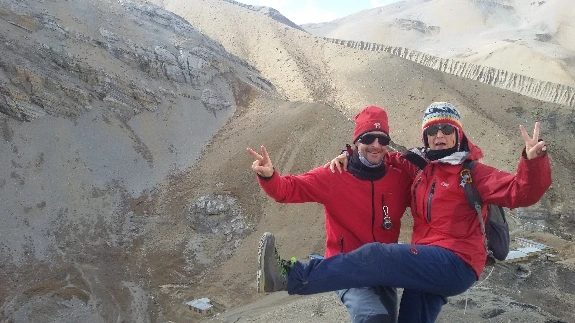
Acclimatization day at Manang village.
Welcome to join the Annapurna circuit group trek and make it budget-friendly and enjoyable, fun, safe and security , meet new people; share the expenses of the trek cost; and make a good trekking experience an annapurna with a memory for a lifetime. If you are travelling solo and looking for company to trek an annapurna then joining a group trek to annapurna circuit trek is the best idea to share the experience, culture and travel history together. Please go through the details below for more information.
Why choose the group joining trekking annapurna circuit trek ?
Planning to join a group trek to the annapurna circuit trek have several advantages for you. From the saved cost to make the best trekking experience in a lifetime.
Low cost – joining a group trek and an annapurna circuit trek you get the cheap cost because the annapurna circuit trek cost will be shared, such as Guide, Porter, Transportation, Accommodation , etc.
Fixed departure date: when you plan to join a group trek, the departure date is guaranteed. You can choose any date convenient for you.
Meet with the potential travelers—you can find the other travelers who are looking for a similar trek experience and share the cost and make a safe trek an annapurna. During the trek you will have a good opportunity to exchange culture and travel history and get some chances to know more about travelling.
Stress-free to plan the trek: you will have less stress to plan the trek as you can share the information with the other travelers. It can be helpful to each other.
Smoother trek: as you are in the group the trek can be easier to organize like making permits and arranging transportation, and pre-booking accommodation in group and trekking with the professional guide and strong porter will be a different experience for you.
Safe trek : During the trek, in case any emergency happens like an accident or altitude sickness, then if you are in the group, you can get quicker help and evacuate to a safe place faster than on a solo trek.
Annapurna circuit group join trek – Best season:
The best time to trekking is after the monsoon ends in Nepal from early September, October , November till the mid December and Spring season mid March , April, May, and June every year. During these months the weather is clear skies, sunshine, reliable temperature, and good visibility, and the mountains are more welcoming.
Trekking an annapurna circuit trek is not recommended in monsoon season like in July and August, or in the winter season, January and February, as the weather is not clear; it is cloudy, hazy, and rainy in summer and snowy in winter and the temperature falls.
On the way to Yak kharka from Manang.
Annapurna circuit trek group join fixed departure dates for 2026 and 2027
Here are the fixed departure dates for the annapurna circuit trek for 2026 and 2027. Individual or couple: if you are looking to join a group trek an annapurna please make your reservation with us without any hesitation. We promised to make your trip the best experience trekking in Nepal.
Group joining dates for 2026:
March , 15, 25 April : 2, 8, 16, 25
May: 3, 10, 18, 25 June: 2, 15
Autumn season 2026:
September : 10, 22, October: 2, 10, 15 , 26
November: 3, 12, 18 , 26 , 30 December: 4, 10, 20
Group joining dates for 2027:
March , 15, 25 April : 2, 8, 16, 25 May: 3, 10, 18, 25 June: 2, 15
Autumn season 2027:
September : 10, 22, October: 2, 10, 15 , 26
November: 3, 12, 18 , 26 , 30 December: 4, 10, 20
Why you choose for the Annapurna circuit group Join Trek:
Annapurna circuit trek is one of the best, most popular and adventure-scenery-rewarding trekking trails in Nepal. By doing an annapurna circuit you can have a good trekking experience and explore the hidden gem of nepal and learn local culture and religion, including the strengthened views of annapurna mountains in close distance. Here are some highlights of the trek and why you doing annapurna circuit trek
Explore the beautiful local villages,
as the annapurna circuit trek lies from lower evasion alt. 750m to the higher elevation of 5416 m. along the way you will cross numbers nepalese local villages and we can see their basic daily lifestyle.
Cultural diversity:
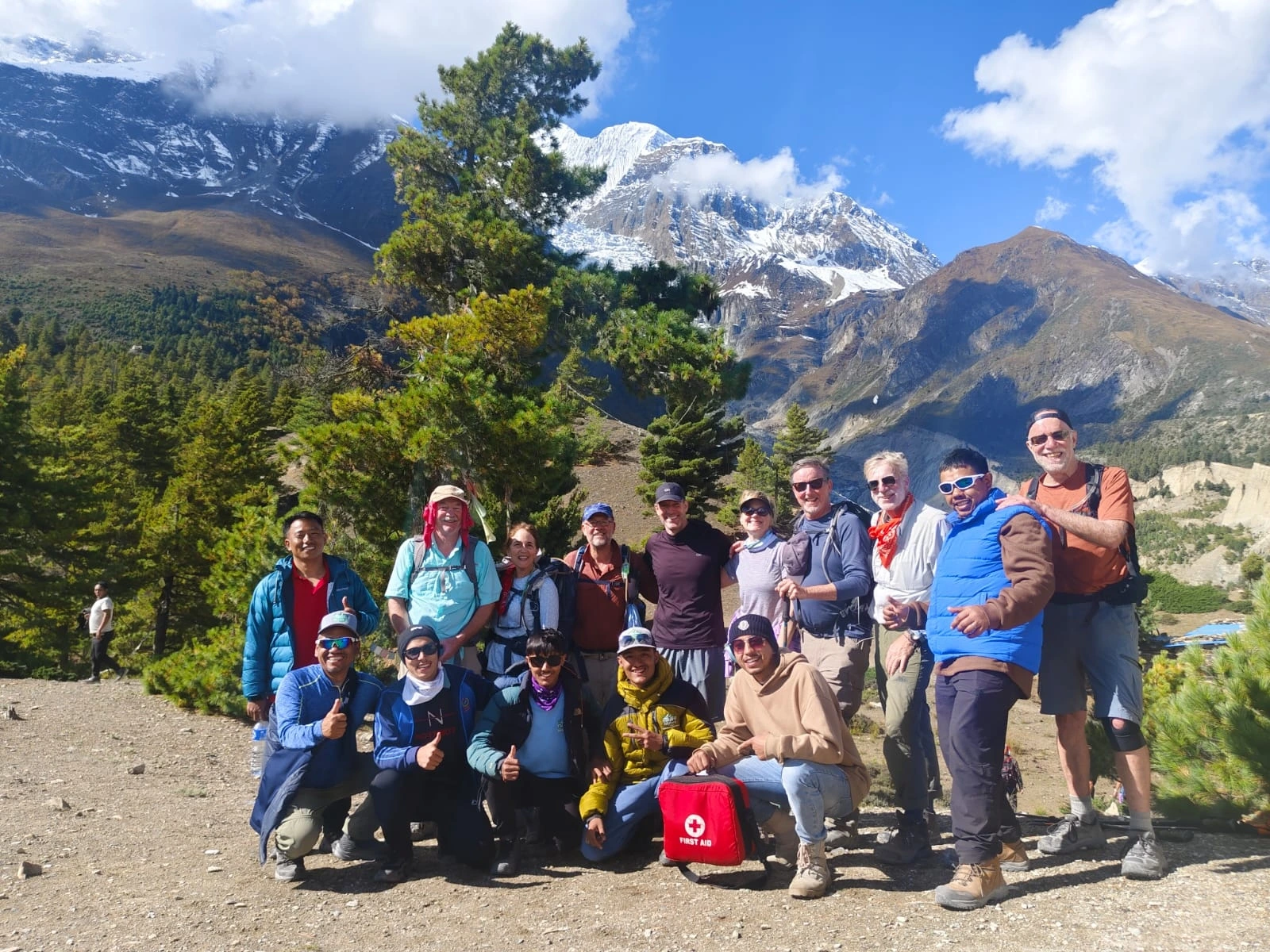
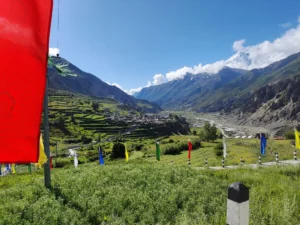
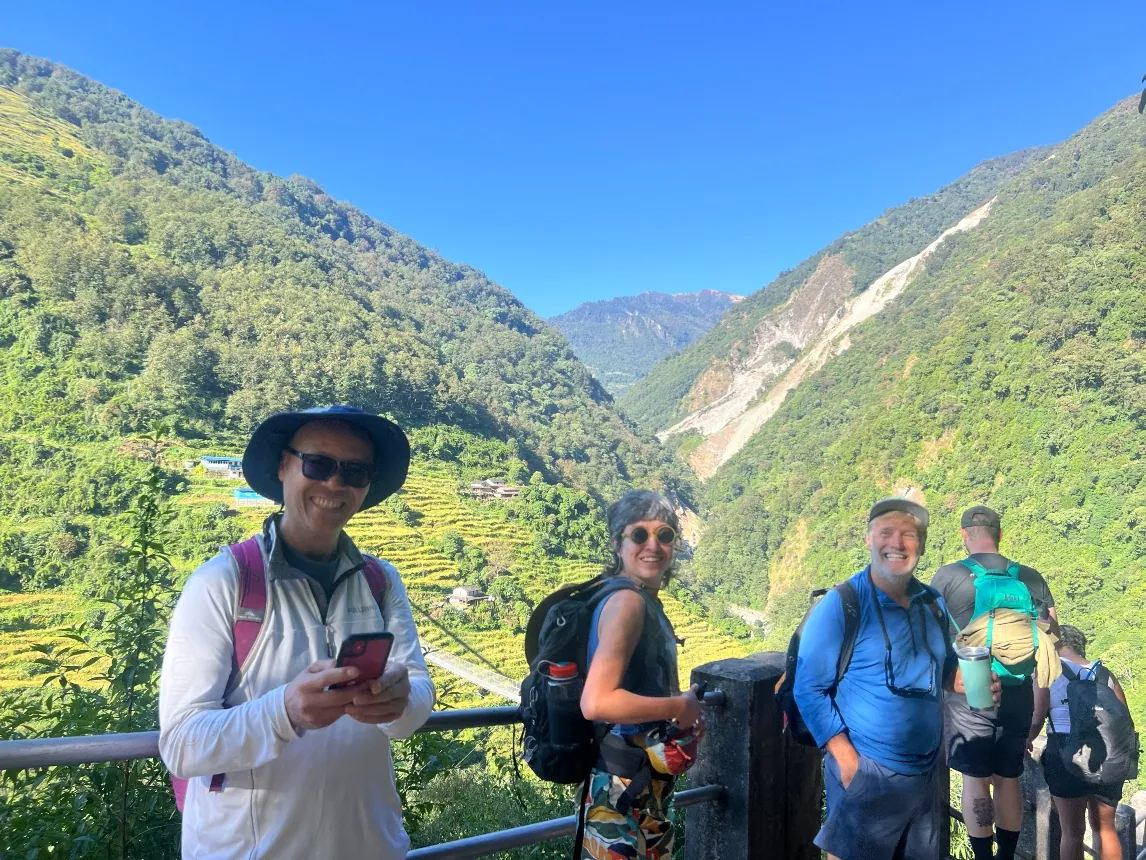
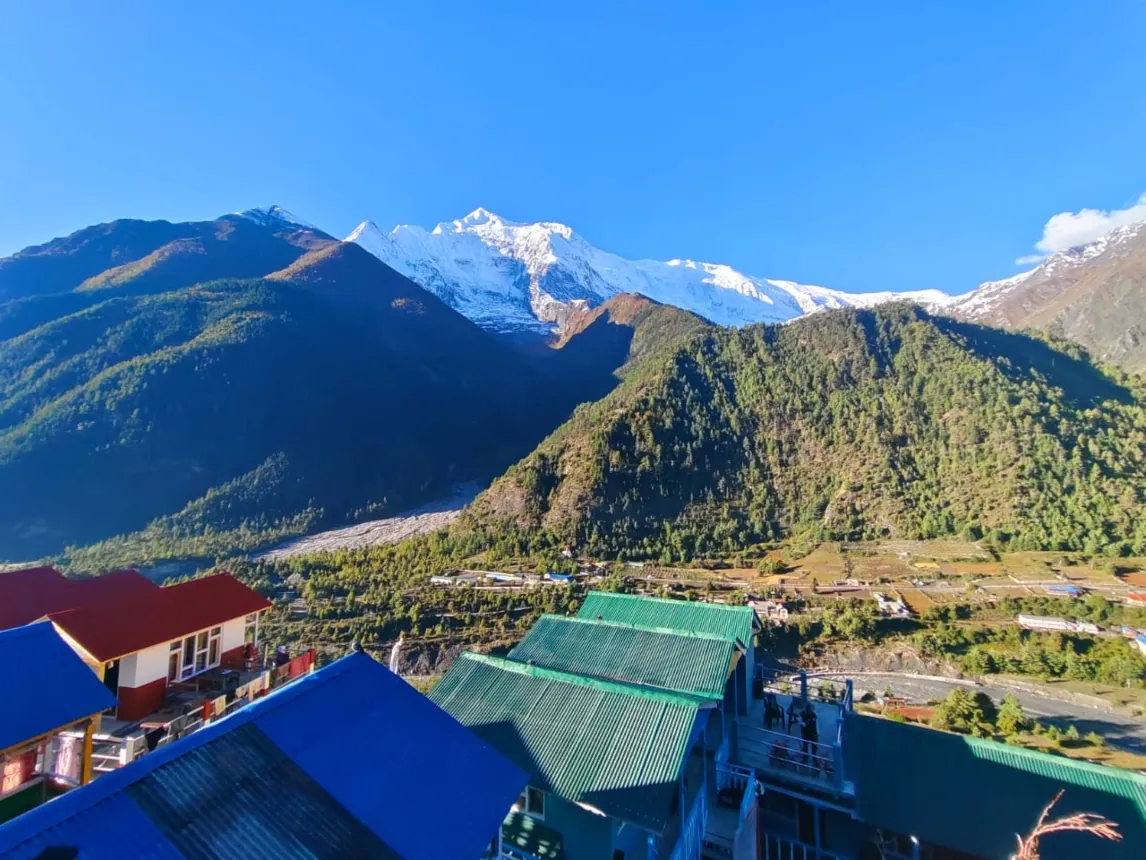
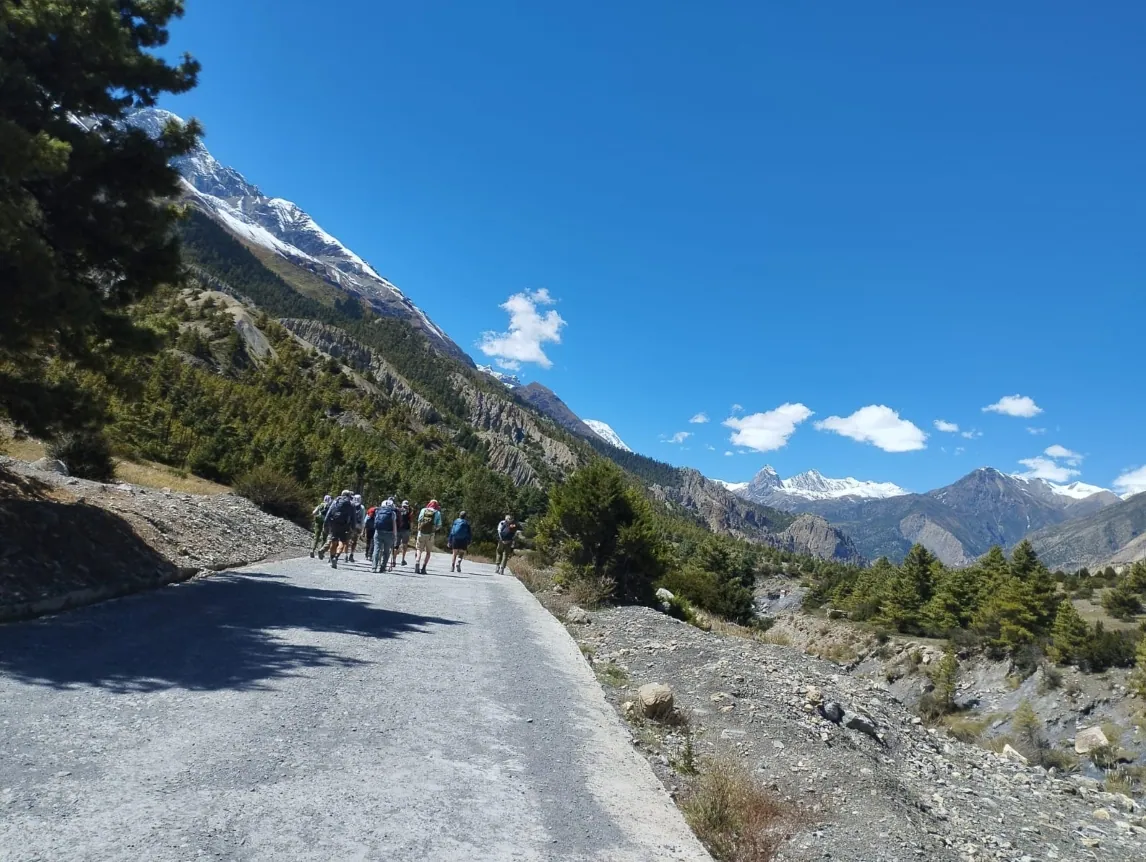
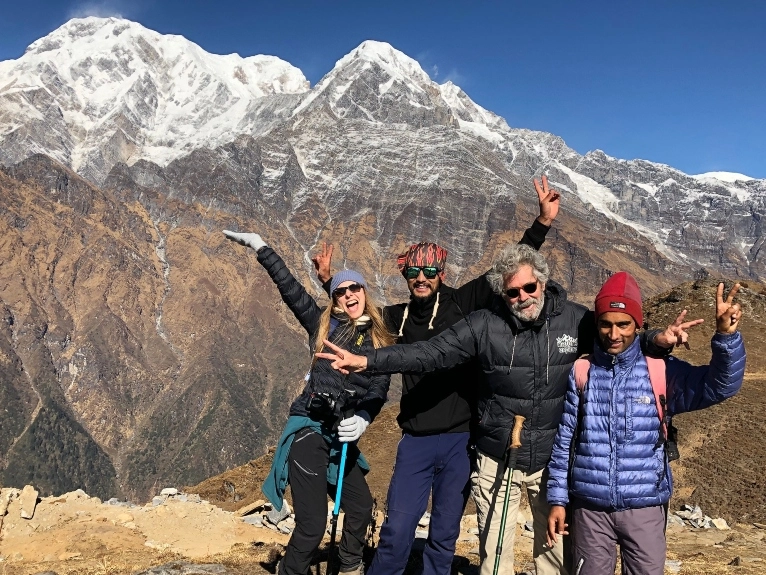
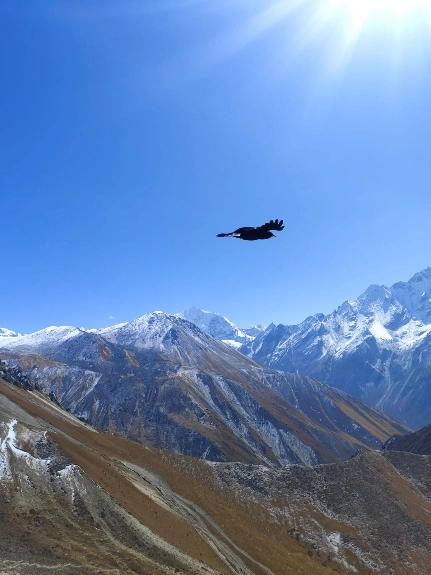
what a good weather. picture took on the way to Annapurna circuit trek!
as the annapurna circuit trek is covered, the long area from the lower sections of the trek to the higher sections of the route, you will cross many traditional temples, monasteries, chortens, mani walls, prayer flags, meditation caves many more. Lower sections of the trek you will meet more hindust religions culture and higher sections of the routes you will explore mor buddhist culture such as we visit the old monastries, Museum, Tshorten, Mane wall etc
Thorongla pass (alt. 5416m) –
its the biggest and adventure high pass that we cross on this trek. It is the most highlighted day of this trek, as it takes 9-10 hrs and reaches an elevation of 5416m from sea level. Rewards with the annapurna and Dhaulagiri mountains.
Manang Valley:
Manang valley in the summer season
The beautiful Manang valley is very famous during this trek as you see the old monasteries, the mane wall surrounded by buddhist culture, and the Annapurna mountain ranges leading to the beautiful Manang village. Religions. Significantly, reach buddhist religious and historical places, years-old local habitation and their daily lifestyle, which make it feel like a really blessed place where you can meditate, Pray and feel like you’re in heaven with beautiful manang landscapes kissed by the white Annapurna mountain range.
Muktinath temple :
the Muktinath temple is a popular site that lies beneath the Thorong la pass and Lower Mustang at Muktinath village. It’s a busy place where hundreds of pilgrims used to visit every year locals and international. Muktinath is a powerful temple and believed to be the home of the god Vishnu. Here are one hundred and eight tops and small places where you can take a shower and pray to Vishnu for a better life and more blessings, reminding you of the annapurna journey back to Pokhara. Muktinath also has many old monasteries and old caves, and the landscape is more dry and less green as well surrounded by Mt. Dhaulagiri, Nilgiri and Dhampush peak includes many peaks. Natural Hot spring in Tatopani—at the end of the trek you will also get the great opportunity to take a bath at nature Hot spring. It is more relief for you after the long trek around the annapurna
Strengthen the scenery of Annapurna mountain and the Dhaulagiri range in the distance.
From the beginning of the trek to ends you will be surrande by annapurna mountains ranges from Annapurna II, III, IV and Gangapurna , Tilicho peak , Pisang peak , Thorng la peak , Chulu east and west peak and Muktinath side Mt. Dhaulagiri, Nilgiri, and Dhampush peak includes many beautiful peaks.
Annapurna circuit group joins the general trek itinerary:
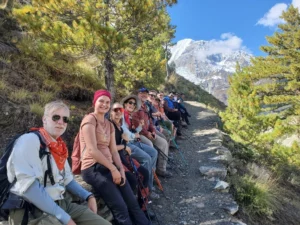
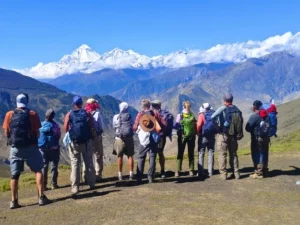
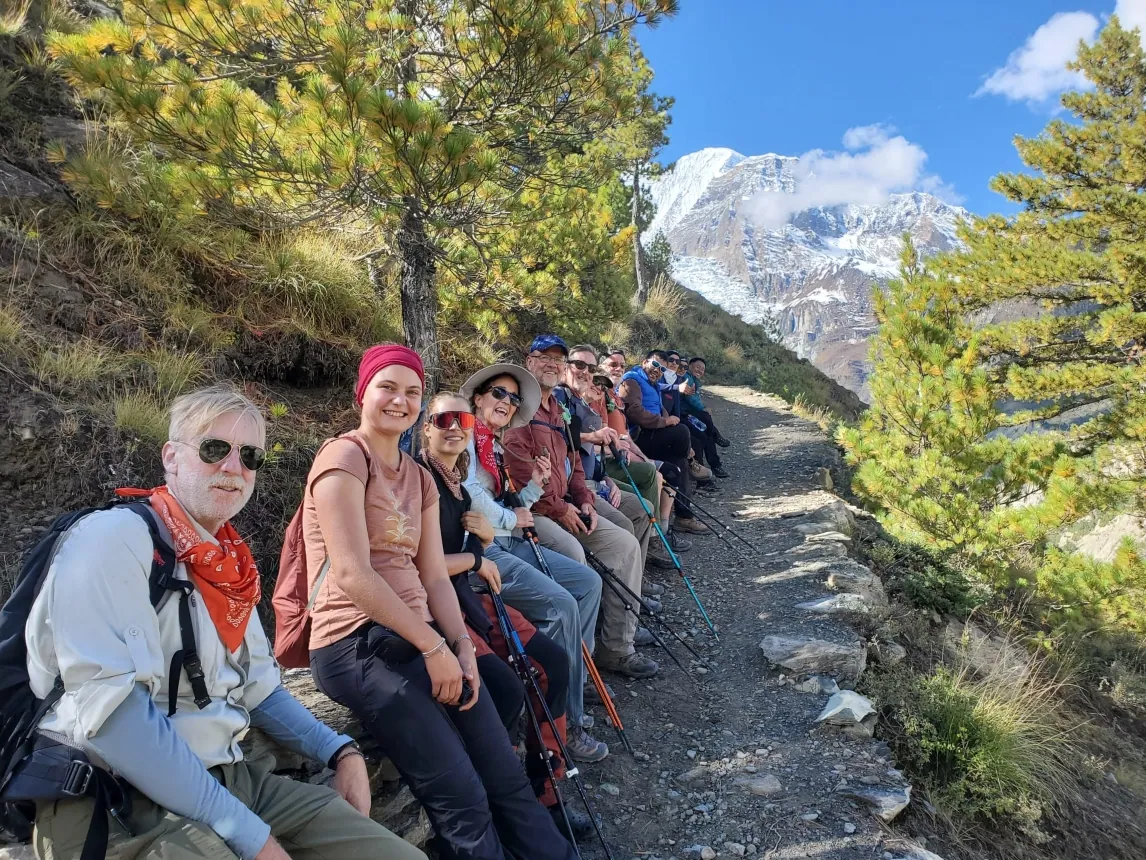
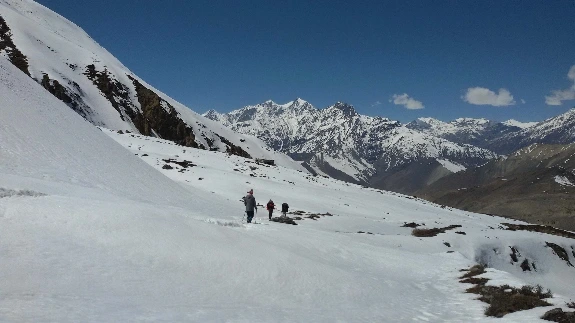
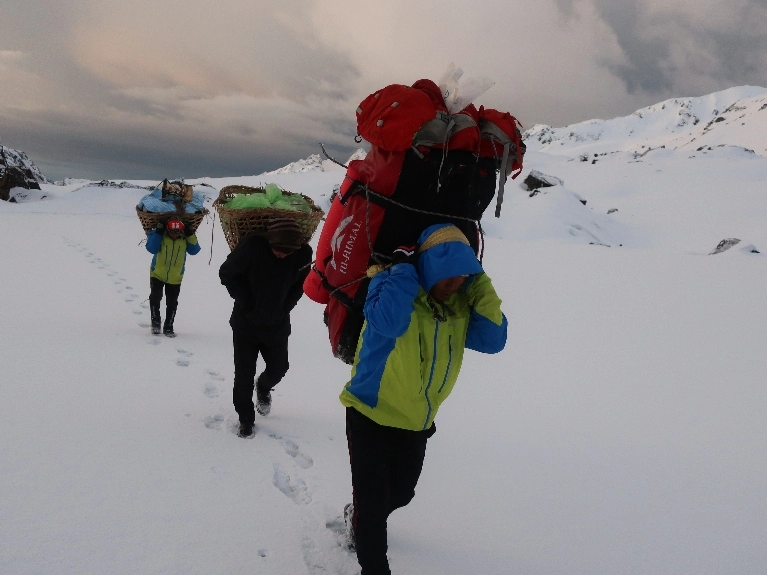
Trekking group heading to Thorong la pass
Annapurna circuit group joins the itinerary, which basically starts from 8 days to 14 -15 days. Group joins the general itinerary we have for 9 nights and 10 days. The trek starts from Dharapani after a scenic drive from Kathmandu and ends in Pokhara after taking a drive from Mukatinath. But solo private groups and any private group can customize the trip as per your interest and timetable. You can add the side trip to Tilicho lake, Ice lake , and you can walk back to Jomom and Marpha, and instead of driving, you can take a short flight back to Pokhara from Jomsom or you can extend the trip to Poon Hill-ABC.
Group joins annapurna circuit trek trekkers also can extent the time if everyone in group agree in same optins and at the end of trek if someone want to ends quicker and if some of you want to extend the trip it is possible and we always happy to help in this condition. Those who back out early, some of our guides will take you back and some guides will guide you on the extended routes. But this is only possible after the Thorong la pass from Muktinath, as from here you can have alternative options available to explore more or end the walk in Muktinath.
Day 1: Drive from kathmandu to Dharapani via Beshishar (alt. 1860m , 6100 ft), 190-200km (65km from Beshishar to Dharapani) 9-10 hrs with the breaks for lunch and toilets.
Day 2: Trek from Dharapani to Chame, alt. (2670m) Ft. 8760.) , 5 hrs, 10 km.
Day 3: Trek from Chame to Upper Pisang (alt. 3300m , 10870 ft.) , 6 hrs trek, 12km
Day 4: Trek from Upper Pisang to Manang via the Nwal, (alt. 3500m , 11480 Ft.) , 8 hrs
Day 5: Acclimatization day in Manang. Visit the Chhongkhor viewpoint (alt. 4400m ) 3-4 hrs.
Day 6: Trek from Manang to Yak Kharkha, 4 hrs (4050 m, 13285 Ft.) 8 km
Day 7: Trek from Yak Kharka to Thorong la Phedi / High Camp (Alt. 4500m , 14760 Ft. ) 4 hrs , highcamp 5 hrs (alt. 4700m)
Day 8: Trek from Thorong phedi to Muktnath (alt. 3800 m, 12464 ft) through the Thorong la pass (alt. 5416m 17765 Ft.) 9/10 hrs. 15-18km
Day 9: Drive back from Pokhara via the Hot spring (Tatopani) 6/7 hrs via the Jomsom, Marpha, and Beni bazaars, and finally reach Pokhara. (Alt. 740m.), 172km
Day 10: Drive back to Kathmandu. 6/7 hrs, 200km alt. 1300m treks end here.
Alternative options: if you want to extend the trek to Ghorepani PoonHill viewpoint and the Annapurna base camp trek, then you have to stop the drive in Tatopani and then you can walk up to ghorepani to meet the Annapurna base camp trail in ghorepani.
It is the annapurna circuit trek group that joins itinerary but if you have your private group and solo trekkers, you can always costomize the itinerary and make a completely new itinerary as per your interest and time.
Annapurna circuit trek group join package cost for 2026 and 2027.
Annapurna circuit trek group join package cost basically starts from USD 700 – 800 perperson as per the general itienray . The cost includes meals (Breakfast, lunch, and Dinner) Transportation sharing-based, professional Guide , Strong porter (each two people), Hot drinks, Trekking permits, (ACAP) Daily trekking maps, trek logistics, Shared room in tea houses as per the itinerary, fresh fruits,First-aid kit, oximeter, etc.
The cost also depends on the service you want to include in the package. And as an alternative option, you can also only hire a guide and porter, and you can pay for permits, accommodation and food drinks, and extra expenses by yourself.
The additional in-full-package service you have carries some cash for cold drinks, bottled water, wifi, laundry, the bar menu, tips for the guide and porter, travel insurance, and trekking equipment not mentioned in the itinerary that we don’t include in the cost.
Who Should Join This Trek?
Budget travelers
Who are looking to join the new company to make this trip more enjoyable?
Adventure travelers who have good fitness level for this type of the trek
Looking for safer trips, especially solo female travelers
First-time high-altitude trekkers
Open people – friendly people and not serious people—never mind for small mistakes in groups, etc.
Anyone who loves the scenic nature of Nepal. And the cultural diversity of annapurna region.
Who should not join in the group joins
Looking for a customized itinerary
Comfortable with the budget
Short-time visitors in nepal
Photographer
First time in trekking
Senior trekkers
Want to do the trek without a rush and more comfortably
Want to have peace and quite during the trek
Want to do the side trips like to Tilicho lake, Ice lake , PoonHill – ABC etc.
Why you book this trek early for 2026 and 2027
Tilicho (Tal) Lake (alt. 4900m)
Guarantee space and prefer date and season
Early birds – 10% discounts
Better chances to join large groups
More time for training and preparation for the trek, which can play a vital role in ending the trek successfully with the group.
Enough time to arrange the basic trip necessary arrangements like permits, pre-teahouse booking, professional guide and all the trek logistics.
Final Say:
Annapurna circuit group joins the trek in 2026/2027 is one of the most popular trekking routes located in the annapurna mountain area. The route lies between the four nepalese popular himalayan disteicted namely Lamjung, Mang ,Mustang and Myagdi. Group joining annapurna circuit trek is budget-friendly and fun, and it’s safe. You get to meet new people and share the culture and experience of the trek. You can have a great trekking experience an annapurna. If you are travelers and looking to share the cost for these trek packages and want to do the trek with less stress but more enjoyment and want to create some lifetime memorable nepal trekking experiences, then join this trek with a group.
view of the Annapurna ranges from Muktinath
The Nature Explore Trek team has many years of experience in group guidance and is knowledgeable and familiar with the routes. We are always flexible with the plan. You can book the group join trek with us. he easily by email or WhatsApp, and ensure your spot on the trek by sending a 15% trip advance and with the clear nepal arrival dates or trek departure date, you want to start this trek and attach a copy of your passport.
Is October the Best Time to Hike in Nepal ? Nepal has become a world-class trekking destination, as it is located in the heart of the Himalayas and attracts trekkers from around the world. Trekkers can find stunning views around every corner because of its diverse topography and dramatic landscapes that range from snow-capped peaks to lush valleys and pristine lakes. Trekkers can choose from popular trekking routes, such as the Everest Base Camp trek, the Annapurna Circuit trek, and the Langtang Valley trek. These walking paths offer hikers an exciting adventure as well as a window into the rich native culture. Interactions with locals and experiencing their traditions are still the highlights of the trek. When planning to trek in Nepal, it is important to select the appropriate time for you to undertake this Himalayan adventure. Nepal has a complex climate that keeps changing monthly, requiring trekkers to understand what to expect each month. The trails get muddy and the view of the Mountain gets obstructed during the trek in monsoon seasons. While trekking in winter at high elevations has cold weather that can hinder your trekking experiences, high-altitude trails may become inaccessible due to snow and high winds. Selecting the right time of year to trek in Nepal is important to ensure safety and comfort.
With William Autumn’s yogi group, return to Pokhara after ending the ABC trek .
Trekking in October in Nepal is the best time for a good reason. October is in the middle of Nepal’s autumn season and is considered a prime time for trekking. The weather is stable, with day temperatures ranging from 15 to 20°C, making it a great time for both high-altitude and lower-elevation treks. The monsoon has ended, leaving clear skies and great visibility, ideal for mountain views and photographs. Trails are bustling with excellent festivals like Dashain and Tihar, perfect for trekkers interested in immersing themselves in Nepal’s vibrant cultural celebrations. October is the optimal time to trek in Nepal and the reasons extend far beyond the blue skies and comfortable temperatures. Besides those advantages, trekkers benefit from longer daytime and a low risk of altitude sickness while accomplishing their treks in comfort, capturing all the wonders of nature and culture that Nepal has to offer. Whether you are a seasoned mountaineer or a first-time visitor to Nepal, hiking in Nepal in October promises not just stunning scenery but intimacy with the land and its people.
Weather in October: Clear Skies and Perfect Temperatures
October in Nepal is the beginning of the post-monsoon clean state, which makes the country a trekker’s dream. After months of oppressive summertime rains, the air is fresh and clean and the dust and pollution are washed away, revealing Nepal’s natural beauty in the least sense. The hillsides are lush green with wildflowers blooming everywhere on the trails, and the rivers are running clear and full. This renewal of the environment makes you feel like you are also reflecting a new vitality and freshness by being in the region. October also has the perfect temperature for trekking. In the daytime, trekkers will experience pleasantly mild temperatures, typically between 15°C and 20°C for popular areas such as the Annapurna and Everest regions. At higher elevations, it will be slightly cooler than in the valleys, but trekking is generally comfortable in frequently chilly weather. At nighttime, you may experience temperatures below freezing. However, in any teahouse or tent, a decent sleeping bag and a few warm clothes will provide a comfortable night’s sleep.
Another good thing about October weather in Nepal is the visibility. The monsoon clouds are gone and the skies are clear, offering stunning views of the snowy mountains. Trekkers can expect views of the high peaks and snow-covered ridges during the day, from sunrise to sunset. This is the time of year when trekkers can see huge peaks such as Everest, Annapurna, and Machapuchare, and many more along the southern slopes of the Himalayan range. Also, this is an excellent time of year for photographers and those who appreciate the beauty of nature. When the air is cool and the golden sunshine of autumn is falling onto the mountain landscapes, photographs are great.
Trail Conditions and Scenery
October provides the best trail conditions of the year for trekking in Nepal. The trails have dried out, leaving firm, stable hiking paths instead of the slippery, muddy, and difficult sections revelatory of trekking during the rains. Trekkers will find obvious, hiked-in trails whether they are trekking the rocky ascents of the Annapurna Circuit or the twists and turns of the Everest Base Camp trek. Dry trail conditions improve safety and enable you to cover more distance each day in relative comfort.
Pikey peak trek
The scenery in October is gorgeous. The hillsides and valleys are painted golden with rice ripening in the fields for harvesting, creating a pattern of color against the dark green forests. The rhododendron and oak trees remain vibrant with birdsongs and wildlife noise. Above the tree line, it is remarkable to see just how dramatically different the golden fields below are from the freshly snowcapped peaks of the Himalayas. The landscape feels almost magical. Each bend in the trail yields another grand view, from terraced farms to stunning mountains. On top of this, the rivers and waterfalls were still flowing strong after the recent monsoon runoff. The streams and waterfalls along the trail are at their most spectacular, glimmering in the autumn sun. The flowing streams provided not only additional beauty but also places of respite along the trail with their sounds and refreshing spots to rest. The dry trails, vivid views, and water led to a full and rich hiking experience in Nepal in October.
Best Treks to Do in October
Everest Base Camp Trek
The Everest Base Camp trek has the best weather of the year in October. After the monsoon season ends, the weather clears up, which allows hikers to enjoy sunny days with little precipitation. Daytime temperatures in the lower Everest region typically range from 12°C to 16°C, while nights can be cold, dropping to about -10°C at higher altitudes near Base Camp. In addition to reliable trekking sections, trekkers will enjoy fantastic visibility with stunning views of Everest, Lhotse, Nuptse, and Ama Dablam against bright blue skies along the way.
October is the prime trekking season for the EBC route, meaning that the trails are alive but still quite manageable. After the freshness of the post-monsoon season, the vegetation along the path is vibrant too, and cool and breezy winds are refreshing. Being the busy season, teahouses and flights to Lukla can fill up quickly, so early planning is important. With mild daytime temperature ranges, clear skies, and views of some of the world’s tallest mountainous regions, October offers keen trekkers the best trekking experience at Everest Base Camp.
Annapurna Circuit Trek
The Annapurna Circuit is one of Nepal’s most popular trekking routes to experience in October. The trails are dry and firm, with diverse landscapes between the subtropical forests and high alpine environments covering the trek. October daytime temperatures are pleasantly mild at lower elevations, with an average temperature range of 15°C to 20°C, while night temperatures can become cool but manageable with the right gear. Additionally, October is a fantastic month for unhindered views of Machapuchare and the Annapurna Range.
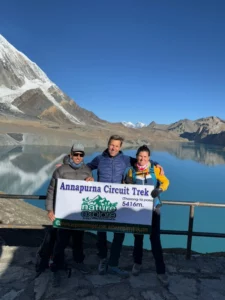
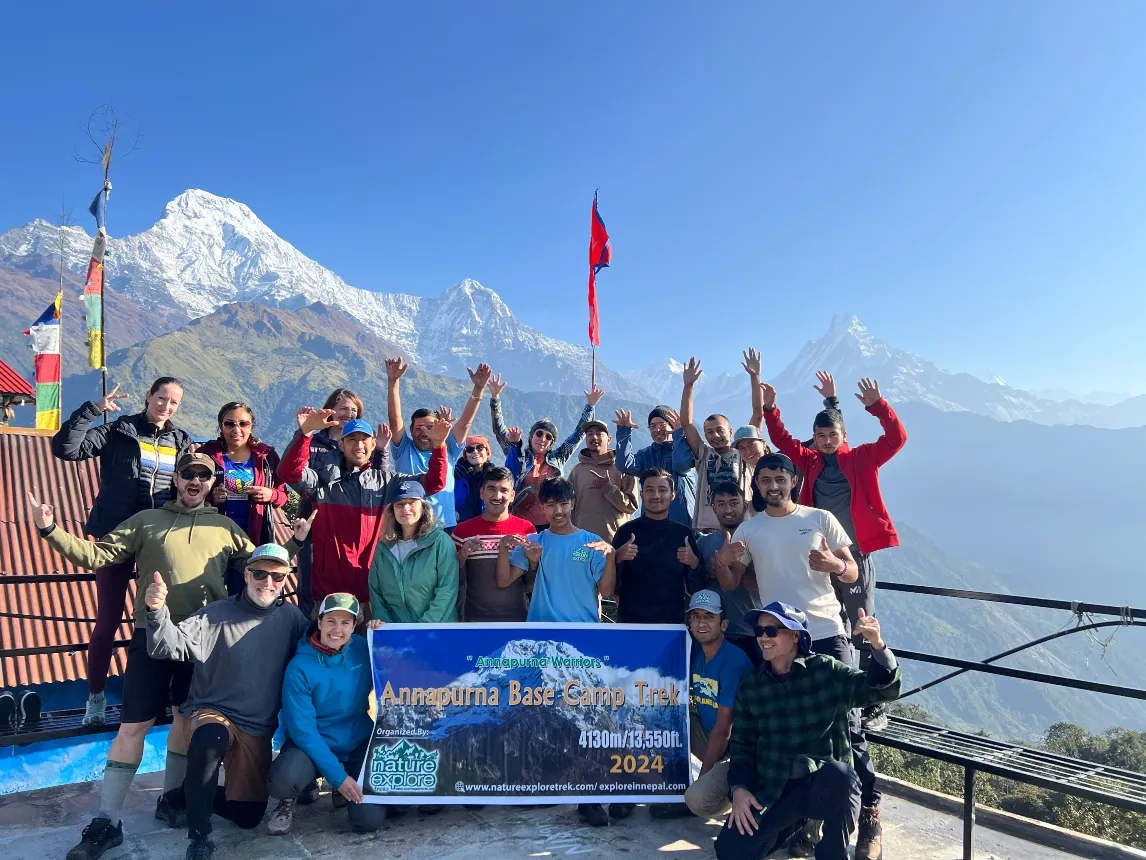
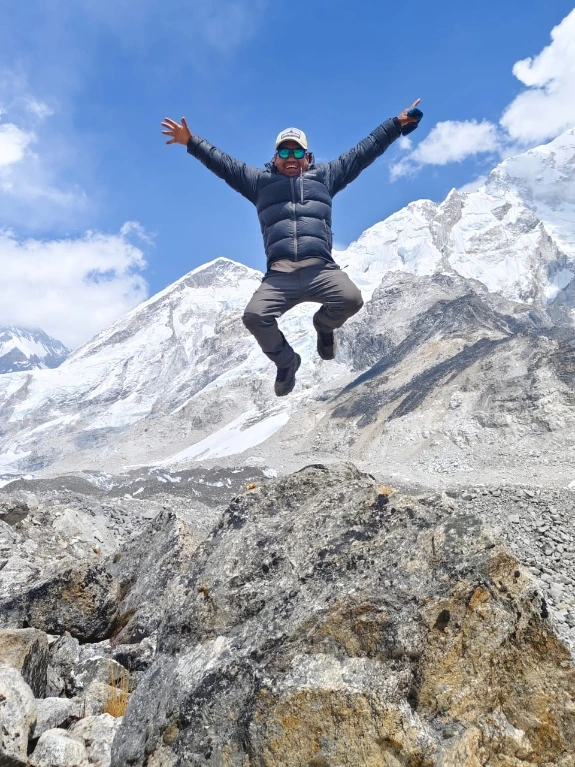
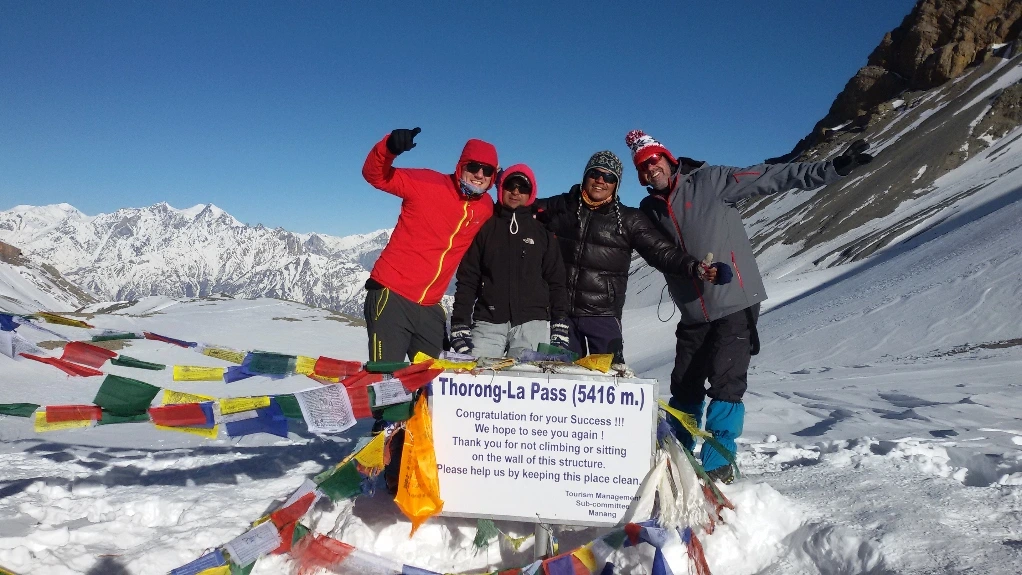
Congratulation Nature Explore Trek team for successfully reach on the top of the Thorong la pass
The trek offers all the great colors of autumn, especially the gold and green shades of the rice areas and forests, contrasting against the snowcapped Himalayan backdrops. Also, rivers and waterfalls will still be active with the larger flows of the monsoon runoff creating beautiful backdrops on the trek. All the excellent weather, stunning scenery, great people, and well-maintained paths all contribute to why October is an ideal time to trek the Annapurna Circuit.
Langtang Valley Trek
October is a fantastic time to hike in the Langtang Valley. The lower valley is usually around 15° to 18° C during the day, but the temperature decreases as you trek higher. At higher elevations, it can be cold at night, but not too cold to interfere with sleep and acclimatization. The beauty associated with post-monsoon clarity cannot be overstated. It will provide spectacular views of Langtang Lirung and the surrounding peaks, which could be frequently obscured during other seasons.
October in the Langtang Valley will also be especially colorful, with golden fields, blooming rhododendrons, and green forest layers supplying a rich assortment of colors. Waterfalls and rivers flow strongly from the previous monsoon activity, contributing to the overall beauty of the trek. A combination of weather conditions, trail conditions, and beauty will make October one of the best months to hike in the Langtang Valley.
Manaslu Circuit Trek
The Manaslu Circuit trek is not only remote but also culturally rich. Completing the trek during October allows for dry, stable trails, as well as the clearest skies, giving trekkers some of the best mountain views in all of Nepal. The daytime trek temperatures at lower elevations typically range between 12° C and 18° C, but nighttime is cold at higher altitudes. October’s good weather assures reduced incidents of landslides and trail damage that often occur during the main monsoon months in the Manaslu Circuit Trek.
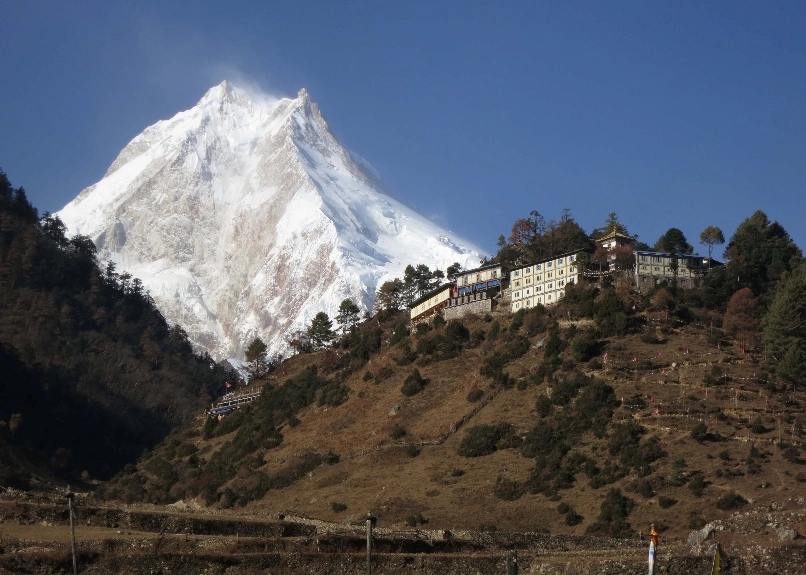
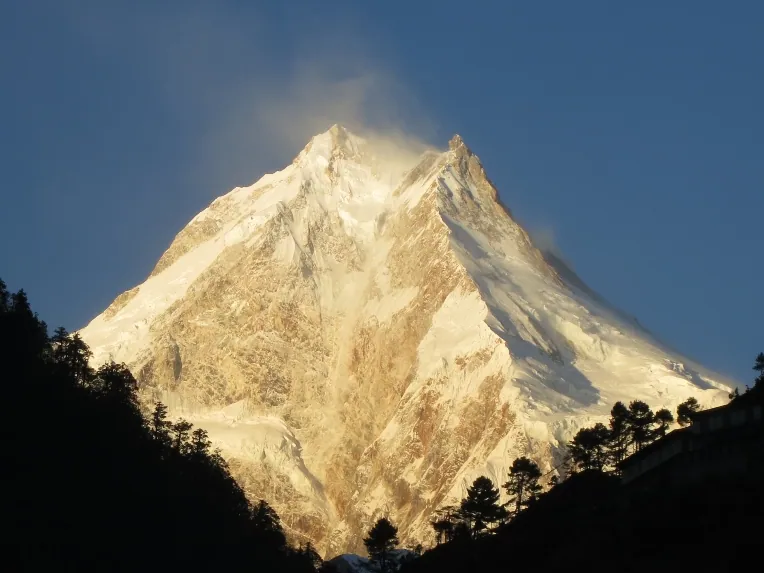
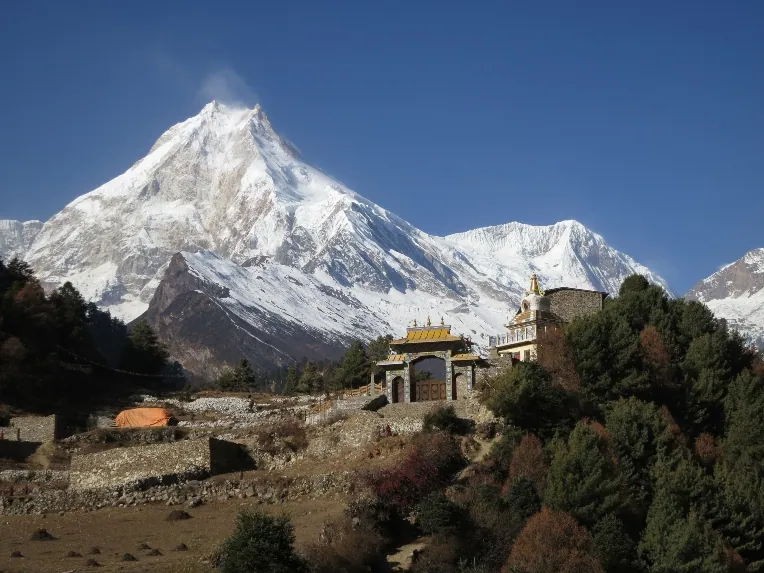
Mt. Manaslu view from Lho gaun
When the skies are clear, it is also easier to admire the colossal peaks of Manaslu. Trails of Manaslu have a rich landscape with golden terraced fields, thick forests, and flowing rivers from the recent monsoon runoff. Additionally, October provides a good opportunity to enjoy the Tibetan-influenced culture of Manaslu without the crowds. If you are looking for an amazing Himalayan trek with fewer crowds, October offers you all the sights and experiences you are looking for with the Manaslu Circuit trek in Nepal.
Festivals That Add to the Experience
Trekking in Nepal during October is a distinctive experience, with vibrant cultural festivals. Dashain, also known as Bijaya Dashami, is a 15-day Hindu festival that celebrates the victory of good over evil and occurs from late September to mid-October. During Dashain, families gather together and receive tika, jamara, and blessings from elders. So, the month has a lively atmosphere that spills into towns and villages along trekking trails where trekkers can observe amazing traditional ceremonies, kite flying, and bustling markets swarming with local food, crafts, and products. After Dashain, Tihar is another festival that takes place in late October to early November, often coinciding with peak trekking season. Homes and streets are lit up with oil lamps and decorated in colorful styles during the Tihar festival. Along popular trekking routes, western trekkers will see locals decorating their homes and celebrating with joy and abundance.
Trekking in October offers an open invitation for trekkers to join in and engage with a variety of ethnic communities in their cultural celebrations. Festivals like Tihar and Dashain give trekkers chances for rare encounters with cultures and deepen learning about Nepal, culture, and hospitality. Enjoying Dashain and Tihar while trekking not only enhances the experience but leaves trekkers with inevitable memories of Nepal’s cultural vibrance.
Pros and Cons of Trekking in October Pros
October boasts the best weather with clear skies, pleasant temperatures, and little or no precipitation. After the monsoon rains, everything is fresh, dry, and stable – making excellent hiking conditions. Trekkers can experience spectacular mountain views and beautiful fall foliage on the way. Many rich cultural festivals occur at this time of year including Dashain and Tihar, which enhance the trekking experience. The peak month creates a vibrant atmosphere when hiking with fellow trekkers and staying at well-established hotels and teahouses. Cons High traffic levels on popular trekking routes. The cost of accommodations and flights tends to increase during popular tourist times. You need to book teahouses, flights, and trekking permits well in advance to reserve your place. Increased flow creates a feeling of being less isolated, which may detract from some trekkers’ preferences for solidarity. Increased flow in busy, narrow areas of the trail will ultimately create occasional delays for trekker groups.
Tips for a Successful October Trek
Secure your flights, teahouses, and guides as soon as possible, since October is peak trekking season with probably higher demand than usual. Layer your clothing for warm, sunny days and cold nights including a warm jacket, hat, gloves, moisture-wicking base layers, etc. Waterproof trekking boots and comfortable socks are important to keep your feet dry and protected during varied weather conditions. Hydration is important throughout the trek for acclimatization, energy level, and general health. Take your time on acclimatization with rest days and slowly ascending at higher altitudes when possible to prevent altitude sickness. Bring trekking elements like a sleeping bag, rain cover, sleeping mat, trekking poles, sunscreen, lip balm, and headlamps to stay safe throughout the trek. Physical training including cardio and strength exercise is important before the trek to build stamina and endurance for long days of hiking. Hike early each day to avoid windy afternoons and unpredictable weather that may arise in the October trek.
Conclusion
October is a golden window for trekking in Nepal, providing a unique balance of favorable weather, lively culture, and beautiful scenery. The freshness of the post-monsoon clears the way for crystal clear skies and often unobstructed views of the world’s highest peaks, an opportunity few other months can give you. Daytime temperatures tend to be comfortably mild with cool breezy nights that help with good sleep, making the month suitable for all levels of trekkers. The balance of weather and beautiful scenery leads to October being the busiest month of trekking in Nepal.
October provides a perfect time for trekking in Nepal and coincides with major festivals such as Dashain and Tihar. Trekkers walking along the designated trails will have chances to experience the local traditions, see the decorations, and meet the locals who are fully embroiled in the festival festivities. The cultural experience mixes well with trekkers exploring the local culture and traditions on their travels to meet and greet with the Kathmandu lifestyle. Because October is the peak month, sharing your experience with fellow trekkers is highly likely because trekkers from all around the world will be there, often fostering an encouraging and supportive trekking environment in Nepal.
Lastly, as the main trekking season, the popularity of October can present some challenges. Popular trekking routes and teahouses will be busier, the price for hotels and flights may be higher, and you have to plan early to secure the best accommodation. However, the benefits of hiking in October: are unbeatable weather, amazing views, and rich cultural aspects of the experience. If you are planning to trek in the Himalayas, October is still the best time to trek in Nepal which provides you with an unforgettable experience in one of the most beautiful parts of the world.
The Annapurna Circuit Trek in September is recognized as one of the best trekking routes in Nepal, consisting of great scenery, cultural variety, and challenges. The total length of the trek is about 160 to 230km and the length varies depending on where the trek starts and finishes. The Annapurna Circuit goes around the Annapurna Massif and crosses subtropical forests, terraced farmland, and dry high mountain terrain. The Annapurna Circuit trek offers trekkers to experience varied Hindu and Buddhist villages, waterfalls, and views of mountains, including Annapurna, Dhaulagiri, Machhapuchhre, and Manaslu.
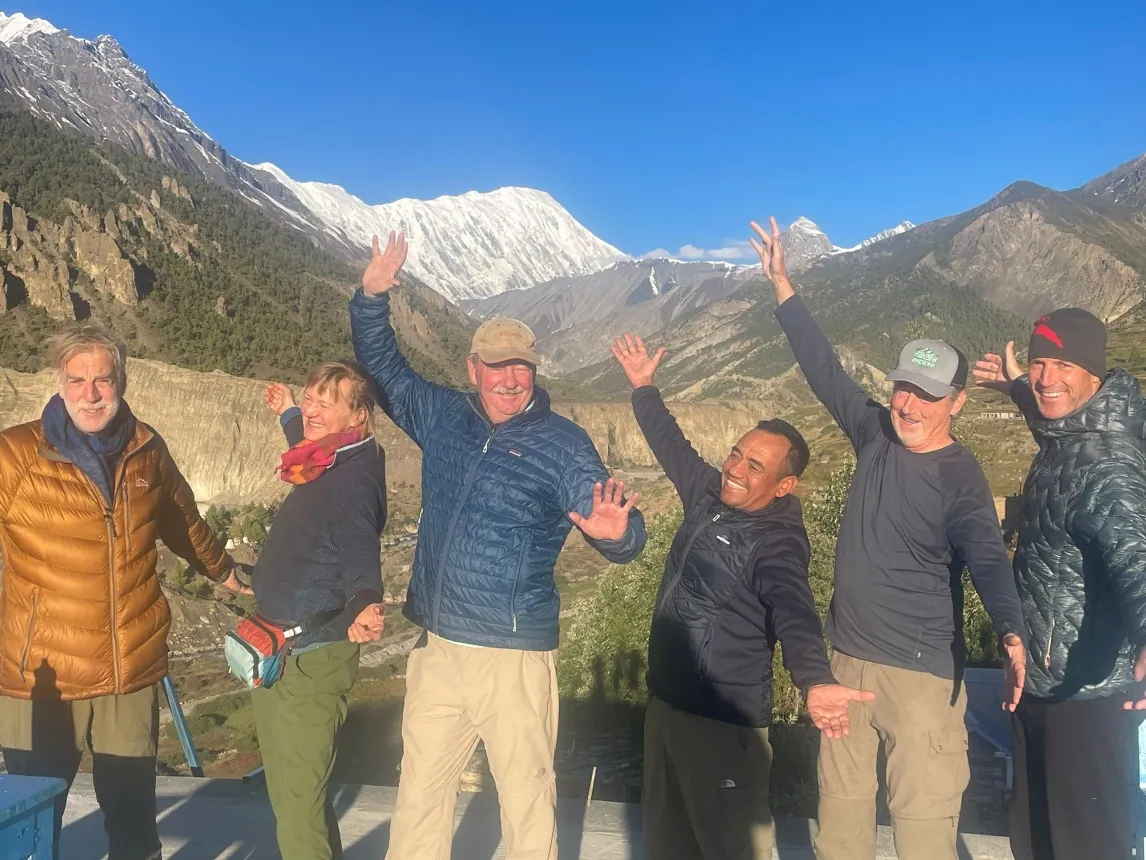
Group of Trekkers from Montana , USA having a wonderful time at Manang village during the month of september,2024
The Annapurna Circuit Trek is best to start in September because the monsoon rains will have passed and autumn trekking has begun on the Annapurna Circuit. At the beginning of the month, you are more likely to experience some rain, especially at lower elevations, because the weather will still be trying to clear after monsoon season. The rains will bring life to the lush landscape, terraced fields, and forests, creating a great freshness for trekkers to experience.
As the month progresses, the weather becomes more settled with clear skies, particularly during the second half of the month, which allows trekkers to appreciate the beauty of the snow-capped Himalayas and the valleys below. During September, the daytime temperatures at lower altitudes are usually between 15°C and 22°C, but cooler at higher altitudes, between -4°C and 5°C. Nighttime is cold, especially at altitude, but generally isn’t as severe as a trekker would expect in the winter months. The mild temperatures and decrease in humidity offer an easier time during long days of trekking, but trekkers should always be aware of changing conditions, particularly in the mountains.
Similarly to the crowds of peak October, crowds are less of an issue in September. The natural environment is in all of its glory and the clarity post-monsoon provides arguably the best views of the year in the mountains. September provides solitude for the early trekkers, but they will most likely mix in with some people toward the end of the month. Mountains and weather change quickly, and it is important to stay flexible at higher altitudes.
Weather in September during the Annapurna Circuit trek.
September is a transitional month on the Annapurna Circuit, where the weather shifts from the end of the monsoon to the clear and stable weather of autumn. Early September still bears the residual rain from the monsoon, especially at lower elevations. Trekkers can expect occasional rain, cloudiness, and high humidity, which may make a wet and slippery path. Since the conditions are damp, the surroundings are lush and green with a flowing waterfall and rice terraces in vivid green bloom. Trekkers will encounter fewer people on the trails and the trail is noticeably quieter overall.
Clear skies during the month of september , along the way to Manang from Chame
As the month progresses, the rainfall will decline, and the weather will begin to improve with more consistent dry days. By mid- to late September, trekkers will see progressively less rain and thoroughly clearing skies. The change in weather provides crisp, clean air and beautiful views of the Annapurna region’s famous snow-capped mountains. As the rain subsides, river crossings will usually become less challenging and the trails will dry, making more pleasurable trekking conditions. The transition from wet to dry can be quite stark as the scenery shifts from mysterious and misty to bright and panoramic within a few days.
The temperature in September can vary widely depending on altitude. At lower elevations at 2,500 meters, the daytime temperatures may range from 15°C to 22°C; nights will get cooler to approximately 10°C. When trekkers reach a mid-altitude of 2,500 to 4,000 meters, daytime temperatures will drop between 8°C and 12°C and nighttime temperatures could be as low as 2°C to 6°C. The air gets cooler and drier as the trekker moves up in altitude—noticeably cooler in the morning or evening, requiring layering to stay comfortable.
At the trek’s highest elevations, like Thorong La Pass (5,416 meters), the weather can be considerably cooler and more erratic. The daytime temperatures at these altitudes may range between -4°C and 5°C, with nights usually dropping below freezing. The days of Late September will be generally clear and pleasant but trekkers will still have to consider changing weather, including winds and early-season snowfall at the higher elevations. Therefore, having the right equipment, such as insulated clothing and a warm sleeping bag, is essential to a safe and enjoyable trek around the Annapurna Circuit in September.
Trail Conditions
September on the Annapurna Circuit provides the greater experience of natural beauty shaped by the rains from the monsoon season. The landscape is green and lush during this month. Terraced fields, forests, and meadows are full of life. The plants are at their peak, with wildflowers lining the trail, adding bright colors to the greenery. The significant amount of vegetation makes a refreshing and beautiful setting for trekking that is an extreme contrast to the dusty and dry conditions later in autumn.
Early September still has traces of monsoon rain, which will affect the trail conditions. In particular, many trails can be muddy and slippery, especially in the lower and mid-altitude areas where the rain has more time to saturate the ground. Despite that, trekkers should get ready for muddy and slippery trails that will require good trekking shoes. Also, trekkers need to use poles to balance their bodies while walking on slippery and uneven surfaces. The mud on the trail creates a challenging trek, but they will also create vigorous vegetative growth and healthy water sources along the route.
Trekkers heading up to Chhongkhor viewpoint on the rest day of an annapurna circut trek.
Of all the experiences of trekking in September, one of the most notable is the volume of water flowing in rivers and streams. Rivers are swelled by monsoon rains, while waterfalls are full providing stunning views throughout the trails of the circuit. Crossing a river can be exhilarating for the trekkers, especially earlier in the month when the water levels and flows are higher. Generally, bridges on the circuit are well-made and maintained, but trekkers have to be aware of these conditions. It is always advisable to avoid a crossing if it’s raining or has rained recently.
As the month progresses, the trail conditions improve significantly. The drying weather reduces mud and slippery conditions, which facilitates travel and reduces danger along the way. Similarly, as the rivers and waterfalls lose their heights, they remain beautiful and lively. September is a time of abundance, and it is exemplified by the combination of vibrant landscapes, blooming flora, and flowing water features. These conditions make the trek memorable and engaging by adding vibrancy to the surroundings.
Pros of Trekking in September
As the monsoon rains have finished, the landscape is vibrant and lush with beautiful natural scenery.
Wildflowers line the trail, adding bright colors to the green grass, making for picturesque views of nature.
The amazing views can be enjoyed away from the crowds often found during the busy October peak season, making this trek truly enjoyable.
Accommodation and meal prices tend to be cheaper at the beginning of the month, giving a more budget-friendly trek.
When trekking at the end of the month is fresh and clean air, enhancing mountain views and photography opportunities.
The trails are quiet and relatively unbroken from the dry season dust clouds.
Cons of Trekking in September
The likelihood of wet rain, particularly during early September, can make trails muddy and slippery.
The temperate and tropical forest of lower altitudes has leeches due to the moist environment left after the monsoon.
Rivers will be swollen, creating difficult and riskier stream crossings.
Transport may be delayed due to unpredictable weather effects up to several days after the rains have ceased.
Some teahouses and lodges may be closed and under service during the early part of the month.
The weather will be unpredictable, with some quickly changing situations requiring trekkers to be prepared for rain and cold on all treks at this time of the year.
Tips for a Successful Trek
September is a great time to hike the Annapurna Circuit, particularly in mid- to late September after the monsoon rains have cleared, leaving clear skies.
If you are traveling early in September, pack some important rain gear, including waterproof jackets, pants, and a rain cover for your backpack in case of sudden rain showers.
Leeches are common in the moist forests of lower altitudes, so it is a good idea to pack some leech socks or repellent to keep them away.
Hire a local guide who knows the trails well and is used to working under wet and slippery trail conditions. This will not only keep you safer, it will also enhance your overall trekking experience.
Having layered clothing will also be important, as you will experience a range of temperatures throughout the day, including warmer days with colder nights, especially at higher altitudes.
Bring cash on the trek because many teahouses along the trail do not accept credit cards.
Make sure to have enough time for acclimatization to prevent altitude sickness.
Sturdy waterproof trekking boots with good grip and soles are recommended for handling muddy and slippery pathways early in September.
Stay hydrated and fuel yourself with balanced meals to help maintain energy levels during your trek.
Permit and Booking Info
The Annapurna Circuit trek requires an Annapurna Conservation Area Permit (ACAP) and the Trekkers’ Information Management System (TIMS) card. This permission fosters local community development, sustainable tourism, and conservation. The TIMS card is a safety and management tool created by the Nepal Tourism Board and Trekking Agencies Association of Nepal to manage trekkers and help rescue them in emergencies. These two permits are compulsory for all foreign trekkers and you can obtain them in Kathmandu or Pokhara along with identification and passport-sized stickers. For non-SAARC nationals, the ACAP permit costs about USD 25, whereas for SAARC nationals, it costs about NPR 1,000. For single hikers, the TIMS card costs around USD 18; for group hikers, it costs around USD 9. You should carry these permits in person throughout the trip as checkpoints will regularly check your permits along the trek. In case of not being able to present the permits, results in fines or not being able to continue into the park. When it comes to accommodation, trekkers may reserve teahouses ahead of the trek. Early September is less busy so you should have no problem getting a room in the teahouses. However, as the trekking season gears up heading into September, the teahouses get busier. To guarantee a room, it is therefore advised to make reservations in advance. Booking ahead can also allow trekkers to more effectively gauge their daily distance with proper sleep after a long day on the trail.
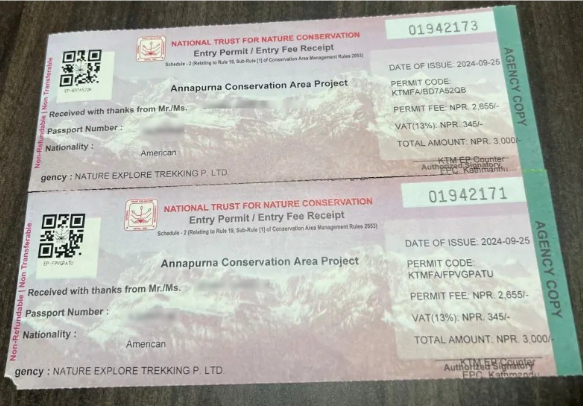
Annapurna conservation trek permits
For independent trekkers, arranging permits is an important part of the planning process, while for trekkers with a guide, the permits can be arranged by their agencies. However, it is a good idea to keep copies of the two permits ACAP and TIMS as these permits are checked several times along the trek. Understanding permit requirements and accommodation options helps to facilitate a smooth, legal, and safe Annapurna Circuit trek and makes a positive contribution to conservation and sustainable development.
Conclusion
September is a wonderful and rewarding time to trek the Annapurna Circuit. The transition out of monsoon is explosive; the landscape turns thick with vegetation, flowers bloom, and nature is iconic. Early September may bring additional showers and slick trails, extra crispness, active streams, and stimulating visuals to create a new trekking experience different from the dryer and dustier months.
One great part about trekking in September is that, there may be fewer trekkers. Fewer trekkers mean a nice escape into the gorgeous Himalayas and great interaction in local villages. Also, early September finds food, and accommodations are afforded. As September goes on, there will be more days of clearer skies and summer out days stuffed with crisper mountain views that may have been hidden during the rainy season.
Generally, the weather is moderate and the areas are less crowded than prime trekking months, providing an opportunity to explore the Annapurna Circuit comfortably and safely. Overall, September is a combination of natural beauty, cultural wealth, and quietness with an unforgettable and fulfilling experience in the Himalayas.
Prepare yourself for an amazing adventure this September !
The Annapurna Circuit Trek in December and January is a wonderful choice for real adventurers who are looking for solitude, peace, and beautiful winter scenery. Trekking the Annapurna Circuit during these months is a bit more challenging compared to the main trekking seasons, but it offers a magical experience with fewer crowds and breathtaking landscapes.
You will find the trails much quieter, allowing you to truly connect with the Himalayas in a calm and peaceful way. However, it’s important to know that trekking during winter comes with some challenges like cold weather, icy trails, and shorter daylight hours. Crossing high passes like Thorong La (5,416m) can be especially tough due to snow, ice, and the risk of avalanches.
Even though it’s challenging, the rewards are unforgettable. Clear blue skies, sparkling snowy mountains, and a feeling of being completely immersed in the natural beauty of the Annapurna region make all the effort worthwhile. With the right gear, proper planning, and a flexible mindset, trekking the Annapurna Circuit in December and January can be an incredible adventure.
Almost all high mountain passes like Thorong La have their own highly challenging aspects because of avalanches or ice curtains. The trip offers its own hardships, but all that pain quickly disappears as the rewards come pouring in-beautiful blue skies above, breathtaking views of snow capped peaks, and the opportunity to truly immerse oneself in the stunning beauty of the Annapurna region at its most serene and softest state. Awareness and preparedness combined with the right gear and planning on how to tackle this circuit during the winter season are required for safe navigation.
It is really attracting to the real adventurer who wants to see complete solitude and be in awe of beautiful wintry landscapes. There are few tourists on the trek during these months, allowing one to more quietly and completely experience beauty in the environmental drainage of the Himalayas. The winter trek presents some very daunting conditions: cold temperatures, snow-covered trails, and short hours of sunshine. The high passes at altitude, for example, Thorong La, face nearly insurmountable challenges due to avalanches and icing. While the expedition has much difficulty, all the efforts are worth it when you have benefits coming in-for all the azure skies over you, fabulous views of snow capped peaks, and more space in which to enjoy the amazing beauty of the Annapurna region in its most peaceful and softest form. Awareness and preparedness, along with the right gear and planning on how to take on this circuit in the winter season, are essential for safe navigation.
Congratulation Nature Explore Trek team for successfully reach on the top of the Thorong la pass
Winter trekking on the Annapurna Circuit
Winter trekking on the Annapurna Circuit comes with its unique gainful experiences, making it worthwhile and very memorable. The most overt benefit is fewer crowds. Being one of the most traversed trekking routes, not many trekkers head to Annapurna in December and January, allowing some peace and solitude to enjoy the mountains. The trails are quiet, tea houses sparsely populated, and long views of snowy peaks can be enjoyed without interruption.
Another benefit of trekking in winter is clear skies with gorgeous views. Winter in the Himalayas often brings in crispness, cold air, and little or no cloud cover, which ensures crystal clear views and stunning panorama views of the Annapurna and Dhaulagiri ranges. The snow-blanketed trees, frozen streams, and snow-draped villages add a picturesque charm to the winter landscape, which is a delight for the eyes.
Winter trekking can also be an opportunity to see a more genuine side of Nepal. Since winter involves festivals such as Tihar and New Year, you may also get a chance to witness some local celebrations in an atmosphere almost free of tourists. The locals living in the high-altitude regions often observe the celebrations with their own traditional rituals, and observing this can add to the cultural enrichment of your trek.
Challenges and Preparation
While winter trekking may be regarded as rewarding, the challenges along the way can be monumental and must be adhered to. Cold weather can be a severe threat, especially during the night when the temperature may drop to very low levels. The nighttime cold can be uncomfortable for sleeping, particularly if one is not properly outfitted in insulated gear and warm layers. You should have a proper sleeping bag rated for at least -15 to -20°C and layer up for warmth.
The snow and ice along the trail becomes a feast for the sight but perilous. Some of the harder portions of the trek, especially those up around Thorong La Pass, can prove challenging and dangerous because of heavy accumulations of snow. Ice patches are treacherous not only for trekking but also tend to increase the risk of injuries due to slipping and falling. Hence, microspikes and crampons would be a wise addition to your pack as they significantly enhance grip on icy surfaces.
Also shorter days during winter present another challenge. With limited daylight hours, it is advisable to be an early riser and to finish the day’s hike before nightfall. In the mountains, darkness comes quickly and it can be deadly to walk trails whose paths are unfamiliar in the dark, especially with snow and ice making navigating all the more difficult. You must have a functional headlamp in place and time your days accordingly to reach your destination during the daylight hours.
Altitude and Acclimatization
Trekking in high altitude is a true challenge on the Annapurna Circuit with altitude sickness being the major culprit, especially after crossing 3500 meters. The thinning air smoothens physical exertion and increases the tendency for altitude sickness. The chances get slimmer in winter because of freezing temperatures and heavy snow which take away your energy and spirit for trekking. Hence, acclimatization is of utmost importance. Taking frequent rest days, climbing slowly, and drinking adequate water can be handy. A good rule to follow is not to gain more than 300-500 meters of elevation per day after surpassing 3000 meters. Give altitude the respect it deserves; listen to your body and give it enough time to adjust this is major for having a safe and enjoyable trip.
Tea houses and Accommodation
Generally, many tea houses along the Annapurna Circuit stay open during winter; however, some of the distant or not-so-frequent places have their tea houses closed during that period of low activity. The tea houses that remain open are quite combed in delicious winter spoiling, with warm coziness to sleep within on hiking days in the freezing cold. But with trekking dwindling in number, websites available for room bookings may be fewer, hence early reservation of rooms would be wiser during the midwinter peak for trekkers. Basic accommodation must be expected since many tea houses will have quite simplified rooms with no to minimum heating, most would offer a warm meal and a relaxing stay by a stove.
Accommodation at the higher altitudes is relatively selective, with some tea houses being shut throughout the months, therefore adding with challenges to the trek. But trekking these months has its perks- fewer crowds, and fewer crowds- a sight of the mountains cloaked in snow imparts a pleasantly otherworldly view! However, the extremes might be quite harsh; these include, talking about winters, extreme cold and sudden occurrence of snowstorms, yet it is the pristine experience worth celebrating with joy by any well-prepared trekker on the Annapurna Circuit.
Guide and Porter Services
Independent trekking is possible along the Annapurna Circuit Trekbut trekking with a guide and porter during winter is strongly advised. The trail conditions will be able to tell the guide about the snow-covered sections of the trails and the activity done for your safety when trekking. Another advantage of having a guide is that he or she would be busy in keeping an eye on your health and acclimatization as they can easily identify the symptoms of altitude sickness and then make the itinerary change depending on the conditions. Having a porter makes the trek less burdensome because they will carry your big pack, focusing your energy on the trek itself. This becomes even more important in the winters as the cold weather gear and supplies add to the already heavy pack.
Flexibility and Prepare
Winter trekking requires a lot of flexibility. The weather in the mountains can change quite abruptly, and conditions like these can mean use of snowstorms or freezing rain with serious dislocations to plans. Passes such as Thorong La can be closed or even dangerous due to snow build-up, making a flexible itinerary imperative. If you’re trekking with a guide, they will be able to change up your schedule as needed, possibly avoiding high-risk areas or suggesting alternate routes. Contingency plans are also essential for emergencies or unintended delays.
Weather and Temperature
The Annapurna Circuit trek during December and January can offer an amazing experience with a few problems related mainly to weather and temperature. During this time, the area witnesses cold and dry weather and clear skies since it is the time for the dry season. Snow is also found at places of higher elevation, especially at Thorong La Pass, where nighttime temperatures might even fall to -20°C or even lower. The lower elevation places like Besisahar and Chame will have daytime temperatures between 5 and 18°C, while nighttime temperatures could fall much lower to maybe 3 or 8°C. Even while trekking in Manang and Thorong Phedi, a decrease in temperature will still be noticeable, with daytime highs averaging between -5°C and 0°C and nighttime temperatures dropping to anywhere from -10°C to lands of being colder at -20°C. The highest section, Thorong La Pass (5,416m), will be severely exposed to cold with temperatures dropping to -25°C and having chances of snowstorms too.
December generally assures clear skies and cold yet refreshing days; however, it may also be gainfully described as the cruellest month of January, which has still colder conditions and more likelihood of snowstorms at the higher reaches. Weather is unpredictable here; snow could fall at any time during the dry months, causing havoc with the trail.
This table summarizes the major locations on the Annapurna Circuit Trek, along with their elevations, average daytime and nighttime temperatures, and important trekking notes.
Location
Elevation
Avg. Day Temp (°C)
Avg. Night Temp (°C)
Notes
Besisahar
760m
10–18
3–8
Start of trek, pleasant
Chame
2,650m
5–10
-5 to -10
Cold mornings & evenings
Manang
3,540m
0–5
-10 to -15
Snow possible, crisp days
Thorong Phedi
4,540m
-5 to 0
-15 to -20
Harsh cold, acclimatization needed
Thorong La Pass
5,416m
-10 to -5
-20 to -25
Snowy, windy, very cold
Muktinath
3,800m
0–7
-10 to -15
Dry and windy
Jomsom
2,720m
5–12
-2 to -6
Windy afternoons
Outline Itinerary of the Trek
Day 01 Arrive in Kathmandu and transfer to your hotel. Day 02 Trek preparation day Day 03 Drive from Kathmandu to Besisahar – Dharapani (alt.1900m) 221 km Day 04 Trek from Dharapani to Chame , 2,710m ,5-6hrs Day 05 Trek from Chame to Upper Pisang, 3,300, 5-6 hrs Day 06 Trek from Pisang to Manang, 3,540m, 6-7hrs Day 07 Acclimatize in Manang (Hike to Chongkor viewpoint) Day 08 Trek from Manang to Yak Kharka, 4,110m, 3-4hrs Day 09 Trek from Yak Kharka to Thorong Phedi, 5,416m , 6-7 hrs Day 10 Trek to Muktinath through the Thorong La pass (alt.5416m), 5-6 hrs Day 11 Trek from Muktinath to Jomsom, 2,720m, 5-6hrs Day 12 Flight from Jomsom to Pokhara, 820m, 25 min Day 13 Drive back to Kathmandu by tourist bus,
Your arrival in Kathmandu paves the way for an entire day of preparation and exploring before this 13-day Annapurna Circuit trek. Thereon, on day three, you do a long scenic drive from Kathmandu to Dharapani via Besisahar. Thus, on day four, trek to Chame because trekking starts from Dharapani. The following two days will see you climbing Upper Pisang and Manang. Acclimatization is done at Manang, including a short hike to Chongkor viewpoint, before going along the trail to Yak Kharka, then Thorong Phedi. On the tenth day, the trek crosses the challenging yet beautiful Thorong La Pass (5,416m) down to Muktinath. For the next day, it will be a trek to Jomsom, from where a short flight will take you to Pokhara, after which you’ll be driven back to Kathmandu, the last stop in what will amount to be an unforgettable Himalayan adventure.
A day like
A winter day on the Annapurna Circuit starts with dead calm when the sun rises over the marble mountains, throwing its golden rays over the frost-covered landscape. A cold, sometimes even subzero morning, frozen tea houses, a quick hot tea and kleenex breakfast – and off into the trail that snakes through placid villages, several pine forests, and glacial way, all together crisp mountain air with brilliant clear blue skies above. The snow crunches underfoot as the sun brings some warmth to the day, though the cold lingers in shaded areas.
Around midday, a steaming plate of dal bhat or noodles offers comfort and energy..As the afternoon processes, the temperature drops again , and racing the next teahouse before dark becomes a priority. Evenings are spent huddling near the stove of the dining room, sharing stories with other trekkers while cooking and eating good food . Early tuck in under a warm sleeping bag, a sky full of stars above awaiting the next leg for a long journey through these quiet , magical winter mountains.
Annapurna Circuit Trek in December
Trekking the Annapurna Circuit Trek in December offers a unique and beautiful experience but it comes with certain challenges due to the winter season . At the lower elevation such as 1000m to the 2,500m temperature are mil rangug from the 5 degree to the 15 degree during the day though it can still drop to freezing or lower at night. As you ascend to higher altitudes temperature can get high especially around the Thorong La Pass(5,416m) where the daytime temperature goes around -5 degree to 5 degree and the night time temperature can drop well below – 10 degree. Snow is common in higher areas which can make the trail slippery and difficult particularly above 3,500m.
The shorter daylight hours in December mean that trekkers need to plan their hhikes carefully to avoid being on the trail after dark. While in winter means fewer trekkers , resulting in a more peaceful and serene experience, it also means some teahouse may be closed insulated jackets and trekking poles is essential for the cold and potentially icy conditions. Additionally , those trekking in winter must be cautious of the altitude sickness as acclimation can be more challenging in colder weather. Despite these challenges the reward of this trekking the Annapurna Circuit in December are clear breathtaking views of snow-capped peaks, fewer crowds, and serene , winter and that offers a truly memorable himalayan adventure.
Annapurna Circuit Trek in January
Walking the Annapurna Circuit in January is an adventure that only the adventurers can cherish, for it is one of the most beautiful and magical experiences. January coincides with peak winter in Nepal and ushers in serenity with beautiful snow-covered landscapes, creating real magic in the already beautiful Annapurna region. Oftentimes the skies would be very bright and clear, offering unhindered views of towering giants like Annapurna, Dhaulagiri, and Machapuchare.
Be prepared to feel extremely cold especially at high altitudes, with daily averages from about 5°C to 10°C, and the nights sometimes going well below freezing. Snow is a common occurrence above 3,000 meters with the major passes such as Thorong La (5,416 meters) having very thick snow, making the trek even more exciting. The best winter trekking gear, good planning, and occasionally a flexible itinerary are essential during January.
The best part about trekking at such times is that one gets a lot of peace and quiet along with scanty crowds. The trail is completely empty relative to its crowdedness during the very famous autumn and spring times. Most teahouses are operational, but those that are higher up may occasionally discourage guests or entertain them in bare hospitality.
The Annapurna Circuit in January is undoubtedly for trekkers who love solace, sceneries of dramatic white landscapes, and the pure thrill that comes with trekking in a very rough and wintry environment. It can be made into one unforgettable experience in the Himalayas with proper preparations and minds put into it.The Annapurna Circuit in January is undoubtedly for trekkers who love solace, sceneries of dramatic white landscapes and the pure thrill that comes with trekkering in a very rough and wintry environment. It can be made into one unforgettable experience in the himalaya with proper preparation and minds put into it
The Manaslu Circuit Trek in October is one of the most rewarding Himalayan treks in Nepal, offering an off-the-beaten-path trek through the isolated mountain villages, untouched forest, and spectacular high passes. The trek goes around the eighth-highest mountain in the world—Mount Manaslu (8,163m)—and offers the ideal combination of culture and nature.
Choosing the appropriate time of the year is crucial for a successful trek, and out of all the months, October is the optimum. Clear weather after monsoons presents breathtaking views of white-capped mountains, and the established climate gives amicable trekking conditions.
Trails are rich in flora and fauna, and local festivals like Dashain and Tihar add cultural richness to the trek. With cool air, flowering landscapes, and dry, sunny weather, the Manaslu Circuit Trek in October promises to be a memorable and visually impressive experience. For adventure and peace of mind, October is simply the best time to visit the Manaslu Circuit.
Overview of the Manaslu Circuit Trek:
Mt. Manaslu (alt.8163m). Picture taken by our guide last year in October from Lho Gaun.
Month of October to do the Manaslu Circuit Trek gives you one of the most unexplored and diverse trekking trails in Nepal. Located in the Gorkha District of western Nepal, the Manaslu Trek encircles the world’s eighth highest peak of 8,163 meters, known as Mount Manaslu.
This remote trek was opened for the first time to outsiders around the early 1990s and is less touristy in comparison to its more popular contemporaries like the Everest and Annapurna treks. The region is deeply saturated with Tibetan culture, with old monasteries, prayer wheels, mani walls, and chortens strewn along the trail.
Through picturesque villages like Samagaon and Lho, where you will come across traditional lifestyles not touched by modern life, you will get to experience unparalleled nature ranging from hills and terraced farms to mountain highlands and the majestic Larke La Pass at 5,106 meters if you do the Manaslu Circuit Trek in October.
The trek usually lasts for 14–18 days, depending on the itinerary and acclimatization days. The trek is of moderate difficulty due to the height and challenging routes. Trekkers must purchase a series of permits: the Manaslu Restricted Area Permit (MRAP), the Manaslu Conservation Area Permit (MCAP), and the Annapurna Conservation Area Permit (ACAP). The Manaslu Circuit Trek in October promises the optimal experience with sunny skies and wonderful trekking conditions.
Temperature in October during the Manaslu Trek:
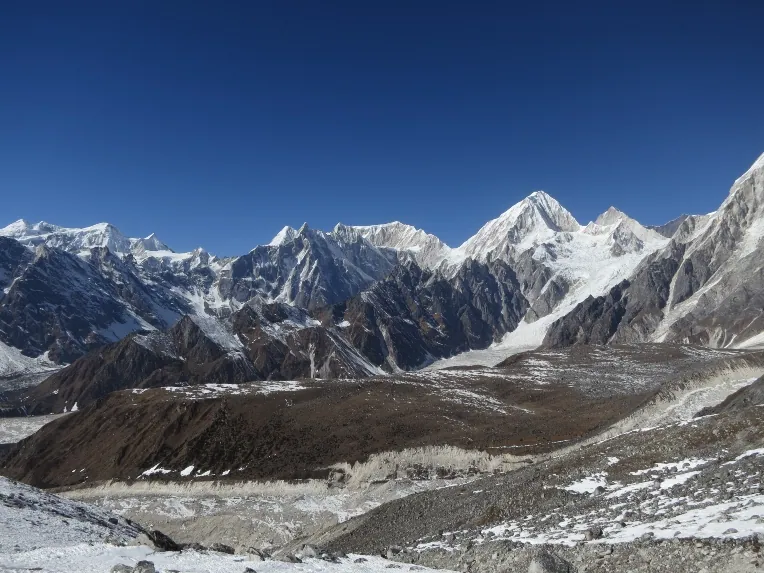
Mountain magic view of the Manaslu region with a beautiful sunny day.
The Manaslu Circuit Trek in October has the best temperature conditions for trekking in Nepal. At low altitudes, daytime temperatures are about 10°C to 15°C, and it is very pleasant trekking. Temperatures drop as you ascend to high altitudes.
At mid-altitudes like Samagaon (3,530m), you can expect daytime temperatures to be about 5°C to 10°C and nighttime temperatures to drop down to 5°C to -8°C. At higher elevations close to Larke La Pass (5,106m), the daytime temperatures are between -2°C and 5°C and can fall as low as -6°C or even lower at night.
In comparison with the other months, the October Manaslu Circuit Trek is much more pleasant. November is very cold, with the temperature dipping even lower, especially in the evenings.
September is also still within the monsoon season, with rainy trails and high humidity, so October is the preferred month if looking at temperature and consistency of weather. The ideal temperature in October offers a great and comfortable trekking experience.
Weather Conditions on the Manaslu Circuit Trek in October :
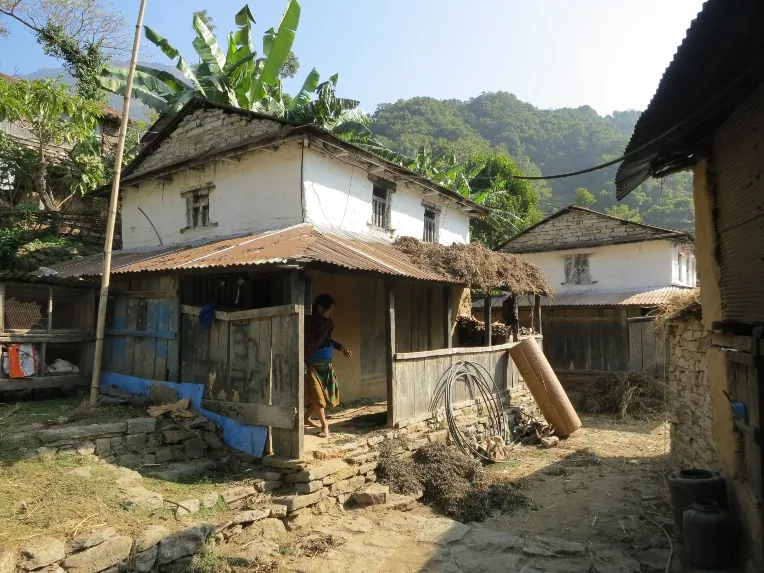
Along the way to the Manaslu Circuit Trek, we also meet one of the traditional Nepalese houses.
The October Manaslu Circuit Trek is renowned for having ideal weather conditions as the dry season begins. The month offers clear skies, no rain, and ideal trekking conditions, making it one of the ideal times to undertake the adventure.
The dry conditions ensure that the trails are maintained clean and the chances of the trekker encountering muddy or slippery trails are minimal, particularly when traversing higher altitudes.
October, while Manaslu Circuit Trekking, has the best clarity. Clear, fresh air with sunshine provides magnificent views of snowy mountains circling the trail, including Mount Manaslu, Himalchuli, and Ganesh Himal. The sun, 8-10 hours of sunshine per day, provides the ideal hour-long trekking period.
Trekkers should prepare themselves for snow at higher elevations, particularly around Larke La Pass (5,106m). Although it is not guaranteed to have snow, it cannot be avoided because of the elevation, and it makes the trek interesting and challenging.
The Manaslu Circuit Trek in October has stable weather conditions and is therefore an ideal time to have a trouble-free, smooth trek. With dry conditions, clear visibility, and stable weather, October is the ideal time to go on this Himalayan trek.
Why October Is the Best Month for the Manaslu Circuit Trek ?
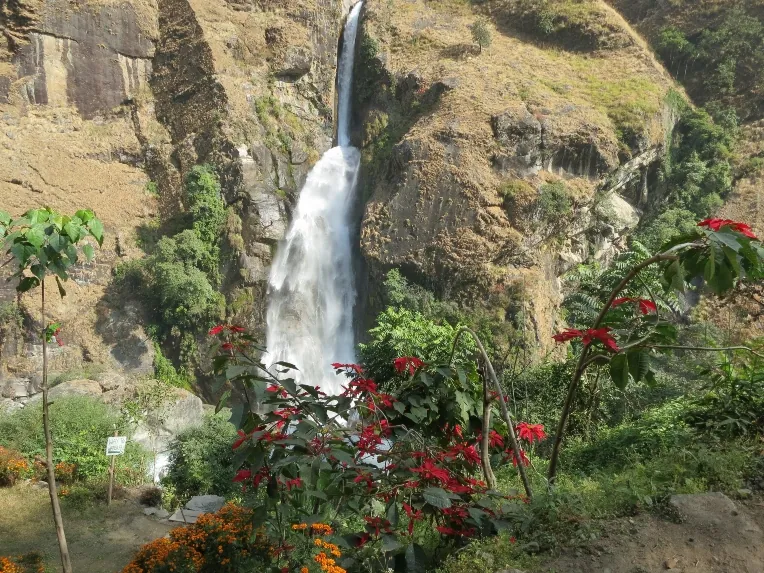
Waterfalls are always welcome to trekkers who are trekking the Manaslu circuit trek between Philim and Dyang village.
October is perhaps the best time to undertake the Manaslu Circuit Trek. The monsoon period comes to an end in October, and post-monsoon freshness begins on the trails. The forests along the way are green and dense, and the trails are neat and clean and devoid of any debris after the necessary repairs, making it a comfortable and safe trekking experience.
One of the top features of October’s Manaslu Circuit Trek is peak clarity. With a clear sky and minimal rain, the trekkers have the opportunity to take dramatically stunning panoramic images of the huge peaks, including Manaslu, Himalchuli, and Ganesh Himal. Visibility in October is unrivaled, with some of the best photo-shooting opportunities in the trek.
October weather is just perfect—not cold and not hot. The temperatures during the day are perfect for trekking, and nights at high altitudes are cold but tolerable. October is therefore an ideal month for trekkers who desire regular weather conditions without the extreme cold of later months like November.
October is culturally a very vibrant month due to the overlapping of Nepal’s Dashain and Tihar festivals. There are festivities held in the villages along the trek, giving the visitor an excellent opportunity to interact with the locals and understand their traditions. Overall, October offers the Manaslu Circuit Trek the best mix of weather, visibility, trail conditions, and cultural exposure and is therefore the optimal time to Everest base camp trek in Spring 2025/2026visit.
Advantages of Trekking the Manaslu in month of October
The Manaslu Circuit Trek in October has some advantages that make it an ideal choice for trekkers who want an offbeat Himalayan experience. Compared to the more popular trails such as the Everest Base Camp or Annapurna Circuit, the Manaslu region is comparatively less touristy, even during peak season.
This gives trekkers a serene, more genuine experience along remote mountain villages and serene landscapes.
October is also the perfect time for photography and movie-making. Blue skies, golden sunlight, and white summits of Manaslu (8,163m), Himalchuli, and Ganesh Himal provide wonderful settings. Whether shooting mountain vistas, fluttering prayer flags in the wind, or village cultural scenes, October’s Manaslu Circuit Trek is an eye feast.
Higher passes like Larke La Pass (5,106m) are more bearable in October, with settled weather and moderate snows. Temperatures that are not very cold reduce the chances of bad conditions halting the trek.
Another important advantage of trekking the Manaslu Circuit in October is the availability of teahouses. Due to the post-monsoon season being fully operational, most teahouses are open, well-stocked, and offer a greater variety of meals. This is an added facility for comfort and experience of travel.
Also, October falls at the time of grand Nepali celebrations such as Dashain and Tihar, when travelers can indulge in interaction with locals and watch celebrations in their traditional manner. The Manaslu Circuit Trek during October beautifully amalgamates adventure and culture and thus proves to be an experience in reality.
Scenery and Nature on the Manaslu Circuit Trek in October
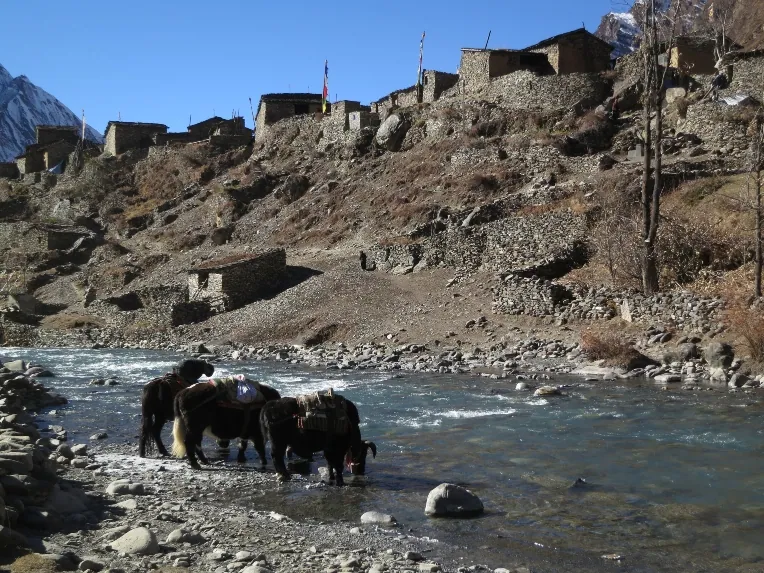
A thirsty yak drinking fresh water from a cold river.
The Manaslu Circuit Trek in October offers some of the most beautiful natural landscapes in Nepal. October is part of autumn, coloring the landscapes with lush autumn colors in red, orange, and gold. The lower slopes are tinted with blooming wildflowers, adding a splash of color to the already gorgeous trails.
Trekkers on the Manaslu Circuit Trek in October can expect to find crystal-clear rivers and waterfalls plunging with fresh energy after the monsoon. The paddy fields on terraces, heavy with mature crops, provide a glimpse of conventional Himalayan agriculture and rural Nepali life.
Hidden further up are the glorious snowy summits of Mt.Manaslu I (alt. 8163 m), Himalchuli (alt. 7893 m), and Ganesh Himal (alt. 7422m), Nike Peak (alt. 6211 m), Larke Peak (alt. 6219 m), and Samdo Peak (alt. 5177 m), lightly draped in an elegant dusting of fresh snow, in vivid contrast to brilliant blue October skies. Altogether, rainbow-colored valleys with white-topped summits make the trek along the Manaslu Circuit Trek in October a visual spectacle from start to finish.
Trek Challenges of Manaslu Circuit Trek in October
Larke La Pass is 5130 m above sea level.
Although the Manaslu Circuit Trek in October is one of the best treks in Nepal, there are some challenges that the trekkers must face and overcome themselves. The greatest issue is the cold nights at the higher altitudes like Samdo (3,875m) and Dharamsala (4,460m). The temperature dips below freezing, and thus proper equipment and warm clothes are required.
Another challenge on the Manaslu Circuit Trek in October is possible sudden weather change near Larke La Pass (5,106m). Although October generally offers stable weather, high-altitude weather is always unpredictable, and sometimes it can snow or become windy. One has to monitor the forecast and be ready to alter the itinerary.
As it is becoming more popular, moderate crowds can mean that teahouse space becomes limited along the trail. It is recommended to reserve accommodation in advance to obtain a comfortable place for the Manaslu Circuit Trek in October.
Everest Base Camp Trek is one of the most beloved treks in the world. Every year, thousands of people appraise this formidable challenge to reach this iconic place. But a common question many trekkers have is : Do I need a guide for the Everest Base Camp? Here in this blog I hope you will find the answer to it.
Independent Trek vs. Hiring a Guide
1. Independent Trekking
Yes, EBC trek can be done on your own. In case you have experience trekking at high altitude , navigating competence using maps or GPS , and consider yourself fit to carry your own pack , you have an option for solo trekking.Nevertheless, one should prepare Nevertheless, one should prepare for sudden weather changes, altitude sickness, and the difficulty of finding lodges during the peak season. Going alone also implies the need for responsible management of your own itinerary, acquiring your permits, and arranging food and shelter for yourself along the way. Although the trail is very well marked, weather and landslide damage may render it temporarily unpassable, in which case some good navigation skills would help.
2. Hiring a guide
Hiring a guide can greatly enhance your trekking experience in terms of safety, cultural awareness, and logistical issues. This is not compulsory but may come in handy, especially if you are a beginner trekker or unfamiliar with the terrain.
One of the areas where a guide is beneficial is communication. Most local guides are fluent in English, which helps bridge the language gap between trekkers and locals. Therefore, asking for directions, ordering food, or haggling for accommodation becomes easier. They also provide opportunities for meaningful interactions between trekkers and villagers as trekkers learn a bit about their way of life, traditions, and customs. They can also assist you in monks and monasteries by explaining their religious and historical importance.
The guides will not stop at mere translation; they delve into the history, culture, and geography of the areas you visit. They will elevate the trek from a mere physical journey to a journey filled with folklore, festivals, and traditions. Knowledge of the hidden hills that provide scintillating views and the back lanes that are not often visited will put a fresh twist on your expedition.
When in tough times, a strong communication skill can be the deciding factor. Whether it is an emergency evacuation for a sick trekker or to seek aid with another trekker down with altitude sickness, a guide is able to communicate efficiently. For example, helicopter evacuations, medical assistance, accommodation issues, etc., can all be solved with proper communication skills; this goes a long way in ensuring your safety and comfort.
Should You Hire a Porter?
A porter carries your heavy backpack, allowing you to trek with just a light daypack. If you dont want to carry all your gear, hiring a porter can make your journey easier. Some guides double asporter and guide you while carrying their own light load. Porter are especially useful if you are unaccustomed to carrying heavy loads in high altitude.This can greatly minimize fatigue and enhance your trekking experience.
Cost of Hiring a Guide
The guide fee follows the same logic, varying according to trekking routes and seasons as well as depends on the guide’s experience. Hiring fees usually range between $25 to $40 per day. Should you hire a porter for carrying your luggage, it normally takes from $15 to $25 per day. While it may be an additional cost, trekkers consider it a worthwhile expense for the extra help, safety, comfort, and enhancement of experience.
A reputable trekking agency hiring a guide takes care that he is licensed, insured, and experienced, so you can be relaxed during the whole journey. The agency also takes care of your logistics; hence it is a hassle-free path. Some independent guides are sometimes cheaper by some bucks, but you need to ensure extensive research in order to make sure your guide is reliable, knowledgeable, and qualified.
You will need to factor in more than just the basic price of hiring a guide in your trek budgeting. Important considerations are the guide’s experience, language fluency, and familiarity with the area. Although high experience level may come with increased costs, a good guide will facilitate and ensure smoother logistics and emergencies. Tips are a common practice and are well appreciated, especially when good work has been done.
It can be said that the price of a guide and/or porter should form part of the entire trekking experience. A good guide offers safety, provides navigation, and lets you understand and appreciate the culture, history, and landscape, all of which will certainly enrich your trip.
Trekking without a guide:
Despite the fact that numerous trekkers have been completing the trek to Everest Base Camp (EBC) without hiring a guide, solo trekking demands meticulous planning, rehearsed experience, and self-sufficiency. Independent trekking offers freedom and flexibility but has a little twist in the tale with different dangerous situations and challenges.
Is It Safe?
Unfortunately, an individual trek to EBC is not possible because of certain dangerous elements. The paths have been marked out very clearly for trekkers as it is indeed well provided with teahouses along the route; thus, this is all well and indeed good for self-supported trekkers. However, and it does not take too much thought to imagine the possible hazards, such as altitude sickness, injuries, and navigation disasters, transforming this solitary adventure into a very dangerous situation.
Altitude sickness: The level of oxygen has almost depleted by 5,364 meters (17,598 ft) at EBC whereby increasing the risk of Acute Mountain Sickness (AMS), High Altitude Pumonary Edema (HAPE), and High Altitude Cerebral Edema (HACE). Without a guide to check symptoms, solo trekkers must recognize early warning signs and take the necessary precautions as per their own judgment
Injuries: Slippery paths, rocky terrains, and extreme weather conditions contribute to producing falls, sprains, or even a bone fracture. Medical attention will be challenging to reach without assistance from a guide in remote areas.
Getting Lost: The trajectory may be well defined, but bad visibility can occur due to fog, snowfall, or sudden changes in weather, therefore disorienting trekkers.To be safe, anyone trekking solo should have a detailed set of maps, GPS devices, emergency contacts, and a solid draft itinerary shared with friends or family.
For Experienced Trekkers only
This solo trek is fully recommended for those who have done high-altitude trekking before; if you have trekked above 4,000 meters (13,000 ft) before and can acclimatize to high altitudes, the chances for you to have an enjoyable and safe trek are higher.
You should be:
Comfortable reading maps, using GPS, and following trail markers
Capable of handling altitude sickness symptoms and knowing when to descend
Physically and mentally prepared for long days of hiking in varying weather conditions
Experienced in managing your own logistics, including finding accommodations and arranging meals
Key Challenges
Altitude:
Proper acclimatization is crucial-follow the rule of not ascending more than 500 meters per day above 3,000 meters and include rest days.Particularly for solo trekkers, pay attention to the symptoms in cases of AMS, such as headaches, dizziness, nausea, and difficulty in breathing.
Navigation:
The Everest Base Camp trail is quite busy, although finding the way may be tough due to bad weather, snows along the trail, or if the time is out of season.Bring a thorough trekking map, compass, or a GPS app like Maps.me or AllTrails.
Logistics:
Without a guide, you will need to work hard to find accommodation and supplies for the trek. During those peak seasons, the teahouses quickly fill up and solo trekkers may have trouble finding rooms in Namche Bazaar, Dingboche, and Gorak Shep, among others. You will have to bargain the prices, take food orders, carry first aid kits, the extra cloth, and travel snacks high in energy.
Necessary Permits
Depending on whether you trek on your own or with a guide, you need to secure certain permits prior to your journey. The two most significant permits you will need are :
Sagarmatha National Park Entry Permit-Required for an entrance to the Everest area.
Khumbu Pasang Lhamu Rural Municipality Permit-Mandatory for all trekkers arriving in the area.
These permits may be obtained in Kathmandu or Monjo, a small village along the route. If a guide is hired, they generally organize these permits on your behalf.
Best Time for Trekking
A glorious site for an Everest Base Camp trek during the months of spring would be facing favorable weather and conditions, bright sunny skies and gentle warmth. Day temperatures throughout the trek average between 5°C and 10°C, with nighttime minimums of -10°C to -5°C. With a lovely combination of green vegetation and blooms of rhododendrons contrasting against the white-eaved summit, this springtime offers fabulous views. The weather conditions are more or less dry, while views of the mountains are a feast to behold! Well, it is a peak season, so do expect a decent number of other trekkers on the Everest trail.
Autumn (September to November)
This period is characterized by crystal-clear skies, dry weather, and lovely mountain sights; thus, the second-best time for an Everest Base Camp trek. The daytime average temperature is pleasant (10°C to 15°C), and it could really turn cold during the nights, especially at higher altitudes where the temperature could dip to -10°C or -5°C. Firm trails make views unto the neighboring peaks unabstr-ucted, with some of the best views ever of Everest and adjoining peaks. This relatively quiet time of trekking with fewer trekkers makes it all worth the while compared to the hustle and bustle of spring trekking.
Winter (December to February)
Very cold conditions prevail at Everest Base Camp in winter, with nighttime temperatures often plunging to -15 degree celsius or – 20 degree celsius . Crisp and clear days are beautiful for views but severe cold and probable heavy snowfall hamper any trekking experience . The higher up the mountains, the tougher these months turn out to be on the few brave trekkers daring during this season. So the winter can be for those few of you who consider yourself backcountry warriors and can handle the challenges of trekking in solitude. Planning ahead with the warmest gear is essential as well so make sure to pack the clothes accordingly.
Monsoon (June to August)
June to August are the monsoon months during which heavy rains make the trails extremely slippery and muddy and increase the chances of falls and injuries. Landslides happen frequently, blocking the paths and rendering the trip treacherous. Rivers and streams fill up quickly, thereby making the crossing tougher and riskier. Humid air tires the trekkers, thus compounding the trouble. Another big issue is leeches, which love the wet environment, often cling to the skin, and put a dampener on the whole trekking experience. However, an upside to monsoon trekking is that the scenery is at its most beautiful: with lush greenery and foggy hills, the views are breathtaking. Waterfalls overflow, adding beauty to the entire trip. The fewer the trekkers, the more peaceful and quiet the experience will be, with accommodations being easy to come by—sometimes even at discounted rates.
Spring (March-May)
Spring, which is another favored time for an Everest Base Camp trek, is characterized by mild temperatures, stable atmospheric conditions, and glorious mountain scenery. Daytime temperatures are ideal with ranges of 10-20°C, making for pleasant trekking, although nighttime at higher altitude can drop down to -5°C or -10°C. The trails are more or less hardened and dry with best available panoramic visibility of Everest and adjoining peaks.
One of the splendors during trekking in spring is the magnificent blossoms of rhododendron, which turn the lower hillsides red, pink, and white. The greenery of the forest and wildflowers burst open, beautifying the entire journey. It is the season for peak mountaineering expeditions, so many climbers are attempting to reach the summit of Everest, enriching the atmosphere with excitement and energy.
Though spring attracts a lot of trekkers, and though the trails have a load of trekkers they really aren’t heavy at all, the weather in early spring is normally fair with little risk of heavy snowfall and landslides. Spring offers a fine mix of gentle temperatures, clear skies, and spectacular scenery, making it the perfect time to visit the Everest region.
Conclusion
Whether you will go with a guide for your Everest Base Camp trek or not depends on how experienced and confident you are and what your trekking style is. Independent trekking may give you all the freedom, but it comes with the disadvantage of likely getting high altitude sickness, getting lost, or having trouble with logistics. Hiring a guide, on the other hand, guarantees a greater safety and comfort aspect: cultural immersion and making the journey itself smoother and more enjoyable.
If you want to trek without the stress and have everything well organized, with put-your-mind-at-ease expertise, Nature Explore Trek is the one. Established in 2015 by a very experienced guide born in the Everest region himself, this trekking company ensures first-hand, authentic, knowledgeable, and high-quality services for the clients. Their team knows the mountains inside and out and is thus able to have you experience the Himalayas with confidence and ease. Nature Explore Trek will ensure that whether you travel solo or in a group, your adventure to Everest Base Camp is unforgettable and safe.
Nepal is considered a paradise place when it comes to majestic mountains, stunning landscapes, and diverse ecosystems. The country is nestled with 1,310 peaks that are over 6,000 meters tall. The country is not only limited to mountain vistas but equally significant for cultural richness, spiritual importance, and adventure opportunities.
In this topic, we’ll discuss Island Peak vs. Mera Peak: Which Trekking Peak is right for you to visit in 2025? Both are considered trekking peaks in Nepal. Mera is significantly higher in altitude, whereas Island Peak is a bit tougher due to steeper abrupt ice ascents and a narrow rocky ridge to reach the summit. In 2025, both will be favourites among mountaineers and trekkers. If you are an adventure lover and passionate about trekking but in dilemma which one to choose? Stay with us to know everything about Mera Peak and Island Peak.
Introduction to Mera Peak and Island Peak
summit mera peak
Mera Peak
Mera Peak has a standing height of 6,476 meters which is located in the Mahalangur Himalayas within Nepal’s Everest Range. It is popular among the trekkers for the distinct of being the highest trekking peak in Nepal. Mera Peak comprises three principal summits: Mera South (6,065m), Mera Central (6,461m), and Mera North (6,476m). Mera Peak is considered a premier summit among trekkers.You do not need technical skills to reach the summit of this peak. In addition, it also provides you with 360-degree views of the popular Himalayas of Nepal like Mount Everest, Mt. Makalu, Lhotse, Kanchenjunga, and Cho Oyu. It is regarded as premier summit among trekkers. J.O.M. Roberts and Sen Tenzing were the first climbers to summit this mountain on May 20, 1953. Later this mountain has been climbed by popular mountaineers like Edmund Hillary, Tenzing Norgay and Several others.
Highlights and Facts of the Mera Peak
• Panoramic views of mountains like Mount Everest, Mt. Makalu, Lhotse, Kanchenjunga, and Cho Oyu • It is not as easy as Annapurna Circuit and Madri Himal Trekking. • Interact and socialize with people of Sherpa, Rai and Limbu communities. • It is appropriate for those trekkers who have basic trekking skills. • Offers an authentic trekking experience in the Khumbu Region.
Island Peak
Island Peak aka Imja Tse is most renowned trekking destinations among the trekkers. This place lies in the Solukhumbu region of eastern Nepal. It has an elevation of 6,189 meters. Island Peak, also known as Imja Tse, is lies within the UNESCO World Heritage Site of Sagarmatha National Park. In addition, this place offers you impeccable views of glaciers, landscapes and other mountains. Island Peak is challenging and bit tough among the trekkers compare to Mera due to high altitude, long days of trekking, challenging paths, rough landscape, severe weather, and parts covered in snow. The southwest summit of Island Peak was first ascended by a prominent British expedition group in 1953. This ascent constituted an aspect of their training and acclimatization strategy. The courageous and mountaineer climbers were Tenzing Norgay, Charles Wylie, and Charles Evans.
Highlights and Facts of Island Peak
• Know the cultures, customs & traditions of Sherpa’s. • The trekkers can explore rhododendron forests and varieties of flora & fauna • Offers stunning views of Everest region • Able to see wildlife and animals like musk deer, thar, deer and many other inhabitants • Stunning views of the highest mountain in the world, Mt. Everest (8848 m).
Best Season for the trekking: Mera Peak vs. Island Peak
The promising time for ascending Mera Peak is autumn and spring. During these times climbers can expect a relatively clear and stable climate, significantly improving the probability of a successful summit. Depending of your chosen time for the ascent, it is essential to acknowledge that temperatures at higher levels remain chilly, though tolerable Conditions at elevated elevations can become risky, requiring climbers to maintain attention and consciousness. Sometimes the weather becomes harsh; so, it is advisable to await calm and ideal weather for the summit ascent. In contrast, Island Peak offers a wide climbing window year-round, except during monsoon months. Ideal times are spring (March-June) and autumn (September-November), with stable weather, clear skies, and lower precipitation. Winter ascents can be challenging, especially for beginners.
The Permits you Required: Mera Peak vs. Island Peak
If you are planning for Mera Peak trekking you need to require several permits which are written below: Permits from Makalu Barun National Park: The permit is compulsory to enter in the Makalu Barun National Park. It costs around 3000-3500 approx for foreign nationals and 1500 for the SAARC nationals and Nepalese. You may acquire the permissions from Nepal Tourism Board (located at Bhrikutimandap Kathmandu). Permits and Fees to Mera National Peak: Apart from Makalu Barun; you also need local area permit. The costs are • $250-300 per person (Summer or Pre-Monsoon) • $125 for person during autumn (Sep-November) • $75-100 per person during off seasons. (Note: the price or costs may vary).
Costs & Permits Visitors needs for Island Peak trekking:
Here are the permissions needed for trekking Island Peak. Entrance permit at Khumbu Rural Municipality: You need to pay approx 2000-2500 NPR for entry in the Khumbu Rural Municipality. You can take this permit from Kathmandu. You can acquire it from Lukla or Monjo. Sagarmatha National Park Permit: Apart from Khumbu Municipality, you also need to permit from Jorsalle to enter in the Sagarmatha National Park. It costs around 3000-3500 approx per person. However, the costs also vary depends on which season you wants to travel.
Here are the documents you need to submit regarding Mera Peak and Island Peak trekking
• Details of Passport or Citizenship for Nepalese • Two Passport sized photos • Application forms • Payment of permit in Nepali rupees • Travel Insurance
on the way to islandpeak summit
Which one is easier to climb? Mera or Island Peak
Mera and Island Peak are the ideal trekking destinations. You do not need special mountaineering skills, experiences, or expertise to climb both mountains. However, compared to Island Peak, Mera Peak is less difficult.
Mera Peak has a slightly higher summit but faces steeper ice climbs, demanding sections, and a formidable headwall. It offers a more straightforward climb with fewer obstacles. Island Peak’s ascent is more challenging due to narrow rocky ridge, glacier traverse, and icefalls. Mera Peak is generally easier to climb, but trekking to its Base Camp presents unique challenges.
Difficulty Level of Mera Peak and Island Peak
Island Peak Climbing
Mera Peak Difficulty
Mera Peak, classified as a trekking peak by the Nepalese Mountaineering Association, is an ideal choice for beginners with minimal technical challenges. It is a relatively easy climb that can be successfully attempted by individuals with basic climbing training and good physical endurance. Previous climbing experience is not required for Mera Peak, considering it less technical than Island Peak. It entails ice trekking and climbing without of the intricacies of crevasses or narrow ridges. The ascent entails various challenges, such as elevated heights, steep inclines, rugged terrain, glacial and icy routes, prolonged hiking days, and isolated situations.
Difficulty Level of Island Peak
Ascending Island Peak demands basic climbing proficiency, as the path requires traversing a combination of rocks, ridges, and glaciers. One need to climb the steep stretch to attain the top, which offers glimpses of Lhotse, Ama Dablam, and other adjacent peaks and summits.
The climb of Island Peak is not harder one. It is classified as Alpine PD+. The ascent predominantly involves glacial terrain or 45-degree snow slopes, featuring some steeper segments and a narrow summit ridge in several areas. Fixed lines are employed to safeguard climbers on any steep or exposed areas; yet, ascending the steep segment and tapered summit ridge necessitates superior physical power.
Food & Accommodation: Island Peak vs. Mera Peak
During your Island Peak tour, the route provides additional accommodation options, particularly up to Dingboche valley, with teahouses up to Chukhung village, followed by tented camps for one or two nights. The Island Peak trail offers similar food options as the Mera Peak route, with teahouses typically having their own menus, but may become more limited as you ascend. You can enjoy mouthwatering Nepali cuisine like Daal Bhat, Tarkari and some other dishes like momo dumplings, soups, bread, chapatti, chow mien, and spaghetti. Both climbing adventures offer appropriate lodgings and a varied selection of substantial meals to sustain your journey in the Himalayas.
During a Mera Peak trekking, teahouses for accommodation are accessible until the town of Khare. Nevertheless, for the final 2 to 3 nights preceding the summit attempt, you will be depending on camping tents. In addition, the teahouses along the trekking route provide basic amenities like clean and hygienic rooms, shared bathrooms, hot water facilities, warm blankets, and meals (dinner and breakfast) at the same location where you will stay. In terms of cuisine, you will find a variety of Nepalese meals as well as a few international options. Popular options include Daal Bhat (a dish made with lentils, rice, veggies, and pickles), momo dumplings, and a variety of soups, chapatti, chow mien, spaghetti, and Tibetan bread.
Similarities of Island Peak vs Mera Peak
Mera Peak and Island Peak have numerous significant similarities. Both are situated in the Barun sub-part of the Mahalangur section in the Nepalese Himalayas. Secondly, these summits have close elevations, with Island Peak at 6,189 meters (20,305 feet) and Mera Peak at 6,461 meters (21,190 feet). Furthermore, these two peaks are situated in close district within the same region. Moreover, both Mera and Island Peaks are classified as trekking peaks, indicating that climbers do not necessitate specialist technical climbing abilities to undertake their ascents. Notwithstanding these similarities, it is essential to recognize that each of these summits presents a unique adventure and experience for travelers, accompanied by specific challenges and picturesque rewards.
Island Peak vs. Mera Peak: Trekking Route
Island Peak’s climbing route, which combines trekking and mountaineering, typically takes around 15 days to complete. The route ascends to High Camp and then the peak by following the traditional route to Everest Base Camp.. Despite being a little shorter than Mera Peak, the ascent of Island Peak is notoriously difficult, including challenging slopes. Climbers have the option to spend an extra four to five days at Everest Base Camp and Kala Patthar. Yet this route is bit harder than Mera Peak. The Island Peak Climbing route starts in Kathmandu and covers Lukla, Phakding, Namche Bazaar, Tengboche, Dingboche, Chukhung Ri, Island Peak Base Camp, Island Peak Summit, Chukhung, Namche Bazaar, Lukla, and eventually back to Kathmandu.
The expedition to Mera Peak commences with a scenic flight to Lukla, succeeded by a hike through lush forests and secluded valleys that concludes in the Hinku Valley, from which the ascent to Mera Peak starts. The climbing itinerary generally extends approx 18 days, incorporating crucial overnight halts in Paiya, Kothe, Panggom, Thankak, and Khare prior to arriving at Mera High Camp at an elevation of 5,780 meters. The ultimate climb to the peak necessitates the utilization of fixed ropes and jumars. Trekkers should anticipate weather-related delays, requiring an additional 2-3 days in the schedule. The Mera Peak climbing itinerary encompasses a journey from Kathmandu to Lukla, followed by Chutanga, Zatra La, Thuli Kharka, Kothe, Thangnag, Khare, Mera Peak Base Camp, Mera High Camp, Mera Summit, and then retracing the route back through Mera High Camp, Mera Base Camp, Khare, Kothe, Thuli Kharka, Lukla, and concluding in Kathmandu.
Mera Peak offers a more technical climb, while Island Peak’s route is shorter and more challenging, featuring iconic Everest landmarks, offering incredible trekking and climbing experiences.
Cultural Immersions during trek of Island and Mera Peak
You will have tour to Mera Peak and Island Peak in the remote Himalayan regions. You will experience distinct and unique Sherpa and Tibetan culture. Tibetan Buddhism massively resides in the higher regions. You will experience their culture and friendly hospitality. In addition, you will have the chance to interact with the people and gain a greater understanding of their customs, cultures & traditions.
Tourism supports the region’s local economy. So travelers should hire the local porters and guiders to support them. In addition, trekkers should admire and respect their cultural & traditions. Aside this, sustainable tourism and preserving the region’s cultural heritage and environment are crucial aspects to consider during your tour.
Things you need during Mera Peak Trek
• Climbing Slings • Waterproof Shell Jacket • 40 liters day packs • Trousers, shorts and fleece • Woolen tops • Small size towel • Small Size Pillow • Toiletries • Wet Wipes • Ear Plugs • Head torch with extra batteries • Sun Glasses • Head Gears • Sleeping bag with compression sack • Footwear’s and trekking shocks • Snow Gaiters • Pee Bottle • First Aid Kit • Accessories like Camera, Phone, Ear Pods
Frequently asked questions (FAQ)
What are the height of Island Peak and Mera Peak?
The height of Island Peak and Mera Peak are 6,189 meters and 6,461 respectively.
Are Island Peak and Mera Peak requires technical mountaineering skills?
Both Mera Peak and Island not regarded as technical mountaineering skills. However, you should have basic trekking skills or previous trek experiences to conquer both.
What is the minimum age needed to summit Island Peak and Mera Peak?
As per rules by Government of Nepal, climbers must be 18 years of his/her age. Therefore people under of 18 ages are not allowed for this trek.
Do I need travel insurance during Mera and Island Peak trek?
A Big Yes!! Climbers must acquire travel insurance that includes emergency rescue coverage when ascending summits such as Mera Peak and Island Peak. In the event of an emergency, your travel insurance will cover the costs of helicopter rescue or any other medical treatment.
The primary recommendation is to acquire the necessary expertise and climbing skills as directed. Acclimatization is essential. We strongly recommend allocating sufficient time along the trip. Prior to commencing your trekking training at home, it is essential to develop strength and endurance through physical training, gain multi-day hiking experience and we recommend prior trekking experience at altitudes over 4000 meters for Island Peak. Appropriate gears and equipment are essential. We will offer optimal logistics and assistance during your journey; our skilled, knowledgeable, and amiable guides will ensure you have the greatest opportunity to reach the summits of both Mera and Island Peak.
Conclusion of Island Peak vs Mera Peak: Which Trekking Peak is Right for you to visit in 2025?
While both Island Peak and Mera Peak are impeccable for the trekkers. They both are the premier trekking peaks in Nepal which are worth to conquer. Both are providing remarkable and unique experiences to the trekkers.
Why Travel with Nature Explore Treks?
We are committed to delivering exceptional services to our clients. From your booking and first email, we ensure about comfortable and stress free tour. Our travel experts consistently strive for superior standards of excellence for their visitors. Our team is exceptionally qualified to guide you in mountaineering, trekking, hiking, and various other activities. If you seek an ideal trip and vacation, we are undoubtedly best in this field. Our team is always glad to assist you with your tour activities. You will be satisfied with our tour services at reasonable prices.
If you are one of the adventure lovers, trekking in Nepal is your dream come true. Among all the peaks in the world, Nepal has the eighth-highest mountains, with both easygoing hikes and difficult climbs.
There are various treks to go on, even in Nepal, but I’ve picked up the best for 2025/2026. There’s something for everyone, whether you’re a beginner or an experienced trekker.
The popular Everest Base Camp Trek is iconic and offers views of Mount Everest (8,848 m), the world’s tallest mountain. For something more challenging, the Everest Three High Pass Trek won’t disappoint.
If you are interested in mountaineering, Mera Peak climbing can be your go-to. In contrast, the Annapurna Base Camp Trek via Poon Hill is a popular trek with golden sunrise views on the Annapurna.
The Manaslu Circuit Trek is one of Nepal’s hidden gems, taking you away from the more crowded trails. The Island Peak Climbing Trek has an exciting adventurous climb that provides the best introduction to mountaineering. In the Gokyo Lake with Renjo La Pass Trek, you can enjoy serene glacial lakes and views of Mount Everest.
If you are looking for a short trek with lots of rewards, dense forests, and Tibetan villages, then the Langtang Valley Trek is for you. For even better remote hikes, Tibetan-influenced regions found on the Upper Dolpo Trek offer a taste of solitude and natural beauty.
Khopra Ridge Trek is a quieter trail with incredible views of the Annapurna and Dhaulagiri ranges. The Kailash Mansarovar Yatra from Nepal is a spiritual walk to Mount Kailash, one of the most sacred peaks in the Himalayas.
In this blog, I will share the top 10 treks in Nepal to do in 2025 and 2026 and essential details, including history, trails, days needed, pricing, gear, and accommodations.
Here are the Top 10 Treks in Nepal for Adventure Seekers in 2025&2026 Packages
1.Everest Base Camp Trek
Our client successfully completed Everest Base Camp (5,364m)
The Everest Base Camp Trek is a very popular trek in the world that takes you to the base of the tallest mountain on earth, Mount Everest (8,848.86 meters). The scenery is rugged, climbs are steep and long, and trek through Sherpa villages like Tengboche, Dingboche, and ancient Tengboche monastery, past picture perfect, and awe inspiring landscapes.
The trek usually takes 12 to 14 days, gains 5,364 meters to Everest Base Camp, and is steady. You begin with the lively city of Kathmandu, continue with a flight to Lukla, and then trek to Namche Bazaar, Tengboche, Dingboche, and Gorak Shep.
An acclimatization day on the route allows you to reach to high altitudes and meet the base camp. The packages usually cost $1,200 to $1,800 per person, including permits, guides and porters, and accommodation.
History of Everest Base Camp Trek
The Everest Base Camp Trek has been a famous route for mountaineers and trekkers alike since the 1950s. This trek is the only opportunity to meet the amazing flora and fauna of Sagarmatha National Park, a UNESCO World Heritage Site. Endangered animals such as red pandas and snow leopards live in this area.
Along the way, you’ll encounter the Sherpa culture, which Tibetan Buddhism strongly colors, as you hike from such Sherpa villages as Namche Bazaar. You can visit ancient monasteries such as Tengboche Monastery, the spiritual hub of the locals.
You’ll pass rivers like the Dudh Koshi along the way and witness the Lhosar festival (Tibetan New Year) in the monasteries.
Highlights on the Everest Base Camp Trek
● A relaxing flight to Lukla, an incredible 35-minute flight from Kathmandu, which is also known as the gateway to Everest. ● Namche Bazaar, a lively hub and acclimatization stop with views of Everest, Lhotse, and Ama Dablam. ● Tengboche Monastery, the largest and oldest monastery in the region. ● Witnessing Khumbu Glacier as you approach Everest Base Camp. ● Hike to Kala Patthar and get the magnificent sunrise above Everest and the surrounding peaks. ● Reach the popular Everest Base Camp, where climbers prepare for the summit of Everest. ● Experience the warm hospitality of Sherpa culture and Buddhist traditions.
What makes Everest Base Camp Trek stand out Being adventurous and part of the culture, this Everest Base Camp Trek is a special adventure. In Sagarmatha National Park, you travel through the beauty of rare wildlife and beautiful landscapes.
As you travel along, you visit Sherpa villages, meet the locals, and learn about their traditions. The trek’s views include mountains such as Mount Everest, Lhotse, and Ama Dablam.
Seeing the world’s tallest mountain at the Base Camp struck a sense of charm within me. This trek is a once in a lifetime experience for anyone wanting to explore all around the world.
2. Annapurna Base Camp trek via PoonHill
Admiring the view of Annapurna region
The Annapurna Base Camp trek via Poon Hill is usually a 10 days trip in the Annapurna region, costing around $700. The views in this renowned trek are insane, especially at the Annapurna Base camp, which is at 4,130 meters.
It’s famous for its sunrise view at Poon Hill (3,210 m), striking golden hues on the Annapurna. You’ll experience charming villages like Ghorepani and Chomrong, wander through forests, and see the lively culture of the local Magar and Gurung people.
It is a moderate trek with some steep climbs and some gradual walks. The 10-day trek begins and ends in Pokhara, with a drive to the trailhead at Nayapul.
History of Annapurna Base Camp trek via PoonHill
Rhododendron forests, magnolia trees, pine groves, Musk deer, red panda, and snow leopard are the dominant features of the Annapurna region, which is home to diverse wildlife and a great variety of flora.
It is a trek in which you will cross traditional villages of Nepal’s Magar and Gurung communities and experience their rich cultural heritage. You’ll also find interesting and engaging the local festivals like Tihar and Dashain, which add colour to the region.
It also crosses rivers like the Modi River, and while trekking, it’s possible to visit ancient Buddhist monasteries, like the famous Tenghoche Monastery. The sacred Tengboche monastery celebrates famous festivals like Lhosar (Tibetan New Year), Maghe Sankranti, and Buddha Jayanti.
The diverse ecosystem and rich culture of Gurung and Magar make this trek no less than a trip to a different place.
Highlights on the Annapurna Base Camp trek via PoonHill
● See the incredible sunrise at Poom Hill with views of Annapurna, Dhaulagiri, and Manaslu. ● Trek through a forest of rhododendrons, magnolia, and pine forests, scenic. ● Insights into traditional farming and cultural traditions of the Magar and Gurung communities. ● Views of the famous Machhapuchhre (Fish Tail) and Annapurna South. ● Relax at the natural hot springs of Jhinu village.
What makes Annapurna Base Camp trek via PoonHill stand out
On the Annapurna Base Camp trek via Poonhill, you get the best view of diverse terrains and a chance for cultural immersion.
Beyond seeing incredible sunrise views from Poon Hill, and having a chance to climb up a little further to the famous base camp, the trek gets you into some of the most beautiful rhododendron forests, and you will feel the warmth of local hospitality too.
With its natural beauty and cultural richness, the trek is a must experience for those who want to make the best trek in the Himalayas.
3.Langtang Valley Trek 7 days
Eagle flying with the stunning backdrop view of Langtang .
Situated only 51 km from Kathmandu, the Langtang Valley Trek is a joyous seven-day adventure through one of Nepal’s most beautiful and accessible trekking areas. Your permit, accommodations, and meals are all covered, and the typical cost is around $800.
We saw the amazing snow peaks, like Langtang Lirung, Dorje Lakpa, and Langtang Ri, and ancient monasteries like Kyanjin Gompa. It is a great route rich in natural beauty, and cultural experiences along the way, following the Langtang River.
The trek begins in Syabrubesi with a drive through a forest of rhododendron and oak and several Tamang villages influenced by Tibet. Kyanjin Ri, at 3,850 meters, is the highest point, and the surrounding peaks are visible from here.
History of Langtang Valley Trek 7 Days
Langtang Valley has been historically and culturally significant for centuries. For centuries, this valley has been populated by the Tamang people, who are under the influence of Tibetan Buddhism.
Nepal’s first Himalayan park, Langtang National Park guards a diverse ecosystem that includes a variety of endangered species endemic to the region, including the red panda, Himalayan black bear, and the snow leopard.
Rhododendron, oak, and pine trees make up the flora. Monasteries such as Kyanjin Gompa provide religious significance to the region. However, the 2015 earthquake caused serious damage to that area, which is now recovering. Tea houses and cultural sites have been rebuilt, attracting trekkers and pilgrims.
Highlights on the Langtang Valley Trek
● Beautiful mountain peaks like Langtang Lirung and Dorje Lakpa can be seen. ● Cultural immersion with the Tibetan Tamang Culture and Lifestyle. ● Wildlife encounters such as the red pandas and Himalayan Monal. ● Golden sunrise at Kyanjin Ri with a panorama of the Himalayas. ● Wander through rhododendron forests, oak and pine. ● Try fresh cheese at Yak Cheese Factory of Kyanjin Gompa. ● Hike to Buddhist Monasteries like the Kyanjin Gompa.
What makes Langtang Valley Trek 7 Days stand out
Trekking Langtang Valley is unique for its accessibility and the variety of landscapes you see. This trek seems suitable for trekkers who are short on time but still want an amazing immersive experience.
The trek takes place in one of Nepal’s first national parks and allows the chance to see rich biodiversity, Tamang villages as Tibetan-influenced including rare wildlife like the red panda. The trek is as much cultural as it is physical, with tamang villages as Tibetan influenced as they are and ancient Kyanjin Gompa.
Among all the treks to choose from, Langtang is a relatively moderate option in terms of altitude. Its stunning mountain vistas make it also a great choice for trekkers looking to explore the cultural side of the Himalayas.
4. 14 days Manaslu circuit trek
Mt. Manaslu (8,163m)
The Manaslu Circuit Trek offers mesmerizing views of the world’s eighth highest mountain, Mount Manaslu (8,163 m). It is a renowned trek off the beaten path in Nepal.
The trek is usually 12 to 18 days long and passes through a wide range of landscapes, including dense forests, high mountain meadows, and challenging high-altitude passes like the Larkya La Pass (5,106m).
The trek is arduous and passes through traditional villages like Sama Gaun, Dharapani, and Lho, monasteries like Pungyen Gompa and Mu Gompa, and cultural landmarks. The sacred Pungyen Monastery is the site of religious celebrations like Holi, Dashain, Tihar, and Buddha Jayanti.
Going to Manaslu Circuit Trek was a peaceful place to be, unlike the populated trek like Annapurna and Everest. You will require three main permits, Annapurna Conservation Area Permit, Manaslu Conservation Area Permit, and Manaslu Restricted Area Permit. Package prices typically range from $900 to $1,800 depending on rate options. History of Manaslu Circuit Trek The Manaslu region has rich cultural heritage, Gurung, Sherpa, and and Tibetan Buddhist local communities. In these remote villages, livelihoods depend on traditional ways of life and deeply rooted practices and customs that are still enacted.
The trail follows the Budi Gandaki River and passes several monasteries, including Pungyen Monastery, reflecting the Tibetan Buddhist influence in that area.
You’ll see diverse wildlife, including rare species such as snow leopards, Himalayan tahr, and red pandas. Manaslu is a thrilling place to trek, with culture and nature making up for the region’s overall beauty.
Highlights on the Manaslu circuit trek
● Stunning views of the world’s eighth-highest peak, Mount Manaslu (8,163m. ● A challenging, adventurous, and rewarding high altitude pass, the Larkya La Pass (5,160m). ● Trek through the diverse ecosystems, subtropical forests, alpine meadows, snow covered landscapes. ● Cultural experience of the traditional Tibetan Buddhist villages, monasteries like Pungyen Gompa, and interacting with the locals. ● Witness wildlife, flora, red pandas, and such as Himalayan tahr and red pandas, along with some high mountain areas. ● Breathtaking views of towering peaks including Annapurna, Shringi, and Ganesh Himal. ● Calm walk along the Budi Gandaki River.
What makes the Manaslu Circuit Trek stand out
Manaslu Circuit Trek is unique by its genuineness with the authentic and natural core of the Himalayas. You will have a quieter trek, more secluded than the well known treks like Annapurna and Everest.
The trail passes through remote villages like Lho and Sho, where the traditional lifestyle can be seen. The Larkya La Pass of Manaslu Circuit Trek is a thrilling challenge for trekkers and the variety of landscapes ranging from thick forest to high altitude desert, ensure that the trek keeps it exciting.
The trek itself is also relatively uncrowded, meaning trekkers can get a closer up-close and personal experience of the region’s natural and cultural wonders.
5. Mera peak Climbing Alt. 6,467 meters.
At 6,467 meters, Mera Peak is the tallest trekking peak in Nepal and a good climb for people new to peak climbing. It lies in the Everest region’s (Solukhumbu) district and provides an exciting but achievable challenge.
A trek itinerary can last 16 to 20 days and cost around $1,500 to $3,000, depending on the route, choices, and inclusions.
Although not super difficult, a few sections thatt require preparation and technical skills to climb. From the climb, you get a sweeping panorama of Mount Everest, Lhotse, and Nuptse, where you see red pandas and snow leopards.
Passing through becomes memorable with sherpa villages and the rich cultural experience along the treks are being passed through.
History of Mera Peak Climbing
Climbers have the Mahalangur section. Along found Mera Peak an attractive peak because it provides beginners with a good challenge, with some steep sections. Mera Peak is located in the Everest region of Mahalangur section, which was the first summit in 1953 by a British team of Army officer Jim Roberts and Sherpa Sen Tenzing summited it in 1953.
Since then, it has become a popular destination for adventurers chasing a high-altitude trip that’s not quite as extreme as the other peaks. The trek is surrounded by villages where the Sherpa people live. Their rich Tibetan-influenced culture creates a unique cultural insight as well as natural beauty for trekkers.
Highlights on the Mera Peak Climbing
● Stunning views of Everest, Lhotse, and Makalu. ● Trek to Mera Peak Summit at 6,461 meters, the highest trekking peak in Nepal. ● Cultural Immersion in the remote Sherpa village places such as Panguam and Khare. ● Traverse the Makalu Barun National Park and enjoy multiple landscapes and rich wildlife forests. ● Less popular treks with more opportunities for serene trek. ● Climb to glaciers and steep sections, perfect for adventurers seeking some demanding climb.
What makes Mera Peak Climbing stand out
Mera Peak climbing is distinct because it combines adventure, cultural immersion, and astonishing views. Nepal’s tallest trekking peak is a great choice for climbers who would like to climb high altitudes without attempting a technically demanding route.
Compared to Island Peak which is much more popular, Mera Peak is less crowded, which means you have a closer encounter with nature and the beautiful Sherpa community.
The trek charters green forests, remote villages, and spectacular views of the Himalayas including Mount Everest.
What I love about this trek is that, even though it is the highest trekking peak, it isn’t the most strenuous. I’ve seen even beginners complete this high altitude trek with proper preparation, allowing all level trekkers to enjoy the views.
6. Everest Base Camp trek with Island peak climbing
Everest Base Camp Trek with Island Peak climbing is a thrilling adventure of two world renowned expeditions. The trek starts in Kathmandu and includes Sherpa villages, ancient monasteries, and great mountain views through classic Everest routes.
When you reach Everest Base Camp, you will try the challenging climb of Island Peak (6,189m). Typically, this trek lasts 16 days, including days for acclimatization to have proper rest and make a successful summit. The price can be varied but is usually $2,500 to $3,000 depending on the provider and what is on the package. History of Everest Base Camp trek with Island peak climbing The Everest region is filled with culture, wildlife, and history. For centuries, this place has been home to the Sherpas, known for its rugged terrain and breathtaking peaks. Namche Bazaar and Dingboche are villages that give you a view of the Sherpa lifestyle.
You can visit popular religious monasteries like Tengboche. The region is renowned for its wildlife, including snow leopards, musk deer, and colorful pheasants. Most parts of the trek pass rivers like Dudh Koshi.
The Mani Rimdu festival, which honors Guru Rinpoche, is a Sherpa festival that showcases their traditions and is mostly celebrated in monasteries.
Highlights on the Everest Base Camp trek with Island peak climbing
● A scenic flight to Lukla, the most thrilling airport in the world. ● Summit to the challenging and rewarding Island Peak (6,189m). ● Stunning views of famous mountains such as Mount Everest, Lhotse, Nuptse, Makalu, and Ama Dablam. ● Visit the Base Camp of the world’s tallest mountain, Everest Base Camp. ● Golden sunrise views of the surrounding mountains from Kala Patthar (5,545m). ● Witness the way of living, culture, and religion of the Sherpa in Namche Bazaar and Tengboche. ● Various wildlife, including endangered ones like snow leopards and red pandas. ● Acclimatization and exploration days in the lively Namche Bazaar.
What makes the Everest Base Camp trek with Island peak climbing stand out
Everest Base Camp Trek with Island Peak climbing perfectly combines trekking and mountaineering. It stands out because it’s appropriate for beginners and more experienced climbers, who are beginning their first Himalayan peak.
While the altitude of Island Peak, 6,189m sounds challenging, the reward on top makes most trekkers push to their limit. You don’t have to go through strenuous trekking like Manaslu, Lhotse, or Everest’s higher altitude.
It’s also great with rest and acclimatization days, making it more accessible for people with moderate climbing skills.
7. 13 days Annapurna Circuit Trek
Those simle after completing Thorong La Pass alt.5416m
The 13 days Annapurna Circuit Trekis one of the most famous trekking routes in Nepal. It includes the wonderful sight of Annapurna, Dhaulagiri, and the Machhapuchhre massif. This 13-day challenging but rewarding trek leads you through different landscapes, from subtropical forests to high mountain meadows and high-altitude deserts.
The highlight is crossing one of the highest trekking passes in the world, the Thorong La Pass (5,416m). From start to finish, you’ll pass through quaint villages, experience the local culture, and see some of the most gorgeous views of the Himalayas.
It costs between $800 and $1,000, based on services, meals, transportation, and accommodations.
History of 13 days Annapurna Circuit trek
Since the opening of the Annapurna region in the 1970s, the Annapurna Circuit has been a popular trekking route. This trek passes through the Annapurna Conservation Area, which is filled with diverse ecosystems and rich cultural heritage.
Historically, the region was an important trade route between the villages of Nepal and Tibet and the Himalayas to the lowland regions. For many years now, it has become a famous trekking destination, attracting trekkers from everywhere.
On the trek, you will pass through Gurung and Magar traditional villages, such as Manang and Phedi, which illustrate an important component of local culture.
Highlights on the 13 days Annapurna Circuit Trek
● The trek crosses the Thorong La Pass (5,416m), the highest point of the trek with amazing, rewarding views. ● Views of tall and popular mountain range like Annapurna, Dhaulagiri, and Machapuchhre. ● Walk through traditional villages like Manang, Marpha, and Ghorepani. ● Hike to the sacred Muktinath Temple. ● Culture and tradition of local communities like Sherpa and Gurung.
What makes 13 days Annapurna Circuit trek stand out
Annapurna Circuit Trek is special for providing a range of landscapes, challenging terrain, and cultural experiences. Crossing the Thorong La Pass on the trek is one of the more notable features, as you get to see the area’s surrounding peaks from an angle not many get to enjoy.
Rich cultural heritage combined with rich natural beauty offering a unique adventure makes the route so special.
The chance to visit the religious Muktinath Temple, trek through traditional villages like Manag and Phedi, and witness wonderful mountain views of Dhaulagiri and Machhapuchhre make this trek a once-in-a-lifetime experience.
8. Gokyo Lake with Renjola Pass trek
Walking through the Gokyo Lake feels surreal
Gokyo lake with Renjo La Pass Trek is a stunning exploration of remote valleys in the Khumbu region of Nepal. From Kathmandu, you’ll start your flight to Lukla before setting off through the beautiful villages of Namche Bazaar, Dole, and Gokyo.
The Gokyo Lake with Renjola Pass Trek lasts about 15 days and costs around $1650. The cost can vary depending on how many trekkers you are going with and what accommodations and meals you choose.
At 5,340m, the dangerously exposed Renjo La Pass marks the end of the trek, with incredible views of Everest, Lhotse, Makalu, and Cho Oyu.
The trek includes a stop at serene and sacred Gokyo Lakes and a trek upward to the top of Gokyo Ri for sweeping views of the Himalayan giants standing before you. This is a quieter alternative unlike more crowded treks like Everest base camp trek.
History of Gokyo Lake with Renjola Pass trek
Sherpa people’s culture and spirituality have been long associated with the Gokyo Lakes. Of these six sacred lakes, Gokyo Cho (Dudh Pokhari), especially, is revered by Hindus and Buddhists and is visited for pilgrimage, especially during the Janai Purnima festival. The lake is famous for worshipping the Nag Devta, known as the Snake God.
Traditionally recognized as important for trade and exploration, Sherpa mountaineers first successfully submitted the Renjo La Pass in the early 1800s. In the 19th century, it became a chief route for British and German explorers to Mount Everest.
Highlights on the Gokyo Lake with Renjola Pass trek
● Scenic flight to Lukla, then a trek to the wonderful small villages of the Khumbu region. ● Wide views across Everest, Lhotse, Makalu, and Cho Oyu, then climb over the beautiful Renjo La Pass (5,340m). ● Attractive and religious Gokyo Lake with turquoise water. ● Sunrise views from the summit of Gokyo Ri (5,483m). ● Visit the Ngozumpa Glacier, the largest glacier in the Himalayas. ● See the Sherpa villages, as well as their culture and traditions.
What makes the Gokyo with Renjo La Pass Trek stand out
The Gokyo with Renjo La Pass Trek is different because it provides a lot of natural beauty and cultural exploration outside of the usual crowd.
On the trek, you gain access to incredible views of Everest and its neighbouring peaks. You also have the chance to visit Gokyo Lakes and hike up Gokyo Ri for fantastic broad views from the top.
You will have the additional challenge of hiking to the Renjo La Pass, which offers amazing views of the Himalayas. You will also be introduced to the Sherpa culture, experiencing warm hospitality and learning about the area’s humble native people.
9. Everest Three High Pass trek
Completing Three High Pass ✔️
The Everest Three High Pass Trek is a thrilling adventure that crosses three of the highest passes in the Everest region, Cho La Pass (5,420 m), Kongma La Pass (5,535 m), and Renjo La Pass (5,465 m).
You will have views of towering peaks, providing unparalleled vistas of Mount Everest, Lhotse, Makalu, and Ama Dablam. This challenging trek includes glaciers, high-altitude passes, and Sherpa villages.
The trek begins and ends in Lukla, and $2200. It allowslasts about 17 days, and costs between $1400 to $2200, allowing you to get close-up views of the Khumbu Region.
On the way, you’ll also make it to Everest Base Camp, Kala Patthar, and Gokyo Lakes. This trek is most suitable for experienced trekkers who want to experience a physically challenging trek and push their limits. History of Everest Three High Pass History The Everest Three High Pass Trek is not new, but one that has evolved over the years to appeal to the wide variety of trekkers who visit the region for the combination of high altitude challenges and cultural experiences.
The British expeditions, which included George Mallory and Andrew Irvine, attempted the summit in 1924, inspiring interest in the Everest region in the early 20th century.
In the 1980s and 1990s, adventure-minded trekkers flocked to the Three High Pass Trek for the wonderful views of the Himalayas and encounters with Sherpa villages.
Today, it is a much wanted adventure, though concerns for the environment have stimulated an effort to encourage responsible trekking.
Highlights on the Everest Three High Pass Trek
● Trek to three famous high passes, Cho La, Renjo La, and Kongma La, which have extensive views of the Everest region. ● Witness the culture, tradition, and life of the Himalayan Sherpa people. ● Chance to visit the famous and sacred Tengboche monastery. ● Hike to the highest glacier in the world, Khumbu Glacier.
What makes the Everest Three High Pass trek stand out
Everest Three High Pass Trek is especially distinctive because it combines high altitude challenges, breathtaking views, and cultural exploration.
Since it’s challenging, it’s the best choice for seasoned trekkers who want an overall thrilling experience of the Everest region. The trek combines the signatures of Everest Base Camp, Kala Patthar, and Gokyo Lakes and offers the chance to navigate across three challenging passes.
More importantly, you’ll trek through less explored paths and see a lot of diverse flora, fauna, and Sherpa culture, making it the most comprehensive trekking route in the region.
10. Kailash Mansarovar yatra from Nepal.
Mount Kailash north face
Kailash Mansarovar Yatra from Nepal takes you to Mount Kailash, the holiest mountain of South Asia, and Lake Manasarovar, a sacred freshwater lake. Mount Kailash is considered the abode of Lord Shiva and is an important pilgrimage for Hindus and Buddhist as well as Jainism, and Bon.
Typically a tour of 10 to 17 days, this includes a scenic drive from Kathmandu to Tibet, a visit to Kyirung, Saga, Mansarovar, Darchen, the Mt. Kailash trek, and others. This trek is quite expensive, starting from $2,500 to as high as $5,000.
This trek offers breathtaking views, remote Tibetan villages, and religiously important sites such as Gauri Kund, Chiu Monastery, and Dolma La Pass.
Depending on the group size and the level of customization and inclusion, the price for this yatra varies and deserves a group visa for entry into Tibet. Trekking in a group can also decrease the expensive price you need to pay for the trek.
History of Kailash Mansarovar yatra from Nepal.
Mount Kailash (6,638m) is deeply religious and is the spiritual center for Hindus, Buddhists, Jains, and Bon followers.
It’s a Hindu belief that Lord Shiva lives there, along with Goddess Parvati and other divine beings. To Tibetans, the peak is named Kang Rimpoche, “The Jewel of the Snow,” and is regarded as the place where Rishabanatha attained liberation, according to Jain tradition.
For the Bon religion, Mount Kailash is the soul of Tibet. The base of Mount Kailash, where Lake Mansarovar is situated, is where many believe the source of all life and energy is. According to mythology, taking a holy dip in the lake washes sins away, and walking around Kailash purifies the soul.
The surrounding flora and fauna include unique Tibetan species like blue sheep, snow leopards, and yaks. Insights from Tibetan villages tell us about the culture and lifestyle of the Tibetan people, who are known for their warmth and hospitality.
Sacred monasteries like Dirapuk Monastery are spots for prayer and reflection. Great festivals such as Lhosar (Tibetan New Year), Maghe Sankranti, Dashain, and Tihar are celebrated here.
Highlights on the Kailash Mansarovar yatra from Nepal
Drive from Kathmandu to Kyirung, a thrilling trip over the Nepal-Tibet border.
Visit Lake Mansarovar, a spiritually significant site of the region.
Hike to Mount Kailash Parikrama believed to purify the soul.
Enjoy your time at GauriKund, the sacred Lake at the foot of Kailash.
Walk around Chiu Monastery, where you will be rewarded with great views of Lake Mansarovar.
Experience the spiritual energy at spots like tradistional Monastery in Keyirung, Saga, Manasarovar , Darchen, Dirapuk and Zutulpuk
See the native Tibetans of remote villages and be fully immersed in their lifestyle and culture.
Dolma La Pass (5,600m), is one of the highest points of the trek to cross.
Enjoy a trip to Lhasa, the spiritual heart of Tibet.
What makes the Kailash Mansarovar yatra from Nepal stand out
Kailash Mansarovar Yatra from Nepal is a spiritual adventure of once in a lifetime, a blend of religious importance, natural beauty, and cultural hothouse.
Mount Kailash is revered by four major religions, Hindus, Buddhists, Janaism, and Bon. It provides opportunities for personal reflection and spiritual renewal. The hike is physically challenging due to the high altitude but also rewarding physically and spiritually, in a way different from treks.
This pilgrimage route attracts fewer crowds than some of the other most popular routes, meaning you can see untouched nature and deeply rooted local culture.
You will go around the Kailash Parikrama, which is accompanied by its sacred lake, monasteries, and Tibetan villages. All of this creates a deeply transformational experience.
Final Say
Nepal is a paradise for those who want to enjoy adventure. You can choose from various treks according to your preferences, from rugged landscapes to easy and breathtaking treks with colorful cultures.
Nepal’s trekking routes are unparalleled, from enjoying the trip from the high Himalayan peaks such as Everest, Lhotse, Annapurna, and Manaslu to taking a break at peaceful and sacred mountain lakes like Gokyo Lake.
While you explore these trails, you’ll see the stark beauty of nature and experience the traditions that have entrenched themselves into these faithful places for generations.
If you’re planning your adventure for 2025 and 2026 or if you’re simply looking to make the most of your Nepalese adventure, the curated trekking packages ensure that you don’t miss out on any of Nepal’s hidden treasures.
So, whether you want to reach the world famous Everest Base Camp, the mystical Langtang Gosaikunda Trek, or the lesser, off the beaten track Khopra Danda Trek, you are guaranteed to meet unique challenges and unique rewards.
You can have various sunrise views from Poon Hill and Kala Patthar, striking golden hues to various mountains like Annapurna and Everest.
I regularly trek to amazing spots, and I can tell you one thing, the Nepalese trekking experience stays with you even long after you’ve left. The difficulties of trekking, whether acclimatizing or the steep sections, and the camaraderie are what make these treks special.
The sense of accomplishment at each new milestone motivates you to go higher and continue trekking in various other treks in Nepal. A trek in Nepal provides both a short trek like the Langtang Valley Trek (7 days) and a challenging multi-week adventure such as the Everest Three High Pass Trek.
Finally, our top treks of 2025 and 2026 are perfect for someone who wants to push their limits, meet nature, and make those everlasting memories.
Hidden Treks of Nepal offer adventurers a chance to explore the country’s breathtaking landscapes beyond well-known paths like Everest and Annapurna. While the popular routes attract countless trekkers each year, these lesser-known trails provide a unique opportunity to experience the pristine beauty of Nepal’s mountains, valleys and local cultures in a more beautiful setting.
From the serene vistas of the Langtang region to the untouched wilderness of the Makalu area, hidden treks invite you to discover the enchanting scenery and rich biodiversity. Whether you’re seeking solitude or deeper connection with the local communities , these trails promise unforgettable adventures filled with the spectacular views and the authentic encounters.
In this guide , we will dive into some of Nepal’s best kept secrets, offering insights and tips for navigating these hidden gems.
1.Gosaikunda Lake Trek
Nepal is famous for its beautiful trekking routes, like the Everest Base Camp and Annapurna Circuit. But if you’re looking for something more off-the-beaten-path , the Gosaikunda trek is a hidden gem you shouldn’t miss. This trek offers breathtaking views , unique cultural experiences and a peaceful; escape into nature. It’s ideal for both seasoned trekkers and those looking for a shorter, spiritual journey in the Himalayas.
Gosaikunda is a sacred alpine lake located in the Langtang National Park, north of Kathmandu. At an altitude of around 4,380m, the lake is surrounded by the high mountains and offers stunning views of the Langtang and Ganesh Himal ranges. It’s considered a holy site by both Hindus and Buddhists and every year in August , thousands of pilgrims visit during the Janai Purnima festival to take a dip in the lake’s icy waters believing it will purify their souls.
The Gosaikunda Trek typically takes 6 to 8 days , depending on your pace and route. It’s a moderate trek, meaning you don’t need to be a professional hiker, but some basic fitness and determination are necessary due to the altitude and uneven terrain.
Most trekkers start their journey from Dhunche or Syabrubesi, small towns that are about a day’s drive from Kathmandu. The trail gradually climbs through dense forests of oak , rhododendron and bamboo providing a serene setting to enjoy the natural beauty of Nepal . Along the way , you may encounter wild animals like the Himalayan black bear, red pandas, and various bird species.
As you ascend higher, the landscape changes dramatically. You’ll leave behind the thick forests and enter a rocky , more rugged terrain. The final stretch to Gosaikinda can be challenging , especially because of the altitude, but the view that greets you at the lake is worth every step.
Gosaikunda is not just one lake but part of a larger collection of 108 small lakes scattered across the region. The crystal-clear water of the main lake reflects the surrounding snow-covered peaks, creating a magical atmosphere. You can spend some time meditating, taking in the natural beauty or simply resting and absorbing the peaceful vibes.
After visiting Gosaikunda, many trekkers choose to return via Helambu or Thare pati taking a different route to explore more of the Langtang region. The descent is much easier you’ll pass through lush forests and terraced fields, offering a beautiful contrast to the rocky highlands.
2. Makalu Base Camp Trek
The Makalu Base Camp Trek is a remote and challenging route that leads the trekkers to the base of the world’s fifth highest mountain Mount Makalu (8,485m). What makes this trek so special is its rugged beauty and the fact that it remains largely untouched by mass tourism. If you’re an adventurous trekker looking for a wild, off-the beaten-path journey, the Makalu Base Camp Trek is an incredible choice.
Mount Makalu is a part of the Mahalangur range of the himalayas which is close to the Everest region but less crowded. The mountain is known for its perfect pyramid shape with four sharp ridges which makes it a striking sight from all of the angles. The trek to Makalu Base Camo offers a unique opportunity to see this massive peak up close while also exploring one of the most isolated areas of Nepal.
The Makalu Base Camp trek typically takes around like 18 to 22 days which depends upon your pace and the route you choose. It’s challenging trek, best suited for experience trekkers or those with a good level of physical fitness. The trail passes through some of the most remote and beautiful landscapes in Nepal, from the tropical valley to high-altitude passes offering breathtaking mountain views along the way.
The journey usually begins with a flight from kathmandu to Tumlingtar, a small town in the eastern part of Nepal. From there, you’ll take a jeep to Chichila, the starting point of the trek. The first few days of the trek take you through a dense forest of rhododendron, pine and bamboo . This area is rich in biodiversity and you may spot wildlife like red pandas, musk deer and various species of birds.
You’ll pass through traditional villages inhabited by the Rai, Sherpa and Lhomi communities where you can experience their unique culture and lifestyle. The people are warming as you continue the ascent , the scenery changes dramatically from lush forest to alpine meadows , rocky terrain and eventually the barren rugged landscapes near the base camp.
The trek includes crossing high passes like Shipton La (4,220m) and the Keke La (4,127m) which provides the stunning views of the world’s tallest peaks including Everest , Lhoste and Baruntse. Reaching Makalu Base Camp (4,870m ) is a rewarding experience as you stand beneath towering Mount Makalu surrounded by dramatic landscapes of snow-covered peaks and glaciers. The return journey will be same back to Tumlingtar, completing a trek that will leave you with unforgettable memories.
3. Kanchenjunga Base Camp Trek
The The Kanchenjunga Base Camp Trek is a remote and adventurous trek that leads to the base of Mount Kanchenjunga, the third-highest mountain in the town, towering at 8,586m. This treks offers an unparalleled experience of trekking through one of the most untouched and the pristine region of Nepal.For trekkers seeking a less crowded and more off-the beaten-path experience, the Kanchenjunga trek is a perfect choice.
Mount Kanchenjunga is located in the far eastern part of Nepal, bordering India’s Sikkim. The name “ Kanchenjunga “ means “ The five treasures of Snow” referring to its five majestic peaks which are revered by local people as sacred. This remote trek takes you through a vast range of the landscapes, from the subtropical forests and rhododendron-filled hillsides to the high alpine meadows, glacial valley and rugged terrain at higher altitudes.
The Kanchenjunga Base Camp Trek typically takes 20 to 24 days depending on the route and the pace and is best suited for experienced trekkers due to its challenging terrain and the remoteness of the area. The trek can take you to both North Base Camp and the South Base Camp offering the breathtaking views of the entire Kanchenjunga massif.
The journey usually begins with a flight from Kathmandu to Bhadrapur or Suketar followed by a drive to the starting point of the trek in Taplejung. As you make your way up to the trail you will pass through diverse landscapes and traditional villages inhabited by Limbu, Rai , Sherpa and Tibetan communities. These local communities are rich in culture, and trekkers can experience their warm hospitality and unique customs and traditions.
The lower part of the trek takes you through dense forests of oak ,pine and rhododendron ,teeming with wildlife including the Himalayan black bear, red panda and blue sheep. As you ascend , the landscape transforms into more alpine and glacial terrain, offering stunning views of the towering peaks such as Kanchenjunga, Jannu(Kumbhakaran), Yalung Kang and many other snow-capped giants. A highlight of the trek is reaching the Kanchenjunga North Base Camp (Pang Pema) at 5,143m where you are greeted with a jaw-dropping view of the kanchenjunga massif.For those trekking to the South Base Camp , the Oktang viewpoint provides equally stunning views , especially of the South Face of Kanchenjunga and the Yalung Glacier.
The trek also involves crossing high mountain passes, such as the Sele La Pass(4,290m) which connect the northern and the southern base camp . These passes offer panoramic views of the surrounding peaks and the glaciers.
4.Panch Pokhari Trek
Panch Pokhari is a hidden gem in the heart of Nepal, renowned for its stunning natural beauty and spiritual significance. This trek leads adventures to Panch Pokhari, a group of five sacred lakes situated at an altitude of approximately 4,100m in the Langtang National Park. Surrounded by majestic mountains and rich cultural heritage, the Panch Pokhari Trek offers a unique combination of breathtaking landscapes and a glimpse into the traditional lifestyle of the local communities.
The Panch Pokhari trek typically takes around 8 to 12 days making it a suitable option for trekkers looking for a moderately challenging adventure. The trek begins from Dhading with the starting point often being the village of Dhulikhel or Sundarijal , depending on the chosen route. The trails are less frequented compared to more popular treks like those to Everest or Annapurna , allowing trekkers to immerse themselves in the serene environment and enjoy the tranquility of the region.
The trail to Panch Pokhari takes you through lush forests, terraced fields, and charming villages showcasing the rich biodiversity of the area. You will pass through dense rhododendron , oak, and pine forests and if you’re lucky , you might spot wildlife such as red pandas, monkey and various bird species.
As you gain altitude the landscape transforms dramatically providing the stunning views of the surrounding mountains including Ganesh Himal, Langtang Lirung and Manaslu. The main highlight of the five pristine lakes are surrounded by the lush hills and provide a tranquil setting for reflecting and relaxation. The view of the lakes against the backdrop of snow-capped mountains.
5. Nar-phu valley Trek
Nar Phu Valley trek is situated in the northern part of Nepal and reaches the Annapurna region. It is lesser-known but incredibly captivating landscapes. Often overshadowed by its more popular neighbors this trek is a gem as it reveals the raw beauty of the Himalayas and the rich cultural heritage of the communities that inhabit that area.
The Nar Phu Trek takes you off the beaten path into a secluded world, ancient traditions and breathtaking scenery converge. The trek starts from Koto, a small village that serves as the gateway to this pristine region. As you go deeper into the valley, you’ll be surrounded by rugged mountains, lush forests and the serene beauty of the glacial rivers. The trails then goes through the traditional villages, allowing trekkers to immerse themselves in the local culture and the life cycle.
One of the highlights of the Nar-Phu Valley is the opportunity to experience the unique culture of the Tibetan Buddhist communities that reside there . The villages of the Nar and Phu are rich in history and tradition with ancient monasteries and chortens dotting the landscapes.The Nar Phu Valley trek offers trekkers a rare glimpse into a world where time seems to have stood still with ancient monasteries and chortens dotting the landscapes giving insights into centuries old religious practices. People here continue to live traditional lifestyles, herding yaks, cultivating cops .
As you ascend higher , the scenery becomes even more dramatic with the towering peaks like Kang Guru and Himlung Himal providing a stunning backdrop. The challenging trails, including crossing the high Kang La Pass (5,320m) reward trekkers with the panoramic views of the Annapurna and Manaslu ranges , making the efforts truly worthwhile.
This trek is a perfect blend of the cultural exploration and natural beauty offering a truly cultural and authentic himalayan experience for those seeking adventure away from the more crowded trekking routes.
In conclusion, Nepal’s hidden treks offer a unique and rewarding experience for trekkers who want to explore beyond the popular routes. These less traveled paths like Gosaikunds , Makalu Base Camp , Kanchenjunga , Panch Pokhari and Nar Phu valley provide an opportunity to immerse yourself in the untouched beauty of the Himalayas, rich local culturals and breathtaking adventures,or peaceful escape , these treks promise unforgettable memories and deep connection to Nepal’s natural cultural heritage.