
 English
 Dutch
Dutch Japanese
 Hindi
Hindi Italian
 Spanish
 French
 German
 Chinese
 Korean
 Arabic
 Hebrew
 Russian
 Portuguese
 Danish
 Czech
Czech Polish
 Swedish
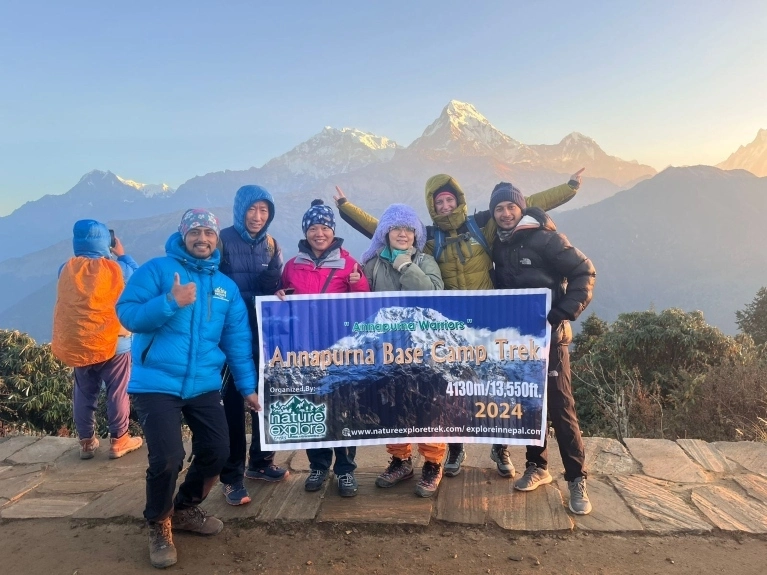
The Ghorepani Poon Hill Trek in November and December is a short and beautiful trek in Nepal’s Annapurna region. Ghorepani Poon Hill Trek is a beautiful short trek in Nepal’s Annapurna region, renowned for its Himalayan mountain vistas, verdant forests, and welcoming village hospitality. This trek is suitable for all kinds of trekkers and is consistently ranked among the most gratifying and accessible treks in Nepal. The pièce de résistance must be the Poon Hill sunrise, a 3,210-meter viewpoint that unfolds the whole glory of the Annapurna and Dhaulagiri mountain ranges.
Trekking in November and December offers a unique mix of cool mountain air, breathtaking views, and empty trails. These months follow the post-monsoon and precede the midwinter heavy snowfall, offering the perfect compromise for trekkers seeking beauty and solitude. In this guide, you’ll receive all the information you should know before setting out on the trek, including a daily itinerary, how to pack, estimated costs, required permits, and local travel advice so that you can enjoy a safe and rewarding Himalayan experience.
Weather Conditions in November and December
November Weather
November is regarded as one of the best months for the Ghorepani Poon Hill trek. The monsoon has ended, and the skies are remarkably clear with a clear mountain view. The weather is cool and pleasant, ideal for trekking, and the humidity decreases by a significant percentage, typically 30–35%, with excellent visibility. This is one of the driest months of the year in the region, and there are minimal to no chances of rai rainfall amounts to just 3mm throughout the month.
Temperatures are comfortable for daytime trekking, ranging from 10°C to 18°C in the lower elevations. In higher elevations such as Ghorepani and Poon Hill, daytime temperatures can drop closer to 8°C, while nighttime can reach between 0°C and 5°C. Though the nights are cold, the days are typically sunny with a decent 7 hours of daylight, allowing trekkers sufficient time to take in the vistas and make distance on the trek. The forests are still lush from the recent monsoon, and the golden light streaming through rhododendron and oak forests lends a magical quality to the trek.
December Weather
December marks the beginning of winter in the Annapurna region. As the temperatures fall below, especially at night, the trail begins to take on a different character. Day temperatures can fluctuate between 5°C and 15°C, but the nighttime temperatures frequently fall below freezing point, especially in Ghorepani and the higher sections such as Poon Hill. Though the days still remain clear for the most part, the cold sets in more severely, and you can anticipate snowfall at the higher altitude sections that turns the trail into a quiet, white wonderland.
Snow will make parts of the trail icy or slippery, particularly on early mornings or in shaded areas, and trekkers will need to proceed with more caution. The added difficulty is more than worth the payoff, however. The mountains are even more breathtaking with snow peaks against the crystal-clear sky, and the off-season silence contributes to the sense of isolation and natural grandeur. With fewer trekkers along the trail, December offers a more contemplative, soul-moving experience perfect for people who wish to seek solitude and peace in the mountains.
What to Pack for Cold Weather
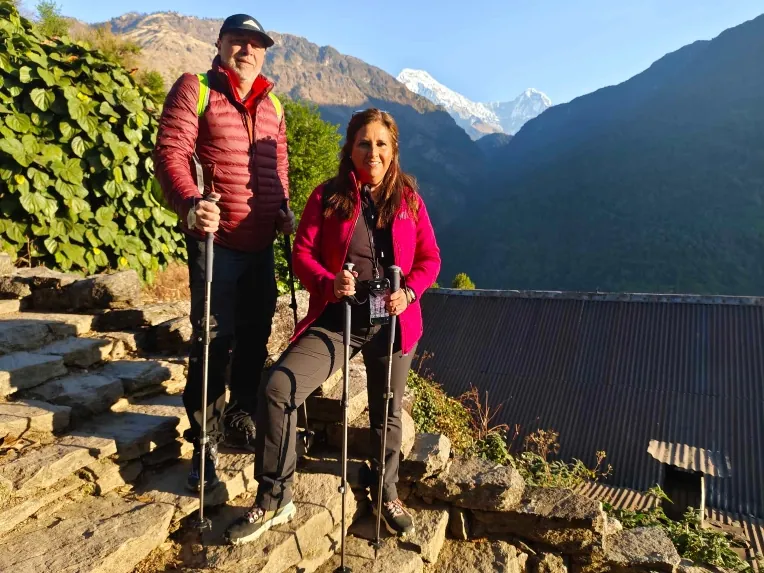
It’s critical to pack the right gear for a trek during November or December to remain comfortable and safe in the cold weather. The secret to clothing during this time of year is layering. Your base layers need to be moisture-wicking thermal tops to prevent sweat from coming into contact with your skin and to help retain heat. A decent mid-layer like a fleece or insulated jacket provides warmth, and a quality down jacket serves as your main insulator in cold weather.
Your outer layer needs to be windproof and waterproof especially important if you get snowfall or cold high-altitude winds. Waterproof hiking trousers and a rain jacket or hardshell will protect against wind chill and snow. Gloves (preferably insulated and waterproof), a warm beanie or hat that covers your ears, and a buff or neck gaiter to cover your face in bitter winds are also vital.
Footwear: Shoes need to be warm, waterproof, and broken-in hiking boots with strong ankle support and rubber boots with good tread. Waterproof boots are highly recommended. Warm, moisture-wicking socks are essential bring at least 3–4 pairs. In December, crampons or microspikes are helpful in icy areas, especially for the pre-dawn hike to Poon Hill. Trekking poles provide extra balance and are helpful for both ascending and descending, especially on uneven, snowy ground.
Accommodation on the trek is in teahouses, which are only slightly heated. A sleeping bag rated at least -10°C is required for this. Most teahouses will have blankets, but these are not sufficient on their own on colder nights. Bring also a headlamp with spare batteries, sunscreen, sunglasses (for snow glare protection), lip balm, water purification tablets or filter bottle, and personal toiletries. Power banks are useful since charging facilities may not be available or are at an extra charge in teahouses.
Ghorepani Poon Hill Trekking Itinerary (5–6 Days)
What follows is a day-by-day Ghorepani Poon Hill Trek itinerary that offers a mix of natural beauty, culture, and moderate adventure.
Day 1: Drive to Nayapul, Trek to Ulleri
You begin the trek with a scenic 1.5-hour drive from Pokhara to Nayapul, the starting point of the Annapurna Conservation Area. From Nayapul, you start trekking on a relatively flat path through the green farmland, river gorges, and village settlements. The trail soon ascends to Tikhedhunga, a small riverside village. If you’re up for the challenge, you can hike the steep stone-paved steps (more than 3,000 steps!) to Ulleri. The hike is difficult but rewarding, with wonderful vistas and a quieter atmosphere in the evening.
Day 2: Trek to Ghorepani
From Tikhedhunga or Ulleri, the trail continues upwards through dense forests dominated by rhododendron, magnolia, and oak trees. The path is well-worn, and the trees thicken and grow more enchanting as you ascend. The final climb in to Ghorepani is cold, but the village itself is a good place to rest. Clothed at the base of the mountains, Ghorepani possesses fine teahouses and a cozy atmosphere. At sunset, you will see your first glimpses of Dhaulagiri and Annapurna South smoldering red and orange in the fading light.
Day 3: Early Morning Hike to Poon Hill, Trek to Tadapani
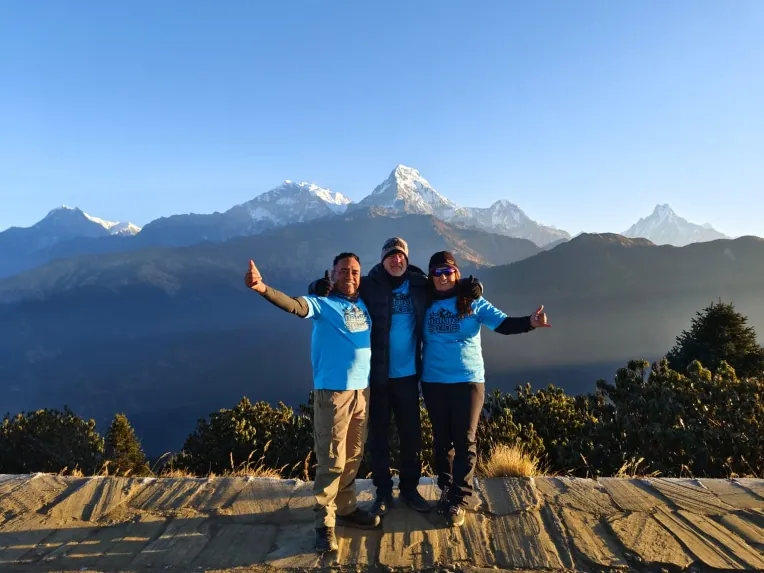
Before dawn, you’ll begin the climb to Poon Hill, a popular viewpoint situated at 3,210 meters. The 45–60-minute climb is steep but manageable with a headlamp and warm layers. At the top, you’re rewarded with an unforgettable sunrise that illuminates a wide stretch of the Himalayas, including Annapurna I, Annapurna South, Dhaulagiri, Machapuchare (Fishtail), and more. Following sunrise intake, you will return to Ghorepani for breakfast, from where you can begin your trek to Tadapani. The trek has gentle ups and downs along ridges forested, with constant sights of the mountains peeking through the trees.
Day 4: Trek to Ghandruk
The trek from Tadapani is down through beautiful forest trails. This route is less populated and normally gives you chances to hear birds and glimpse wildlife. After a couple of hours, you reach Ghandruk, a large and culturally significant Gurung village. Ghandruk is renowned for its panoramic view of Annapurna South, Hiunchuli, and Machapuchare. You may also visit the museum and study traditional Gurung dress, customs, and daily life. This is a comfort stop where you can experience comfort and culture.
Day 5: Trek to Nayapul, Drive Back to Pokhara
Your final day is spent walking gently downhill through terraced countryside and villages to Nayapul. The route is quite straightforward and mostly downhill, allowing you time to reflect on the experience. From Nayapul, a vehicle drives you back to Pokhara where you can treat yourself to a well-earned meal and the comforts of lakeside hospitality.
Cost of Ghorepani Poon Hill Trek in November–December (2025)
Budget Trek
For budget travelers, the total cost of the Ghorepani Poon Hill trek can range between $300 and $500 per person. This also includes simple tea house accommodation, local food like dal bhat, and shared transport from Pokhara to Nayapul. Hiring a guide or porter is optional, though highly recommended for beginners or December when trails are likely to be slippery. Budget about $20–$25/day for a porter or guide, and tipping (roughly $10–$20/day) is discretionary. Budget trekkers can expect a more independent but rewarding experience.
Midrange Trek
A midrange experience typically costs between $600 and $900. This includes upgraded accommodation, full board meals, licensed guides and porters, and private or tourist-class transportation. In this category, you’ll have more comfort—cleaner rooms, better food variety, and an agency that arranges permits and logistics. This option offers a great balance between cost, comfort, and support, making it a popular choice among international travelers.
Luxury Trek
For complete comfort, luxury packages start from $1,000 and go up to $1,500 based on the extent of services included. The treks involve private jeeps or helicopter transport, top-rated Pokhara hotels, high-end lodges or boutique-style teahouses en route (with private bathrooms and hot showers), and a personalized team of guide, porter, and staff. Meals are organized, snacks and beverages included, and arrangements settled nicely. This is the best option for those who want a luxury trekking experience with minimal effort.
Permits Required
Two permits are required to trek in the Ghorepani Poon Hill area: the Annapurna Conservation Area Permit (ACAP) and the Trekker’s Information Management System (TIMS) card. The ACAP is NPR 3,000 and goes to the conservation efforts in the Annapurna region. The TIMS card is NPR 2,000 and secures your data for the purpose of safety and tracking. The permits are available at the Nepal Tourism Board office in Pokhara or Kathmandu or can be obtained through trekking agencies. The permit checkpoints are present along the trail and are to be produced if asked.
Highlights of the Ghorepani Poon Hill Trek
The sunrise on Poon Hill is undoubtedly the crowning glory of the trek, with an unbroken chain of Himalayan giants stretching out in all directions. But outside the mountains, the trek offers exposure to Nepal’s diverse landscapes from lush forests and waterfalls to remote mountain villages and slope fields. Ghorepani, Tadapani, and Ghandruk villages offer real experiences of local culture, with friendly, warm inhabitants, traditional houses, and home-cooked food. The forests, especially in November, are full of life, and December offers the possibility of snow making the ground white a serene winter wonderland.
Travel Tips for November and December Trekking
To get the best out of your hike in November or December, it is advisable to begin early in the mornings to utilize scarce daylight hours. Tea houses tend to become full in November, so booking in advance is advisable, while in December a few lodges are closed—check ahead of time. Warm clothes should always be carried along with you, and one should be ready for rapid temperature fluctuations, particularly at night or dawn.
December should bring snow and ice, and stability and security could be provided by trekking poles and crampons or microspikes. Carry enough money for the whole trekking because there are no ATMs along the trail and the tea houses prefer cash. Water should be drunk regularly even in cold weather, and the pace should be consistent while walking to stay away from exhaustion and altitude issues. Finally, inspect the road and trail conditions prior to departure, as winter weather can sometimes interfere with travel to and from Nayapul.
Conclusion
The Ghorepani Poon Hill Trek is the best of Nepal’s short treks, particularly in the late fall and early winter months of November and December. With crystal-clear skies, breathtaking sunrises, and serene trails, this trek presents an unforgettable combination of nature, culture, and Himalayan majesty. Whether you’re a budget-conscious traveler or a luxury seeker, the Ghorepani region welcomes you with open arms, beauty, and serenity. November is perfect for those who prefer to enjoy perfect weather and colorful landscapes, and December rewards the brave with white trails and serene mountain villages a true winter wonderland in the heart of Nepal.