
 English
 Dutch
Dutch Japanese
 Hindi
Hindi Italian
 Spanish
 French
 German
 Chinese
 Korean
 Arabic
 Hebrew
 Russian
 Portuguese
 Danish
 Czech
Czech Polish
 Swedish

250 reviews in 


14
Days
Days
US$ 1400Per Person (Group Size: 2 - 25)
Group Discounts- Best price guaranteed
- Secure & easy online booking
- Flexible booking dates
- Decades of experience
- No. of Pax Per person
- 2 - 3 peopleUS$ 1450
- 4 - 7 peopleUS$ 1400
- 8 - 10 peopleUS$ 1350
- 11 - 13 peopleUS$ 1300
- 14 + people 9999 US$ 1250


- No. of Pax Per person
- 2 - 3 peopleUS$ 1450
- 4 - 7 peopleUS$ 1400
- 8 - 10 peopleUS$ 1350
- 11 - 13 peopleUS$ 1300
- 14 + people 9999 US$ 1250
Have Questions?




At a Glance

Duration
14 days
Destination
Nepal
Trip Difficulty
Moderate
Max altitude
5545m
Group Size
2 - 25 Pax.
Activity
Trekking,hiking & sightseeing
Accommodation
Hotel in Kathmandu, lodge & tea houses during the trek.
Meals
Breakfast,Lunch and Dinner during the trek
Vehicle
Private car \ jeep , bus and flightOverview of Everest Base Camp Trek Group Joins
Everest Base Camp Trek group joining package offers an incredible opportunity for adventure enthusiasts who want to explore the Everest region with like-minded trekkers. You can make millions of unforgettable moments with your group by choosing Nature Explore Trek for your next adventure. The trek is about 14 days as per our itinerary, which you can customize according to the group preference. There are many options like couples, friends, and families, and if you are interested, we can provide a small group to a large group to travel together. The trek typically starts from Lukla and passes through villages such as Namche Bazaar, Tengboche, and Dingboche before reaching the base camp and the best season to go for the trek is from march-may and from september-november.
Everest base camp is the highest peak in the world, standing at 8,848 meters (29,029ft). In Nepali it is called Sagarmatha and in Tibetan it is known as chomolungma (Goddess Mother of the World). Our 14 days Everest Base Camp (EBC) trek is one of the most valuable treks in the Everest region.
The 14 days of the Everest Base Camp trek will fulfill your dreams to reach the base camp of Mount Everest. The trek begins with the flight from Kathmandu to Lukla. You will either meet your guide and porter in Kathmandu or in Lukla. They will guide you to every terrain, route, and scenario. The trek begins with gradually descending to Phakding and the following day we head to Namche Bazar. Namche Bazar is the largest sherpa village with an altitude of more than 3400 m above sea level. It is a hub of khumbu region where you will rest for one day for high-altitude acclimatization.
A beautiful namche offers several facilities for trekkers, such as internet cafes, banks and medical facilities, so if you are short of money, want to buy some medicine, or want to update or contact your friends or families, make sure you do it on this day.
Leaving a namche, we will hike to Everest View Hotel at 3,880 m altitude and get a 360 degree view of Mount Everest, Ama Dablam, Lhotse, Nuptse and several other Himalayan monsters. And visiting several places like sagarmatha National park museum and artifacts of sherpa culture and customs.
After spending a day at Namche Bazar, we will hike to Tengboche, where we will visit a beautiful Buddhist monastery. Then we trek to Dingboche, acknowledging the wonderful view of Ama Dablam (6812 m) up close. After another rest day and acclimatization in Dingboche, we will continue trekking to Lobuche-Gorekshep. We spent one night at Lobuche and Gorekshep. Both are small Sherpa people settlements from where we will have an astounding view of Mt.Nuptse , Mt. Pumari, and Lobuche East peak in the distance.
The final stretch is from Lobuche to EBC via Gorakshep. In the Gorakshep, you can enjoy the Khumbu icefall at the head of the Khumbu glacier at 5364 m (17,999 ft). After reaching EBC then, the next day of the trek begins with the ascent to Kala Pathar viewpoint (alt. 5,643 m) early in the morning to catch a sunrise and from there, you can see an awesome scenario of the Himalayan mountains, including the Mt. Everest ranges in close distance.
Highlights of Everest Base Camp Trek Group Joins
- A scenic flight from Kathmandu to Lukla and Kathmandu. A scenic view includes panoramic views of Langtang, Ganesh Himal , Gaurisankar , Rolwaling valley and the Mt. Everest ranges in the distance.
- Busy Namche Bazaar (alt. 3400m) – it is one of the best places where we spend two nights and visit the local markets and hike to Everest View Hotel (alt. 3800 m). enjoy the panoramic views over Mt. Everest, Lotshe, Nuptse, Ama dablam , Lhotse, moreover, Explore the old monasteries and museums.
- Visit the serene monasteries and Mane – along the way to Everest base camp trek we cross several monasteries and museums, such as the Tengocohe monastery, Phorte monastery, Khunde monastery, Namche monastery and many more.
- The Everest region includes hundreds of mountain peaks surrounding: during the Everest base camp trek you can see the stunning views of mountains like Mt. Everest, Lhotse, Nuptse, Mt. Ama Dablam, Pumari, Tawache, Lobuche peak , Island peak , Thamserku, Kusumkangaru, Kongde peak many more in the close distance.
- Stretch at the iconic Mt. Everest base camp at an altitude of 5364 m from sea level. After a week-long trek from Lukla, we reached the base camp of Mt. Everest. Dreams come true when you successfully reach the world’s highest mountain base camp.
- Hike to the kalapather viewpoint (alt. 5550m) – Kalapatter viewpoint is the closest viewpoint to see Everest at both sunset and sunrise over the mountains.
- Explore the sherpa culture and their basic lifestyle—along the way to Everest base camp trek, we’ll cross the several traditional sherpa villages like Khumjung, Dinboche, Phakding, Phortse, Pangboche, Thame, and many more
- Meet new people and share the experience of trek to Everest base camp with the local guide and porter.
Itinerary
01
Day 01 Arrival in Kathmandu and transfer to your hotel
One of the representatives from the Nature Explore trek will come to pick you up at the airport and drive you to the hotel, where you can rest.
In the Evening, we will meet you at the hotel to clarify about the trek. And the introduction with the guide who is guiding you from Kathmandu to EBC (Everest Base Camp).
Max altitude
1300mMeals
Breakfast, Lunch, DinnerAccommodation
Hotel02
Day 02 Trip preparation and Kathmandu Valley Sightseeing
You can pack necessary equipment and warm clothes. And we will arrange all the necessary permits and flight tickets for the trek.
We will take you on a tour of Kathmandu’s historic sites, including Durbar Square, Boudhanath, and Pashupatinath Temple.
Max altitude
1300mMeals
Breakfast, Lunch, DinnerAccommodation
Hotel03
Day 03 Fly to Lukla and trek to Phakding, 30-35min, alt.2,610m, 3-4 hrs
Today we are taking a flight from Kathmandu to Lukla and starting our trek to Phakding, a small village of khumbu region in the Dudh Koshi.
Duration
3-4 hrsMax altitude
2,610mMeals
Breakfast, Lunch, DinnerAccommodation
Local Teahouse04
Day 04 Trek from Phakding to Namche Bazaar, 3,440 m, 3-4 hrs
Today’s trek will be strenuous. We will begin our trek after breakfast. We will go through the trail through the flora and fauna, forests of pine and rhododendron.
We will cross several bridges of the Dudhkoshi river. You will pass through the Toktok, Monjo, and Jorsalle villages. After a long ascent, we will arrive at Sagarmatha National Park, where permits will be checked. The trail takes around 2 hours to reach namche after crossing the Hillary suspension bridge. Right Before Namche,There is a viewpoint where you can see your first glimpse of Everest, if weather permits.
Namche is a town full of energetic Sherpas. It is the biggest city along the Everest Base Camp, where you can see trekking gear shops, bakeries and much more.
Duration
3-4 hrsMax altitude
3,440 mMeals
Breakfast, Lunch, DinnerAccommodation
Local Teahouse05
Day 05 Rest day at Namche Bazaar, 3,880 m, 3-4 hrs
Today we will stay at Namche for acclimatization and do short hikes. We will hike to the Everest View Hotel.
known as the highest hotel in the world. Enjoy the hot cup of coffee while taking in a 360-degree view of the Himalayan monsters, including Mount Everest, Ama Dablam, Lhotse, and Nuptse.
We will also visit the Sagarmatha National Park Museum and also explore the old monasteries. In the
In the afternoon, we will be exploring Namche’s Bakeries and market.
Duration
3-4 hrsMax altitude
3,880 mMeals
Breakfast, Lunch, DinnerAccommodation
Local Teahouse06
Day 06 Trek from Namche Bazaar to Tengboche,3,860m, 5-6 hrs
The trek will start from namche with breathtaking, continuous views of Everest, Lhotse, and Ama Dablam. After a continuous trek, we will descend to the bridge over the Imja river.
The trail will begin ascending through the forest. It takes around 2 hours to reach Tengboche. At the top, there is Tengboche monastery, which is also known as the largest monastery in the khumbu. From the top, sunsets are magical with the peaks glowing orange.
Duration
5-6 hrsMax altitude
3,860mMeals
Breakfast, Lunch, DinnerAccommodation
Local Teahouse7
Day 7 Trek from Tengboche to Dingboche,4,410m, 5-6 hrs
After stretching in the early morning, we will start our trek to Dingboche. Today we are passing through some villages: Deboche, Imja Khola Bridge, Pangboche, Somare, and Orsho. Until we arrive at Dingboche, we travel across enormous plateaus, passing forests and the first clouds.
Duration
5-6 hrsMax altitude
4,410mMeals
Breakfast, Lunch, DinnerAccommodation
Local Teahouse8
Day 8 Rest in Dingboche and hike to Nangkartshang hill, 3-4 hrs
Today we are hiking to Nangkartshang hill above 4,000 m-5,000 m altitude, where it offers a panoramic view of Makalu and Amphu Laptse. Along the way, we will travel through the pastures where yaks graze or stop at the Nangkartshang monastery. You can know more about the sherpa tradition, culture, and lifestyle of mountain people.
Duration
3-4 hrsMeals
Breakfast, Lunch, DinnerAccommodation
Local Teahouse09
Day 09 Trek from Dingboche to Lobuche, 4,910m, 5-6 hrs
Lobuche is the last destination of the trek to reach Everest Base Camp. Today we are crossing through many stupas in thukla hills, erected in the memory of sherpas who have lost their lives in expeditions. To reach Lobuche, we keep walking through the rocky, grassy landscape.
Duration
5-6 hrsMax altitude
4,910mMeals
Breakfast, Lunch, DinnerAccommodation
Local Teahouse10
Day 10 Trek from Lobuche to Everest Base Camp (5,364 m) and back to Gorakshep, (5,164m), 7-8 hrs
Today is the day you have been waiting for to fulfill your dream. Firstly, we will trek from Lobuche to Gorakshep, where we will put all backpacks and take a rest for a while.
After taking a rest, we will start our second trek of the day to Everest base camp. It is the base camp of the world’s highest mountain. Enjoying the Khumbu glacier and surrounding peaks. After all, we will return to Gorakshep for an overnight stay.
Duration
7-8 hrsMax altitude
5,164mMeals
Breakfast, Lunch, DinnerAccommodation
Local Teahouse11
Day 11 Early morning hike to Kala Patthar viewpoint (5,545 m) and back to Gorakshep, trek to Pheriche (4,371 m), 6-7 hrs
We will start the hike early in the morning to reach the Kala patthar viewpoint to view the Sunrise. We will also get a panoramic view of Mt. Everest (alt. 8848m) Nuptse (alt. 7930 m), Lhotse (alt. 8516 m), Mt. Ama Dablam (alt.6812m), Mt. Cholaste (alt.6440m) including many beautiful Himalayan peaks around. After that, we will return back to Gorakshep and head to Pheriche for an overnight stay.
Duration
6-7 hrsMax altitude
5,545 mMeals
Breakfast, Lunch, DinnerAccommodation
Local Teahouse12
Day 12 Trek back to Namche Bazaar, 3,440m, 6-7 hrs
From today we will be constantly descending to return to the capital of the country. We will continue hiking along the well-known route that will return us to Dingboche, Tengboche, and Namche Bazaar, where we will spend the night after warming up and eating breakfast.
Duration
6-7 hrsMax altitude
3,440mMeals
Breakfast, Lunch, DinnerAccommodation
Local Teahouse13
Day 13 Trek back to Lukla, 2,860m, 6-7 hrs
Today, we will trek to the domestic airport from the Namche bazar. We will again cross all the bridges and continue the trek to lukla for an overnight stay.
Duration
6-7 hrsMax altitude
2,860mMeals
Breakfast, Lunch, DinnerAccommodation
Local Teahouse14
Day 14 Fly back to Kathmandu
Today is the day our trek will end after reaching Kathmandu. Once again, we will take a domestic flight from Lukla to Kathmandu. After reaching Kathmandu, you can shop around Thamel and buy gifts for your friends and family before you go to your native land. Overnight at the hotel in Kathmandu.
Duration
30-35 minMax altitude
1300mMeals
BreakfastAccommodation
Hotel
Is this offered itinerary not suitable for you?
Inclusion/Exclusion
What's Included?
- Airport Pickup and drop-off (Car/ Jeep/ Bus as a group size).
- Hotel in Kathmandu, including breakfast as per the itinerary.
- Three Times Meals a day during the trek (Breakfast,Lunch and Dinner).
- 1 cup of Hot Drinks (Tea or coffee) after each meal.
- Seasonal fresh fruits
- Flights from Kathmandu to Lukla and back (Note: Flight will be from Ramechhap Airport during the autumn season (October–November) and spring season (March–April). The round trip includes a 4-hour drive from Kathmandu to Ramechhap.
- Through Ramechhap, a public shared bus/van/jeep is included; if you want to go through a private vehicle, an additional USD 90–120 will be charged after deducting the public transport cost.
- Accommodation throughout the trek in normal twin-sharing basic room
- Professional English Speaking guide
- All the necessary airport pick up and drop
- Sagarmatha National Park Entrance Fee
- Khumbu-Pasang Lhamu village municipality fee
- TIMS card
- Basic Medical kit bag
- Treat drinking water.
- All necessary trip arrangements
- Last night dinner after the trek.
What Nature Explore Trek provides
- T-shirt and Cap as a gift
- Trekking successful Achievements Certificate
- Duffle bag (To be returned after the trek)
- Down-Jacket (To be returned after the trek)
What's Excluded?
- International Airfare
- Personal Insurance (Incase of Emergency only)
- Trekking equipment
- Porter
- Extra night in a hotel and lunch and dinner in Kathmandu
- Bar Menu like coke, sprite, beer, etc.
- Personal expenses such as Wi-fi, extra snacks, laundry, Hot shower, battery charge during the trek.
- Not mentioned in the itinerary or above include section
- Tipping the guide or porter
Note: You can also choose the helicopter option for the flight from Kathmandu to Lukla and Lukla to Kathmandu. This is the best option in case of flight cancellations, tight schedules, or other unforeseen situations. Since the flight is included in the package, the cost of the helicopter for one way will be covered, but for the return trip, an additional charge will apply.
Trip Information
Why choose the group joining the Everest base camp trek?
Advantages of joining a group trek to Everest base camp trek :
- Lower budget: joining a group, you will save the balance, as the trek cost will be shared in Guide , transportation, Porter , Accommodation at teahouse, etc.
- Meet like-minded people—As a solo travelling to Nepal planning to trek to Everest base camp you will have a good opportunity to meet new people and you have good chances to share adventure trekking and climbing experiences, etc.
- Fixed departure dates & Itinerary – Trekking to Everest base camp in the group the departure dates and itinerary are fixed already. So if you are looking for a group join a trek, let us know the your interesting departure dates and season
- Safety – in the group you feel safer, especially in higher sections of the trek. When we need someone to help in an emergency situation in the group, there are more people and strong manpower so it can be a quick service to take you to a safe place or evacuate.
- Pre-booking Teahouse—if you are in the group, this will be much more reliable for booking the teahouse and more secure for booking in the mountains in a group.
- Professional guides and strong supporting porters—as a group, more experienced guides will lead the group share the culture, adventure experience and traveling history with new people you meet on this trek.
Disadvantages of joining group trek to EBC
- Higher cost- as you plan to go private, the trek cost is expensive, as you have to cover basic expenses such as transportation, guides, porters, Accommodation, permits in restricted area like in Manaslu, Upper Mustang, Upper Dolpa
- The group’s preplanned No customized itinerary—since you are planning to go in a group, the itinerary is fixed already, as it should match all group members’ time frames. And you can’t customize it in the middle of the trek because the trip is already planned as per the group’s preplanned international flight schedule. We can change the itinerary if all members agree on the new plan.
- Not the same fitness level; as you are joining the new travelers, you don’t know until the trip departure so it may not have the same fitness level sometime. When you hike, you may be faster than them or slower and it makes others wait.
- Limited choice in food and accommodation: as you trek in a group, especially in the peak season, the meals can be ordered in the group for fast service and make it less of a wait. Which you may not like the test, especially at lunchtime.
- Accommodation: you have to share the room with another group member, so it may not be comfortable if you are one of those who prefer a private room.
- Missed the side trips, which are not included in the itinerary. When you are in a group, you have to follow the itinerary so if you want to do the side trips that are not included in the itinerary, you may miss those trips, like extended trips to Gokyo valley , cross high passes like Chola and Renjola. Make an extra night stay in some nice places, etc.
Best months to trek Everest (EBC) in 2026–2027
The best months (seasons) to go to the Everest base camp trek in a group are early September, October, November and December, and the spring season March, April and May, is a good time to trek to bed.
Autumn season: The autumn season starts in September after the monsoon ends. The autumn season in Nepal brings green landscapes, reliable temperatures, sunshine, and clear visibility of mountains, landscapes, and hills in the distance. Moreover the season is known as the festive season in Nepal as a number of popular big festivals are celebrated in this season like Dashain, Tihar, Chhat, Lhoshar, Mane remdu
Spring season: the spring season starts after winter ends from March, April, May and mid-June every year. Spring offers a warmer temperature , more dryness and drizzling, and light snow in the afternoon. As the new season begins new seeds, the forests and every single tree changes the new leaves with the beautiful smell of new followers’ seeds.
Here is the monthly weather report for Everest basecamp trek:
Everest base camp trek in September:
September is the beginning of the season and the monsoon ends. The landscapes and trails are covered with greenery and still muddy, and sometimes it can be rainy and cloudy. As the weather is unpredictable and global climate changes, we can’t guarantee exactly 100%, but we can tell you based on the past years experience that normally from mid september the weather is good and visibility is clear. So we recommend trekking to Everest base camp in September.
Everest base camp trek in October:
October is the best month to trek to Everest base camp, as the weather is favorable like sunshine, clear visibility, and reliable temperature. As we have experienced for the past 5-7 years, in early October the weather is still rainy and cloudy. After the mid october its changes are clear and it makes everyone feel that autumn is back with the clear weather and sunshine.
The temperature in the lower section of the trek during October is 15-18 degree celsius during the daytime and falls to 7-9 degree celsius and the higher section of the trek, like around the Everest base camp, is 10 – 12 degrees during the daytime and falls to 3-5 degree celsius. So overall, October is the best time to do the trekking to Everest base camp.
Everest base camp trek in November:
November is highly recommended to all adventure lovers, as the weather is much clearer, with blue skies, clear visibility, and no flight cancellations to Lukla—return to Kathmandu as the weather is good. If you are a photographer or making some nice pictures and videos from the Mount Everest regions, November is the best month to do the Everest base camp trek.
The temperature will fall slightly cooler than in October, as we are one way to the winter season in Nepal. Lower sections of the trek at daytime 9- 12 degree celsius when sunshine and at night time falls to 5-7 celsius and higher sections of the trek falls to 6-8 at daytime and night time falls to -5 -10 around the Lobuche , Goekshep . Moreover, at Basecamp, Kalapatter viewpoint hikes can be more chill and the temperature falls to -15 – 20 if it has winds and no sunshine during the daytime while you hike to explore the views.
Everest base camp trek in December:
Joining the Everest basecamp group trek is an ideal plan for those travelers who have no time to trek to EBC in October , November . Although the temperatures will continue to drop, resulting in colder weather, the weather remains mostly dry, stable and clear, offering a great view throughout the trek. December is known to have a low crowd, so for those people who want to have their quiet trek, it is an excellent month to enjoy the Everest region at a slower pace with peaceful trails, easy accommodation options and uninterrupted mountain views.
While trekking in December, make sure you pack enough warm clothes, as it’s very cold in the Everest region other than that, there might not be a problem trekking in December. Please note that in December there is no flight to Lukla, so you have to drive all the way.
In December, the temperatures on the Everest Base Camp trail become noticeably cooler. The lower section of the trek remains pleasant during the day, ranging between 9°C and 12°C,While in the nighttime it drops to around 5°C–7°C. As you move higher toward Dingboche, Lobuche and Gorakshe, the daytime temperature falls to about 6°C to 8°C, and the nighttime temperature can reach –5°C to –10°C. At Everest Base Camp and during the Kala patthar viewpoint it gets colder; especially when there is wind or no sunshine, the temperature drops to like –15°C to –20°C.
As the whole world is facing global warming, weather in the Everest region is also being affected, so now these 2 , 3 years we are experiencing good views even in December the sky is clear. For sure, morning and evening become colder but daytime weather is perfect for trekking. As December is a festive season, make this season more meaningful by celebrating it with your loved ones in Everest Base Camp
Everest base camp trek in March:
March marks the beginning of the trekking season to Everest Base Camp Trek. The weather becomes gradually warmer as the snow starts to melt at lower altitudes. In early March, the trails might be slightly icy or cold, especially at the higher elevations. However, in late March, the condition becomes more favorable. The sky is mostly clear, with a perfect view and favorable weather to trek.
During the March season, the temperature on the lower section of the trek ranges from 12 to 15°C during the day and at nighttime night time it drops to 3–5°C. At the higher altitudes near the Everest BaSE Camp , daytime temperatures range from around 5-8 degree celsius in the daytime and -2 to 0 degrees in the nighttime. Overall, March offers a quieter trekking experience. You will also see the first signs of spring as rhododendrons and other alpine flowers start to bloom. It’s a perfect month for the trekkers who want to enjoy the serene landscapes with the chance to encounter the flora and fauna.
Everest base camp trek in April:
April is widely considered as one of the best months to trek to Everest Base Camp. The weather is stable and favorable with clear skies, sunshine and excellent mountain visibility. The rhododendrons are in full bloom, painting the valleys in vibrant shades of red, pink and orange. The temperatures are warmer than in March, making the trekking more comfortable while still cool enough to avoid all the fatigue.
As for the temperature in the daytime its between 15–18°C and nighttime temperatures are 5–8°C. In higher regions, such as around Everest Base Camp, daytime temperatures range between 8–12°C and nights drop to 0–3°C. April is also ideal for those people who want to encounter the flora and fauna and for the photographer, as the contrast between the blooming flora and towering snow-capped peaks is breathtaking. The combination of moderate weather, beautiful scenery and increasing daylight makes April a very popular month for the Everest trekkers.
Everest base camp trek in May
May is yet another excellent month for trekking. The weather is generally warm, dry, and sunny with the long daylight hours. Visibility is usually excellent, allowing trekkers to fully appreciate the stunning view of the Himalayas. Snow at higher elevations may still remain in some areas, which advantageously adds to the dramatic scenery.
In the lower section, daytime temperatures range from 16 to 20°C, with the nighttime being around 8–10°C. Higher regions has the daytime temperatures of 10–14°C and nighttime temperatures dropping up to 2–5°C. May is perfect for those who want to enjoy the warmer weather with lush green landscapes. The trails are busy in these months, as it’s the
To trek around this time the trails are busy, especially near the popular stops like Namche Bazaar and Tengboche but the good weather and stunning views make it worthwhile. Additionally, trekkers often encounter a variety of wildlife and alpine flora in full bloom which makes the journey even more rewarding.
Everest base camp trek in June:
June marks the start of the monsoon season in Nepal. While trekking is still possible, it kind of becomes challenging due to the rain , cloud cover and occasional landslides in the lower regions.
In early June there will not be that much rain so the trails will not be as muddy and slippery as in late June . Mountain views are often obscured but when the skies are clear, you will see the best views, as the landscapes are full of lush greenery and vibrant.
Lower regions have daytime temperatures of 18-22 degree celsius and nighttime temperatures of 10-12 degree celsius . Higher altitudes will experience daytime temperatures of 12-15 degrees and nighttime temperatures of 5-8 degree celsius.
Trekkers who are trying to attempt Everest Base Camp in June should be well prepared with waterproof gear, trekking poles for the slippery sections and patience for the reduced visibility
Despite the challenges, the trails are less crowded, which will allow for a more solitary experience on the mountains. This month is ideal for trekkers who are seeking adventure and off-peak experiences.
Everest base camp trek in July
July is the peak of the monsoon season. Trekking to the Everest Base Camp is possible but might be difficult, resulting because of the strong winds, heavy rain and frequent clouds that cover up the visibility and the trails are often muddy and slippery. Trekkers have to make sure they have the proper equipment with them and throughout the trail you will encounter the leeches so be careful while walking on the trails. In the lower sections daytime temperatures range from the 20-24 degree celsius and the nighttime temperatures are around 12-14 degree celsius . At the higher elevations daytime temperatures are about 14-16 degree celsius and the nighttime temperatures drop to up to 7-10 degree celsius .
Everest base camp trek group join fixed departure dates for 2026 and 2027
Following are the fixed group departure dates for the Everest base camp trek—2026 & 2027.
Spring season:
March: 7, 16, 25, 30 April: 5th, 13th, 21st, 27th, 30th
May: 1st, 10th, 18th, 25th June: 2nd 8th
January: 2nd, 15th February: 5th, 18th
Autumn season – 2026
September: 4th, 12th, 21st, 27th October: 2nd, 7th, 13th, 18th, 23rd, 28th
November: 1st, 5th, 11th, 17th, 22nd, 27th December: 3rd, 9th, 15th, 26th,
Fixed group departure dates for Everest base camp trek – 2027
Spring season – 2027
March: 7, 16, 25, 30 April: 5, 13th, 21st, 27th, 30th
May: 1st, 10th, 18th, 25th June: 2nd 8th
Autumn season – 2027
September: 4th, 12th, 21st, 27th October: 2nd, 7th, 13th, 18th, 23rd, 28th
November: 1st, 5th, 11th, 17th, 22nd, 27th December: 3rd, 9th, 15th, 26th,
Above mentioned months and dates are when we depart with the group to Everest base camp trek. If any of you are interested in joining a trek, feel free to contact us. If you are group leaders or looking for a private trek solo or couple we still organize it. You can choose your own departure dates and month to trek to Everest base camp trek.
The Everest base camp trek group joins package costs for 2026 and 2027.
The Everest base camp group joins the 2026 and 2027 treks; the cost depends on the group size. Generally, the cost starts from USD 1350 to 1450 per person. The cost depends on the service that you want to include in the package. And alternatively, you can only hire a guide and porter and the rest of the trip expenses you can pay yourself too.
Here is the cost difference in the full board package as per the group size for 2026 and 2027.
| S.N | Number of People in Join Group | USD – Per Person | Starts & Ends |
|---|---|---|---|
| 1 | 2 – 3 people | $1450 per person | Kathmandu – Kathmandu |
| 2 | 4 – 7 people | $1400 per person | Kathmandu – Kathmandu |
| 3 | 8 – 10 people | $1350 per person | Kathmandu – Kathmandu |
| 4 | 11 – 13 people | $1300 per person | Kathmandu – Kathmandu |
| 5 | 14 – 16 people | $1250 per person | Kathmandu – Kathmandu |
Safety & acclimatization plan
When you plan to go to the Everest basecamp trek, no matter if in a group or solo, private, safety and acclimatization are good plans that play the key roles in making the trip a hundred percent successful. For safety and security, please choose the right reputable company and an experienced guide who has knowledge about this trek and who can organize properly. When you trek with the local experience guide who has knowledge about first aid, and past experience leading a group and can quickly understand any difficult situation and make a good decision to save the group members from difficult moments.
Acclimatization is very important to do while we do the Everest basecamp trek. We always pulse the few extra acclimatization days during the Everest base camp trek as such in Namche bazaar alt. 3400m and Dingboche village alt. 4410m and do the hikes at higher elevation and return down to the teahouse, which is helpful to digest the altitude. When you reach higher elevations of this trek everyday go to the short ascent from your teahouse. This makes you sleep well as you reach higher elevation, and then you sleep tonight.
Logistics & flight details
Everest Base Camp group join the trek when you plan the first stage of the process of this trip, you have to send us 15% of the trip in advance and a copy of your passport. As we need to know it for the pre-booking of the trip, necessary arrangements such as lukla flights are tight in the high peak season, so we have to book in advance to get tickets to Lukla on time as well as make the trip necessary arrangements.
In the main season like in October and November, and in the spring season, March and April, you have to go through the Ramechhap airport. It is a 5-hour drive from Kathmandu. Then take a short flight to lukla. But in September, at the end of November, and in December, May, and June, you can still fly directly from Kathmandu to Lukla. In case of a flight delay or cancellation due to the poor visibility, then we have to wait for another day or a new schedule. We always recommend you have extra days before the trek starts and at the end of the trek.
Fitness & experience required for Everest camp trek
For Everest base camp trek, you need to have a minimum good level of fitness. Minimum you can do the 4-5 months of basic training, such as running, hikes, Yoga, go on high and long hikes every month if possible in the higher altitude elevation with a backpack. I highly suggest doing good exercise to prepare for the Everest base camp trek, which can be very helpful to end the trek with a 100% successful trek.
Everest base camp trek group Joining a trek does not require past experience of high-elevation treks, but if you have done some treks or you have good experience with them, then it could be a big help for you. From beginners to senior and child trekkers, anyone can do this trek but you need to have good mental and physical preparation and a good itinerary plan with an expert guide and strong porters.
Packing checklist
Packing list for group trek Everest camp, we basically provide you with a clear, useful list. Unnecessary clothes and gauze that you don’t use on the trek then you can store in Kathmandu. The Everest base camp trek clothes required as per the time and season you are trekking to Everest base camp here is the short, basic, important list for you.
- Trekking boots,
- Backpack 70-80 liters
- Day backpack 25-35 liters
- Trekking Map
- Warm, heavy jackets pulse waterproof / extra windproof jackets
- Pairs of warm trousers
- 1 warm sweater and extra light jackets
- Pairs of warm socks and think pairs socks
- Six-month veiled Passport
- Sleeping bags – 20
- Think liner
- pairs of Short t-shirt and 1 pair of half pants for the lower section of the trek
- Inner thermal
- Warm Gloves
- Sunscreen and sunglasses
- Trekking poles
- First aid kit bags
- Toiletries
- Water bottle
- Cash nepali rupees to extra expenses on the trek, Etc for more details please go through the link
Complementary those items, we provide you if you book your trek with us
- Warm down jackets (returnable at the ends of the trek)
- -20 sleeping bags (returnable after the trek)
- Trekking map
- Duffel bags—you can convert your suitcase into the duffel bags
- T- shirt , Cap , farewell Dinner, etc.
Everest Base Camp Trek Difficulty
Everest base camp trek is a medium-difficulty trekking route. It is a popular, beautiful adventure route that provides you with enhanced views of the Everest region’s mountain views and explores the traditional sherpa culture and amazing landscapes you have to get ready to do this trek. Every day you have to walk 6-7 hrs and altitude varies every day 400m to 500m ascent as per the general itinerary, which demands difficulty as you are traveling from sea level and trekking directly to higher elevation.
But if you are prepared both physically and mentally, you can do this trek comfortably and enjoyably. Since the everest base camp trek route lies in the higher elevation region of the mountain, and everyday jumps to different high elevations feel harder and challenge the trek, for the success of the full trek and to avoid basic issues during the trek we highly suggest basic training and preparation to avoid the severest base camp trek difficulty.
Joining an Everest basecamp group trek can be more difficult as you meet new travelers whom you never knew before; therefore, some trekkers have good trekking preparation and some may have less time to prepare and train for the trek. So when you don’t have the same level of fitness, it can matter and add more difficulty, like you have to wait for them or others have to wait for you while you hike to Everest base camp.
The best way to be good enough and strong enough for the trek is to join a basic exercise class at least 4-5 months before the trip start date, and you can do the basic exercise like Hike, Yoga , Runs every week 10-15km , do cardiovascular training; and do the long hike every month which can be the good way to be ready for the everest base camp trek.
Moreover, mentally you can also prepare yourself for the Everest base camp trek as it’s a remote, basic route, especially in the higher section of the trek. you may not find the good facilities of rooms, toilets and food. If you are already prepared mentally, then you don’t feel difficult in basic facilities at teahouses like in Tengboche, Lobuche and Gorekshep.
Food facility during the Everest base camp trek
During the Everest base camp trek, you can choose the foods from the menu card everyday like continental food, mexican food, indian food, chinese foods and Nepali food.We suggest you choose the nepali organic fresh foods which grows in the mountains, like Dal bhat, rice, lentil soups, vegetables, pickles, etc. Chapati bread items, Potatoes, like veg fry, boiled, and deep-fried buckwheat breads, champa porridge ,Relduk soup Green vegetables like , Sag,cabbage, cauliflower, radish, carrot ,Didoo, etc., which basically we can get along the Everest base camp trek.
We encourage you to eat the organic fresh foods from the local kitchens along the Everest base camp trek. Your money directly goes to the locals instead of buying and eating packed food items. Packed food is all they have to buy from markets and pay to them; it can only save a small margin for locals. Supporting locals and saving the sustainable tourism we have, we have to support the locals’ products, which can save the basic lifestyle of mountain people. This is only our idea and suggestion but you can choose whatever you want to eat from the menu and what is available at the restaurants.
Accommodation
Basically in group join packages, we provide the twine sharing beds, and rooms and toilets are common. At the beginning of the trek and the end of the trek, you can get still-attached toilet rooms like in Phakding, Namche, and Dingboche. If you are looking for more special and comfortable luxury accommodation it is possible and we can book it for you at an additional cost.
Electricity
Along the Everest basecamp trek you can get electricity. But in Lobuche and Gorekshep they have solar panels.
Charging the mobile, Power backup –
Yes, you can charge them the additional cost, like 300 to 500 rupees for the full charge. The lower section of the trek can be cheaper and the higher section is expensive.
Wi-fi facility
Yes you can get the wifi during the Everest base camp trek at an additional cost like rupees 300 – 350 in the lower section of the trek and rupees 500- 600 in the higher section of the trek. You can also buy the mobile data packages, which work in most of the places.
Everest Base Camp Trek Permits required
On this trek two permits are required. One is sagarmatha national park permits which cost rs 3000 per person and another is Khumbu Pasang Lamu municipality permits, which cost rs 2000 per head. We obtain Sagarmatha national park permits in the nepal tourism office in kathmandu or we can also buy them at Manjo village. And village municipality permits we buy at lukla.
If you are going for peak climbs like Island peak , Lobuche peak, mera peak then you don’t have to buy the sagarmatha national park permits.
Lukla baggage limit & flight issues
Fly to lukla the baggage weight limit is 15kg main bag plus 7 kg of hand bags is allowed. In case you have more weight, then you have to pay the additional cost a little bit.
More often cooler flight issues come when it is cloudy in lukla , no visibility and winds. Sometimes it can be cancelled for the day and we have to wait for the new schedule on another day. If more days are cancelled for the flights, then you have alternative options: go by helicopter or by road via the Salleri-Kharikhola and Phakding.
Altitude sickness during the Everest Base Camp Trek
Altitude sickness is acute mountain sickness (AMS). The altitude sickness starts after 2500m above sea level. Anybody can feel it anytime when we reach the higher elevation of the trek. No matter if you are experienced or beginner trekkers, we can feel it. Some people quickly accommodate and some do not. Its effects as per our buddy structures and who we adopt it from in that situation. Experienced trekkers can quickly adopt it and beginners feel it is hard and suffer more sometimes.
Early symptoms of altitude sickness:
- Headaches in the backside
- Vomiting
- Dizziness
- Not appetite
- Confusion
- Weakness, etc.
- Avoiding altitude during the Everest base camp trek
- Walk slowly.
- Flexible itinerary, add extra acclimatization day
- Drink more water
- Quite smoke and alcohol drinks
- Eat the healthy food
- Listen to the guide.
- Share with teammates or guide if you feel it.
If someone catches it, then you have to tell your partner or guide. If you don’t tell anyone and keep walking uphill with feeling, it can be more dangerous and harmful to your health. If anyone feels it first, they descend 400 – 500m and eat garlic soup, more warm water, etc. we have also taken on the trek basic medical kits bags. If you do not feel better, then we will take you to the nearest hospital, and as per the doctor’s suggestion, we will take care of you. The last alternative option is to evacuate to a good hospital if anyone gets more serious.
Everest Base Camp Trek Viewpoints
There are many viewpoints during the Everest Base Camp Trek, such as:
Namche bazar viewpoints(3,880m): Your first real view of Mount Everest . From this hill above the Namche you will see the Everest, Lhotse, Nuptse and Ama Dablam rising together.
Hotel Everest View (3,880m): After a short acclimatization hike from the Namche. This viewpoint offers wide, open and stable views of Everest and surrounding peaks.
Tengboche Monastery viewpoint (3,867m) : One of the most scenic spots on the trail. The monastery sits in an open meadow surrounded by towering ridges, giving iconic views of Ama Dablam , Everest and the entire valley.
Dingboche Ridge/ Nangkartsang Viewpoint (5000m) : An acclimatization viewpoint above Dingboche offering 360 degree himalayan panoramas including Makalu (5th highest), Island peak and Ama Dablam
Everest Base Camp Viewpoint (5,364m): Not ideal for Everest views but unbeatable for the khumbu Icefall, glaciers and the Base Camp Environmeny . You stand right at the foot of the world’s highest peak
Kala Patthar (5,555m): The best and highest viewpoint of the entire trak. It offers the most legendary sunrise view of Mount Everest, Nuptse , Lhotse , Pumori and the full Khumbu Glacier.
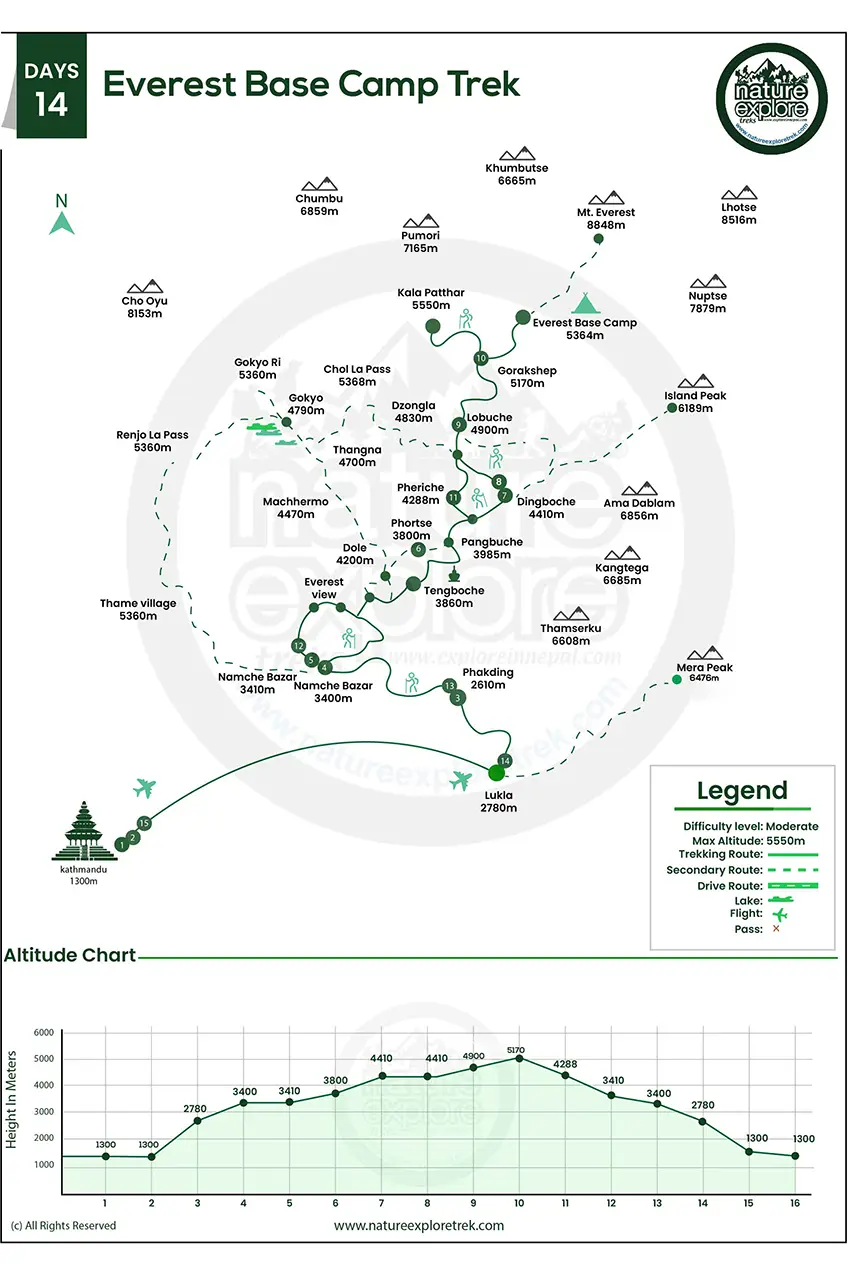
Map and route elevation profile
Testimonials / Trust signals
Nature Explore Trek has been organizing the Everest Base Camp Trek and other Himalayn adventures since 2015 offering expert guidance and reliable services. With over 235+ reviews on TripAdvisor and 60 + reviews on Google our clients consistently praise the professionalism, safety and unforgettable experiences of our treks.
Our certified guides and experienced support staff ensure safe trekking, proper acclimatization and smooth logistics throught the journey. In this Everest Base Camp Trek we will provide the authentic Sherpa village experience , local hospitality and visit to the monasteries adding a rich cultural dimension to the trek. Our long standing reputation and highrating reflects our commitments to the client safety, comfort and unforgettable Hinalayan adventures.
Who Should Join the Everest basecamp group?
Here are some tips to know before you decide to join the group trek or go on the private trek to Everest base camp trek in 2026 and 2027.
- Solo Traveller, who is looking for Fun, enjoys the trip, and is looking for good company.
- Met with a new traveler and experienced the trek together to do this pristine EBC trek.
- Reduce trek cost with the group join package, as you will share the Guide, Porter, Transportation, accommodation costs.
- Couples & Friends — if you are couples or friends looking for group joins to make a bigger group for EBC Trek
- More comfort – Hike in a group, and you will feel more comfortable and enjoyment along the trek
- For partners who want epic views and line-shooting rights – if you are one of those seekers who want to shoot nice videos and photographs of the Himalayas.
- Join with your squad and make memories with friends – this can be another experience to meet new people.
- Families can join together and teach teamwork.
- lifelong family memories
- First-time trekkers
- Can experience new trail with no prior trekking experience
- Often guided to ensure safety and smooth acclimatization
- Experienced Trekkers
- Seek the challenge of longer walks and higher elevations.
- Can act as normal as guides within experienced group
Who should not join the group Trek to EBC?
- Those trekkers who are looking for a fully customized itinerary
- Anyone who is very particular about the daily pace, rest days or side trips
- Trekkers who want luxury accommodation or upgraded services
- Short-time visitors in Nepal who cannot adjust to a fixed departure.
- Photographers who need extended hours for shooting or slower pace
- First-time trekkers who prefer personal guidance and more support
- Senior trekkers who require more acclimatization days.
- Trekkers who prefer peace and quiet rather than walking in a larger group
Why you book this trek early for 2026 and 2027
- Guarantee space on your preferred departure date and season
- More chances to join larger groups
- More time for the fitness training and preparation, which is crucial for the high altitude of EBC
- Ensures the smoother planning, less stress and a better trekking experience
- Advantages of getting Early Bird Discount of about 10 % on each trek you choose to do
Booking, deposit & cancellation policy
Booking and Payment Policy
Inorder to conform your spot for a trek with us i.e Nature Explore Trek you must pay a 15% deposit of the total trip cost . It for your advance booking of hotels and permit . Permits can be made in cash USD , you can also pay via credit card but please note that 4% charge will be added for the credit payments and Once you arrive in Kathmandu you can make your full payments and once we received we will provide you a receipt .
Cancellation And Refund Policy
If you need to cancel your trip with us. The refund depends on the timing of your notice. Cancellations made 30 or more days before the first departure from Kathmandu are eligible for a full refund of the deposit. If the cancellation occurs within 15 days of departure only 14% of the trip cost will be refunded and cancellations made within 7 days of departure or in case of a no-show are non-refundable. In situation where the company cancels the trek due to the weather or other unavoidable circumsatabces a full refund will be provided.
Final Say
EBC is suitable for all travellers who love or enjoy travelling—solo travellers, couples, Friends, families, First-time trekkers, and Experienced trekkers. EBC welcomes all experience levels, from first-time trekkers to experienced trekkers, provided they have proper preparation, fitness and acclimatization.
With breathtaking Himalayas scenery, cultural experiences, and the challenge of high-altitude trekking, EBC offers a life-changing adventure for anyone ready to embrace endurance, teamwork, and the spirit of exploration. In a group join trek, you can meet new travelers, and the cost of the trek will be reduced.
MAIN POINTS:
- No climbing gears required
- Proper training and gradual acclimatization are essential
- Ideal for adventure and unforgettable moments in ebc
Our company, Nature Explore Trek , offers you a group joining package at a reliable cost. We provide you with an experienced and friendly guide for your trek, which will make your trek more memorable. Single travelers benefit from joining the trek in groups, especially if they want to split the high cost of lodging, transportation, guides, support staff, and permits for restricted areas with other Trekkers. Another benefit is that you can meet people who share your interests and share experiences while trekking, which will ultimately make the trip more memorable. If you want to join Group trek then contact us anytime on: [email protected] or whatsapp on : +977 9851131287
Everest Base Camp Trek Group Joins FAQ'S
Q
What is the best time to trek to EBC?
Spring(march-june) and autumn (september-november) seasons are the best times for clear views, moderate temperatures and less risk of landslides or heavy snow.
Q
How long does it take to trek to EBC?
It takes 14 days as per our itinerary however, You can customize the itinerary as per your group’s needs and demands.
Q
What is the total distance of the EBC trek?
The total distance is roughly 130-150km , also depends on side trips you may be interested to go (such as Kala Patthar or Gokyo Lakes)
Q
Do I need a guide for the EBC trek?
Hiring a guide for the EBC trek is highly recommended for your safety, navigation and cultural perception. Guides also help in emergency situations, and they have been going to EBC for many years so they will know how to act in unexpected situations.
Q
Is the EBC trek suitable for beginners?
Yes, for beginners who are physically fit, as long as the right pacing and acclimatization are done, we highly recommend you to do some cardiovascular exercise atleast 1 month before you plan to trek to Everest Base Camp.
Altitude is the biggest challenge for beginners, which can be minimize by the proper acclimatization and slow pacing make sure to extend the more days if you are beginners which will eventually result to successful EBC trek.
Q
What permits are required for EBC trekking?
A TIMS (Trekkers’ Information Management System) card and Sagarmatha National Park entry permit are required for the trek.
Q
How much do the TIMS and Sagarmatha National Park permits cost?
The TIMS entry permit costs NRS. 3,000 & the Sagarmatha National Park permit cost NRS. 3,000.
Q
How do i get the permits?
For the permits, if you are going with the agency, then you don’t have to worry about it, as the agency will provide you. But if you are going independently, then you can get it in Lukla.
Q
Are there restrictions on solo trekking in Nepal?
No, there is no restriction on solo trekking in Nepal . If you are solo travelers then make sure you have guide by your side throughout the trek.
Q
Do I need a visa to trek in Nepal?
Yes, you need a visa to trek in Nepal which you can get once you arrive in nepal .
Q
What is the best acclimatization strategy for EBC?
The best acclimatization strategy for Ebc would be Following the “climb high, sleep low” principle, spending rest/acclimatization days in Namche Bazaar and Dingboche, and gradually ascend.
Q
What is Acute Mountain Sickness (AMS) and how can I prevent it?
AMS (Acute Mountain Sickness) occurs due to low oxygen at high altitudes. It arises from 2000m and the trek highest point is 5545m so there is a high chance for it; however, you can prevent it by resting, drinking plenty of water, avoiding alcohol, and gradually ascending.
Q
Can I take medication to prevent altitude sickness?
For us, we basically carry Acetazolamide (Diamox) to prevent altitude sickness. Take a consult with the doctor before using them.
Q
How do I know if I need to descend due to AMS?
AMS symptoms include severe headache, nausea, vomiting, lightheadedness, exhaustion, and disorientation. HACE/HAPE requires immediate descent.
Q
What health precautions should I take before the trek?
Medical check-up, vaccinations (hepatitis A, typhoid, tetanus), fitness training, and ensuring no chronic illnesses prevent high-altitude trekking.
Q
Where will I stay along the trek?
During the trek you will stay at Teahouses or lodges, which are locally owned by the families.
Q
Are there toilets along the route?
Yes, most tea houses have toilets, though some may require a $1-2 fee to use them.
Q
What kind of food is available on the trail?
During the trail you will get a variety of food like Local dal bhat, noodles, soups, pasta, momo, tea, coffee, etc. As you are trekking in Nepal, we highly suggest you have local food, as in teahouses they produce it themselves, i.e., organic, which will eventually boost your energy for the trekking.
Q
Should I carry my own water?
Yes, you can carry your own water but it will be a hassle, so you can buy a bottle and purifier, as in the trek you will find many natural spouts from which you can drink using the purifier.
Q
Can I find vegetarian/vegan food easily?
Yes, you can get the vegetarian food easily infact, teahouse owners grow their own vegetables so it will be fresh also.
Q
What level of fitness is required for the EBC trek?
Moderate fitness level is required and the ability to walk 5-7 hours/day on uneven terrain at high altitude.
Q
Can elderly people or children do the trek?
Yes, with proper acclimatization and health considerations. Age extremes need extra caution for altitude sickness.
Q
How many hours a day will I be trekking?
You will approximately trek 4-7 hours/day on a trek. According to altitude, terrain, and acclimatization pace.
Q
How difficult is the trek compared to other high-altitude treks?
The trek is Moderate. Although the trail is technically non-technical (no climbing gear required), it is physically demanding primarily because of the altitude.
Q
How do we keep trekkers safe from altitude sickness on EBC?
Slowly ascend, drink plenty of water, eat healthily, keep an eye on your symptoms, and descend if necessary.
Q
What clothing is necessary for the EBC trek?
Layered clothing (base layer, fleece, down jacket), Waterproof jacket and pants, Thermal wear, gloves, a hat, and warm socks are mandatory during the trek.
Q
Do I need special trekking boots?
Yes, sturdy, waterproof boots with ankle support are recommended for a trek.
Q
What essential gear should I carry?
Backpack, trekking poles, water bottle, headlamp, sunglasses, sunscreen, first aid kit, sleeping bag, and maps/GPS.
Q
Can I hire porters or guides to carry my luggage?
Yes, you can hire a porter to carry the luggage. Please note, one porter is for 2 people and the weight limit is 20-25 kg.
Q
Is sleeping bag rental available on the trail?
Yes, in major villages like Namche Bazaar, Dingboche, and Gorak Shep. It’s cheaper and lighter than carrying your own. Also, you can take it from the trekking office; as for us, we do provide you if needed and it is expected to be returned after the trek.

Got a question about Everest Base Camp Trek Group Joins?
Reach out to our travel experts.Customer Reviews
250 Excellence Reviews
14
Days
Days
US$ 1400Per Person (Group Size: 2 - 25)
Group Discounts- Best price guaranteed
- Secure & easy online booking
- Flexible booking dates
- Decades of experience
- No. of Pax Per person
- 2 - 3 peopleUS$ 1450
- 4 - 7 peopleUS$ 1400
- 8 - 10 peopleUS$ 1350
- 11 - 13 peopleUS$ 1300
- 14 + people 9999 US$ 1250
- No. of Pax Per person
- 2 - 3 peopleUS$ 1450
- 4 - 7 peopleUS$ 1400
- 8 - 10 peopleUS$ 1350
- 11 - 13 peopleUS$ 1300
- 14 + people 9999 US$ 1250
Have Questions?
US$ 1400