

 English
 Dutch
Dutch Japanese
 Hindi
Hindi Italian
 Spanish
 French
 German
 Chinese
 Korean
 Arabic
 Hebrew
 Russian
 Portuguese
 Danish
 Czech
Czech Polish
 Swedish

250 reviews in 



15
Days
Days
US$ 2550 US$ 2300Per Person (Group Size: 2 - 16)
Group Discounts- Best price guaranteed
- Secure & easy online booking
- Flexible booking dates
- Decades of experience
- No. of Pax Per person
- 1 - 1 personUS$ 2650
- 2 - 3 peopleUS$ 2300
- 4 - 7 peopleUS$ 2200
- 8 + people 9999 US$ 2100


- No. of Pax Per person
- 1 - 1 personUS$ 2650
- 2 - 3 peopleUS$ 2300
- 4 - 7 peopleUS$ 2200
- 8 + people 9999 US$ 2100
Have Questions?




At a Glance

Duration
15 days
Destination
Nepal
Trip Difficulty
Moderate
Max altitude
6,464m / 21,831 ft
Group Size
2 - 16 Pax.
Activity
Trekking & Climbing
Accommodation
3 star hotel in Kathmandu & standard lodge during trek
Meals
Breakfast, Lunch & Dinner during the trek
Vehicle
Private car and flightOverview of Mera Peak Climbing
Climbing the 6000m peak in the Himalayas and experiencing the thrill of high mountain trekking? If yes, we invite you to join our Mera Peak climbing expedition which stands tall at 6461 m above sea level. The peak itself is situated in the central part of the Khumbu region, south of Everest. It has evolved as an attractive destination for mountain enthusiasts due to its easy Himalayan conditions, accessibility, and tempting altitude.
In our Mera Peak climbing trip, we have managed to include almost everything. From climbing one of the highest peaks available to high-mountain tourists to viewing the greatest mountain panoramas in the world, with the peaks of Everest, Lhotse, Makalu, Kanchenjunga, and Cho-Oyu at the forefront.
We will also cross high passes, pass deep valleys, and penetrate challenging glaciers. We will also meet wonderful Sherpa people living in these little-visited areas of the Himalayas.
To begin our Mera Peak climbing, we will take a flight to Lukla. We will then head to Thuli Kharka admiring the remarkable view of the Hinku Valley. Passing through the green dense forests of pine and rhododendrons, we quickly gain the elevation. The landscape now gives way to the rocky surroundings on the Zatwarz La Pass elevated at 4,600m above sea level.
The next section of the route leads us along the Hinkhu Khola River. Above the settlement of Khare, we enter the snow and ice zone. The gentle slope onward allows for a relatively comfortable approach to the summit.
We will take the help of rope, crampons, and ice axes when climbing the summit. At the summit, we will have an unforgettable impression of the surrounding mountains. We will then return to Lukla via the initial path we have taken at the beginning of the journey.
We want to ensure you that the approach to the Mera Peak summit is not technically demanding but the altitude requires good acclimatization and good physical condition. We have designed our program with adequate time for appropriate acclimatization and regeneration, as well as a flexible approach to unforeseen situations.
Therefore, our Mera Peak climbing trip is also suitable for people without experience in high mountains. But they should be physically active on a daily basis and prepare properly before the trip to easily cope with the route.
Highlights of Mera Peak Climbing
- The breathtaking spectacle of five 8000 peaks including Everest, Lhotse, Cho Oyu, Makalu, and Kanchenjunga as well as other peaks
- Opportunity to climb the Mera Peak and experience the overnight stay at camp
- Exploration of the Khumbu and Everest regions off the beaten path
- Hike through the foothills of mountains, terraced rice fields, rhododendron forests, and mountain villages where ethnic minorities live
- Acquaintance with the authentic Sherpa culture and traditions
- A thrilling short flight to Lukla with incredible mountain views
- Exploration of culturally rich Kathmandu Valley
Route Map and Altitude Chart
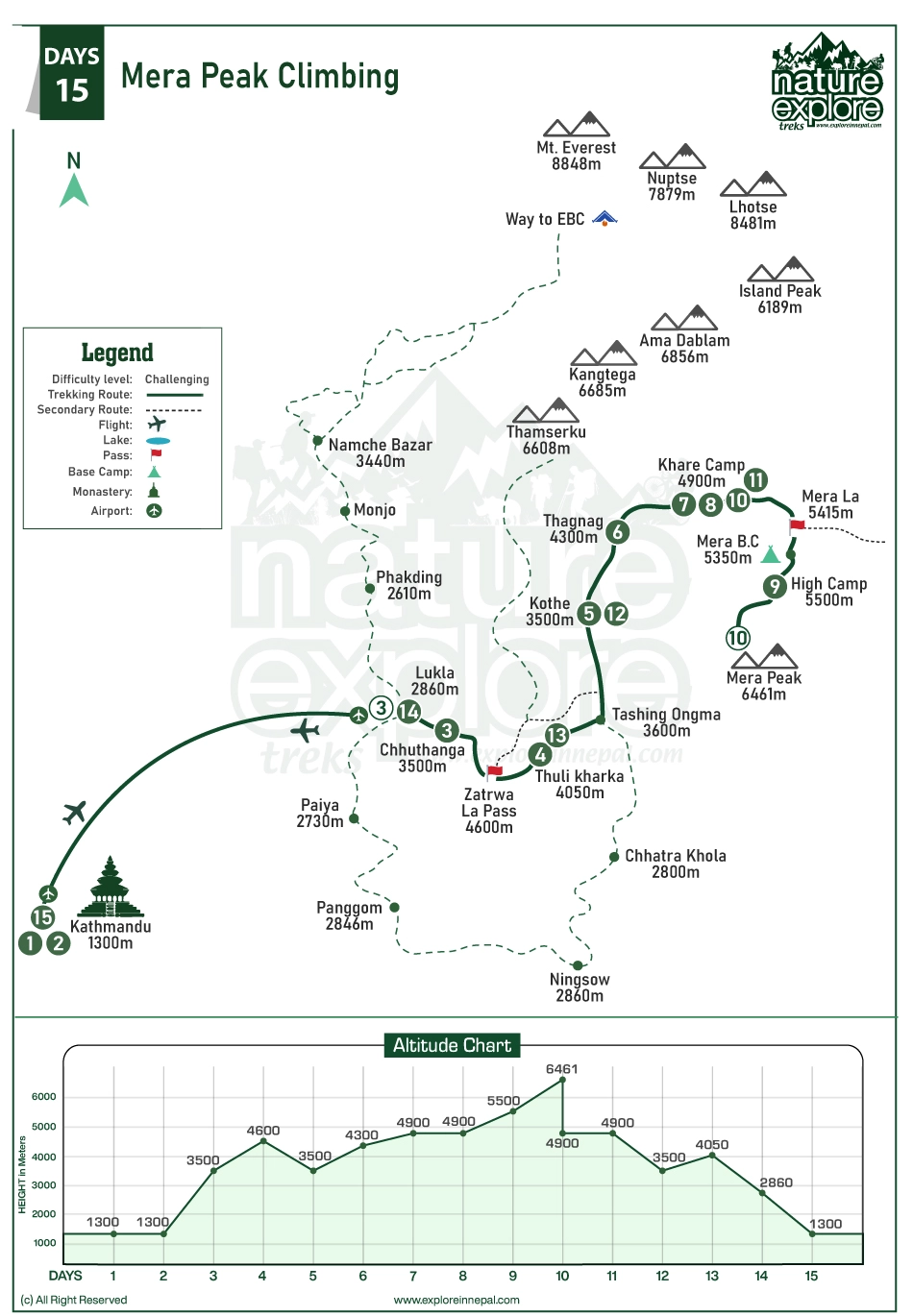 Download Map
Itinerary
01
Day 01 Arrive at Kathmandu, 1300 m
Nature Explore Treks is privileged to welcome you to Kathmandu, the first base for all mountaineering and trekking expeditions. Once you are out of TIA, our rep and driver will be there at the gate to receive you warmly and take you towards your designated hotel.
Take a moment to get refreshed and settle in your room, till then we will await the arrival of our fellow adventurers participating in the Mera Peak climbing expedition.
In the evening, you will all meet our guide who will explain the comprehensive details about our planned Mera Peak climbing itinerary. You can then venture out to know a little about the aura of Kathmandu.
Duration
30 minutesMax altitude
1300mMeals
ExcludedAccommodation
3-Star Hotel02
Day 02 Sightseeing in Kathmandu
Today, we will all engage in the Kathmandu city tour with our expert guide. Together, you will get to see the very known stupa and the Buddhist Hill of Swayambhunath Temple.
The 365 uprising stone steps guiding to the temple on the hill represent the days that directly lead us to the self created stupa of Swayambhunath. The whole Kathmandu Valley also open up very clearly from here.
Next, our tour will advance us towards the medieval alleys of the Square Palace of Kathmandu. The time stood pagodas, temples, the palace, and the architectural houses are simply fascinating to watch.
Once the tour is over, our guide will assist you in checking your equipment for the upcoming adventure. If you are missing out on any items, with the help of our guide, you can get them at a cheaper rate.
Note
Kindly understand that there will often be no straight flights from TIA to Lukla in the spring and autumn time. The flight will be shifted towards the Manthali Airstrip of Ramechhap, which is merely a 4-hour driving journey from Kathmandu.
A Ramechhap travel can occur around midnight, so we urge you to get an early sleep. A private vehicle and a driver will be available for this travel. Also, on the way back, Ramechhap landing, followed by a drive to Kathmandu, may take place.
Meals
BreakfastAccommodation
3-Star Hotel03
Day 03 Fly to Lukla, trek to Chhuthanga alt. 3500m. 4-5 hours
Early morning, a short but remarkable Himalayan flight will land us in Lukla in the middle of the high Himalayas such as Kongde Ri. Here, we will get to know our local crew who will distribute our luggage and then we will walk together, beginning the Mera peak climbing expedition.
The track from Lukla faces south, guiding us toward the incredible territory of Makalu Barun Conservation Area. A little further, the authorities of this conserved land will stop us to inspect our documents.
Once complete, we will head on along the comfortable trail past numerous chortens and stupas beside the energetic Dudh Koshi River. In approximately 4 hours, we will see the small charming huts of the Chhuthanga Village which is often used by the yak herders.
Note:
In case of flight cancellation, or delay, and in the peak season of spring and autumn, we will first drive to Ramechhap airport in a jeep for 4 hours and take a Lukla flight.
Duration
4-5 hoursMax altitude
3500mMeals
Breakfast, Lunch, DinnerAccommodation
Lodge04
Day 04 Trek to Thuli Kharka alt.4050 m via Zwatra la pass (alt. 4600 m). 6-7 hours
We will have a very first tough day today as a steep and rigorous climb towards the Zwatra la pass awaits us. First, we will traverse up along the slope of the Kalo Himal Ridge that serves as the natural border between the Hinku and Khumbu Valleys.
Descent from the walls of this ridge is not that problematic and will advance us to Kharitang Settlement at 3900 m. Our path will once again start to climb slowly at first, then steeply towards the gigantic Pass.
Take a relaxing breather for a moment and look at the distant views of Lumdung, Everest, Kusum Kanguru, Kongde Ri, Numbur, Kanchenjunga, Cho Oyu, Makalu, and Lhotse.
We will now enjoy the slow descent to Thuli Kharka to experience a restful night in the middle of the high snow monsters.
Duration
6-7 hoursMax altitude
4600mMeals
Breakfast, Lunch, DinnerAccommodation
Lodge05
Day 05 Trek to Kothe , alt .3500 m. 5-6 hours
After we leave the ambiance of Thuli Kharka, we will move slowly down into the depth of the Hinku Valley. The trail will move with the energetic Hinku River that pilots our way upward through the rhododendron, oak, and pine jungle to Tashi Dingma.
The route will keep varying which will again descend towards Tashi Ongma. The forest here and there will open up giving us the splendid visual of Mera walls.
Kothe is approaching near but first, we will again have to put some effort into the steep ascending path. Locals know this small riverside village as Mosom Kharka which has a more dramatic landscape. Peak 43 and Kusum Kanguru will catch our heart and mind in the evening.
Duration
5-6 hoursMax altitude
3500mMeals
Breakfast, Lunch, DinnerAccommodation
Lodge06
Day 06 Kothe to Thagnag, alt.4300 m. 4 hours
We will head west and start to walk along the ridge of the Hinku Khola. On the way, we will be graced by the small summer pastureland of Hinku Drangka.
Most of the forest that was once here is now gone giving us the more open views of the Hinku Valley. We will soon be at a tiny settlement of Gondishung inhabited primarily by the shepherds.
We will take the opportunity to see the Lungsumgba Monastery a little further which has been standing eternally for two centuries. Apart from its historical testament, the Gompa is also the perfect spot to watch Kusum Kanguru, Thamserku, Charpate Peak, Peak 43, and Mera of course.
Shortly after around one more hour of ascending, we will be at Thangnak, a tranquil Sherpa meadow with Mera in our sight.
Duration
4 hoursMax altitude
4300mMeals
Breakfast, Lunch, DinnerAccommodation
Lodge07
Day 07 Thagnag to Khare, alt .4900 m. 3 hours
Going further deep into Hinku Valley, we will strive for thirty minutes to arrive at the Sabai Tsho glacial lake (4463 m). we will then involve in the scenic uphill but very tough climb along the rock moraines of Dig Glacier, then Hinku Nup and Shar Glaciers.
Soon, Khare will welcome us which is the last village with lodges before we head towards the base camp of the Mera Peak. The unimpeded views of north Mera, Kyashar, Kusum Kanguru, and Kangtega are simply mind-boggling from Khare.
Duration
3 hoursMax altitude
4900mMeals
Breakfast, Lunch, DinnerAccommodation
Lodge08
Day 08 Acclimatize day in Khare
Khare is the beginning spot for ascending the Mera Peak which has also incredible spots to go for our acclimating treks. Such as we can take the short but exciting upward hike towards the Khare Ri (5500 m) or towards the Mera Glacier.
If we select the Mera Glacier up route, we will have to go over numerous huge boulders while the rocky yet manageable terrain will diver us to Khare Ri. See the fearsome yet attractive walls of Mera La Pass (5245 m) and Mera North.
Afterward, under the monitoring of our climbing guide, we will go through extensive practice with our gear such as going up on a rope, moving along the fixed rope, and utilizing the ice axes, carabiners, and harnesses.
Meals
Breakfast, Lunch, DinnerAccommodation
Lodge09
Day 09 Khare to Mera High camp alt. 5500 m. 6-7 hours
From Khare, the Mera glacier will direct us towards the Mera La pass. The initial climbing will be a bit hard and if needed, our guide may put up the fixed rope for us.
Once at Mera La, we will be standing between the Hinku and the beautiful Honku Valleys. Everest, Mera, and Makalu seem very different and clear from up here.
Generally, a camp is set around 100 m down the pass as the base camp of the Mera peak. However, to make our summit attack a bit shorter for tomorrow, we will advance a little further up towards the High or the Advance Camp.
We will climb upward to the end of the rocks that separate the Mera Glacier from the Naulekh Glacier. The constricted glacial path will continue to march us up over a few crevasses where we need to be a bit more careful.
Once at the High Camp, there we can see the huge gathering of Chamlang, Kanchenjunga, Makalu, Lhotse, Baruntse, Cho Oyu, Mera and Everest.
Let’s get on with our practice once again till our team works to put on our tents.
Duration
6-7 hoursMax altitude
5500mMeals
Breakfast, Lunch, DinnerAccommodation
Tented Camp10
Day 10 Mera high camp to summit, alt.6461 m - return to Khare (5100 m) 9-10 hours
The day of the Mera Peak climbing expedition that has been dominating our minds is today. In the dark shade of the night, we will get up and gear up for the summit climb.
A long ascending hike over the icy terrain awaits us till we reach the pinnacle of the summit. The slope to the peak is not that steep, and there are also not many crevasses. The technicality is also very low however, every inch will need more effort from us.
Our final and steepest part will occur when we are 50 m below the Mera Peak. Here, our climbing guide may decide to use the already installed railings.
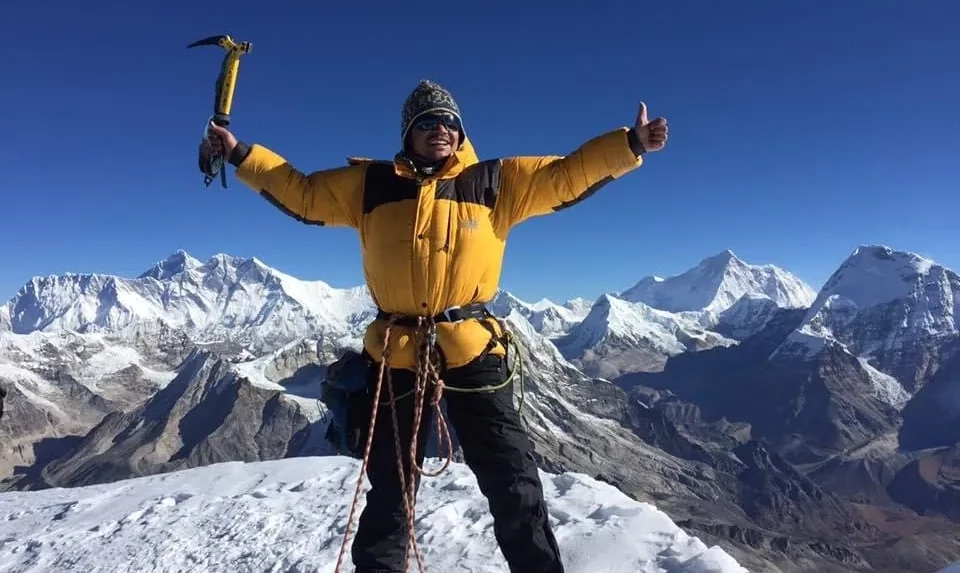
When we are at last at the Mera Summit, we will soon forget all our inconveniences as we wave our flags in front of Ama Dablam (6812 m), Chamlang (7319 m), Lobuche (6145 m), Nuptse (7855 m), Cho Oyu (8201 m), Kanchenjunga (8586 m), Lhotse (8516 m), Makalu (8463 m), Everest (8848 m).
We will then descend towards High Camp to report our success to the remaining team and get set to move back down towards Khare.
Duration
9-10 hoursMax altitude
6461mMeals
Breakfast, Lunch, DinnerAccommodation
Lodge11
Day 11 Reserve a day in case of bad weather
We have reserved an extra day for climbing the Mera Peak. If due to adverse climatic conditions, we were not able to climb the peak the day before, we will use this day to summit the peak and return to Khare.
Meals
Breakfast, Lunch, DinnerAccommodation
Lodge12
Day 12 Khare to Khote
From Khare, we descend to the Hinku Valley traversing through Thagnag. The route will be quite tiring, but as we descend we will gain strength. As we arrive in Khote, a warm lodge with a hot shower awaits us. Overnight stay in Khote.
Duration
5 hoursMax altitude
3500mMeals
Breakfast, Lunch, DinnerAccommodation
Lodge13
Day 13 Khote to Thuli Kharka
Another day on the return path. We will hike along the path running through the deep pine and rhododendron forests. First, we will climb a little further and then gently go down. We will then hike through the meadows and pastures towards Thuli Kharka where we will stay for the night.
Duration
6 hoursMax altitude
4000mMeals
Breakfast, Lunch, DinnerAccommodation
Lodge14
Day 14 Thuli Khara to Lukla
Today we have a long day of hiking ahead of us. We will go through the Naulekh Himal ridge, further to the Zathrwa La pass. We will then pass through the village of Monjo and the last gentle part of the trek takes us to Lukla. This is the last evening we will spend in the mountains. During the descent to Lukla, we may have to use crampons.
Duration
5 hoursMax altitude
2780mMeals
Breakfast, Lunch, DinnerAccommodation
Lodge15
Day 15 Fly to Kathmandu
Early in the morning, we will once again board the domestic flight to Kathmandu from Lukla. In about 30 minutes, we will arrive at the domestic terminal of the International airport. We will then transport you to the hotel in Kathmandu where you can rest and take a hot shower.
In the evening, you can once again walk around the nook and corners of the city street. We will have a delightful farewell dinner at one of the typical Nepali restaurants with a cultural dance show.
Duration
30 minutesMax altitude
1300mMeals
Farewell DinnerAccommodation
3-Star Hotel
Is this offered itinerary not suitable for you?
Inclusion/Exclusion
What's Included?
- Airport peak and drop
- Three nights Hotel in Kathmandu. (Two on arrival and one on departure
- Three times meals on the trek (breakfast, lunch, dinner)
- Hot drinks, tea, or coffee
- Fresh fruit every day after dinner
- Accommodation during the expedition
- For camping part tent & all kitchen crews
- Professional guide and porter ( Two people and one porter (each porter carries 25kg)
- Kathmandu – Lukla – returns Kathmandu air ticket
- Makalu national park entrance fee
- All the ground transportation
- Treated drinking water
- Nature Explore Trek duffle bag (refundable after the trip)
- Nature Explore Trek t-shirt as a gift
- All the Gov. Vat, tax, etc
- Last night’s dinner at Nepali Kitchen with a cultural dance show
Climbing Part Includes
- Climbing permit for Mera peak
- Garbage deposit cost as per require from Nepal Gov.
- Professional climbing guide.
- Tent and kitchen crews for the climbing part.
- Fresh food and hot drinks cook during the climbing period.
- All the necessary climbing documents etc.
- Guide and porter insurance.
What's Excluded?
- International airfare.
- Personal insurance (incase for emergency only.)
- Personal Trekking and Climbing gear.
- Lunch and dinner in Kathmandu.
- Wi-Fi Laundry, Hot shower, Cold drinks, (mineral water, beer, and coke Fanta etc.), Extra Snacks during the trip.
- Extra then above mention in itinerary.
- Tipping to staff.
Trip Information
How Mera Peakc climbing journey starts with us?
Our journey of Mera Peak climbing begins with a flight to Lukla from Kathmandu. Then we move on to cross the enormous Zwatra la Pass and reach the village of Thuli Kharka. From here on, we cross several small Sherpa settlements of Khote, Thagnag, and Khare.
After spending a day at Khare, we move ahead to the Mera High Camp from where we will climb the summit of the Mera Peak. After successfully climbing the peak, we will return through the same path we have walked before to return to Lukla.
What to expect on Mera Peak Climbing?
Our Mera Peak climbing trip is an ideal trip for anyone who wants to get a taste of expedition life. Before setting off on our journey, we will explore the cultural city of Kathmandu for a day. We will then take a short scenic flight to Lukla and gradually walk towards the great solitude of Sherpa villages.
These picturesque villages provide us with an insight into the rich culture of the Everest region. We will then walk through the primeval mountain forests made up of huge hemlock spruces, conifers, and large-leaved rhododendron bushes of the Hinku Valley.
Being one of the less visited areas in Nepal, we will be in solitude with the purest form of nature. We will gradually gain height as we progress in our trek. Eventually, we will cross the 4600 m high Zwatra la pass and walk on a steady uphill route. Traversing Thagnag, we will stay in Khare for a day and carry out exercises with crampons, ice axes, and the fixed rope technique.
After ascending the Mera High Camp, we will set off to climb the Mera Peak from where we will witness five of the top eight thousand meters mountains. We will admire the majestic sunrise over Mount Everest, Cho Oyu, Makalu, Kanchenjunga, and Lhotse. We will also forget ourselves in the splendid beauty of other six and seven-thousand-meter high ice peaks.
Then we descend through the already known route for yet another adventurous flight to Kathmandu from Lukla. In Kathmandu, we will have one more opportunity for individual discovery tours and shopping.
Through our Mera Peak climbing tour, you will discover the uncontaminated nature, and authentic century-old traditions, and meet extraordinary Sherpas. You will get to pride yourself on climbing the 6461 m high mountain peak in Nepal. You will get to tell the story of seeing the grandest mountain of all with your own eyes.
Best Time to Climb Mera Peak
The best time for Mera Peak climbing in Nepal is from March to May in spring and September to November in autumn. The pre-monsoon period of spring and the post-monsoon period of autumn months are ideal seasons when the snow melts with less probability for rainfall.
Especially when ascending the summit of Mera Peak, the trail will be covered with a thin layer of snow facilitating the use of ropes, ice axes, and crampons. Besides, summiting the peak is not the only goal of our expedition. We want to witness the incredible mountains and the experience of the flora and fauna in their full glory.
Therefore for the paramount experience of the mountains, we recommend you undertake this expedition in spring and autumn.
Elevation and distance during the Mera peak Climb
The Mera peak erects at a height of 6461 m above sea level lying at a distance of around 75 km from the capital. Our journey begins and ends in Lukla which lies 367 km from Kathmandu. However, the aerial distance of Lukla from Kathmandu is only 135 km which can be covered within 25 to 30 minutes by flight.
Before summiting the Mera Peak, we will first ascend to the Mera High Camp which is located at 5500 m above sea level. From the camp, we will climb the peak the following day. Our Mera Peak climbing expedition consists of 15 days itinerary which needs you to cover 7 to 8 km each day walking around 4 to 7 hours a day.
Maximum/Minimum walk per day
In about 15 days itinerary of Mera Peak Climbing, we will hike for 10 days in total including the short hikes during the acclimatization day on day 8. Since we will be covering about 8 km each day, we will walk on average for about 5 to 7 hours every day. However, the walking duration each day differs depending on the overnight destination, terrain, pace, and altitude.
On the 7th day of the trek, we will only walk for only 3 hours covering the distance of only 3 to 5 km when trekking from Thagnag to Khare. This will be our minimum walk in the entire trekking duration of the journey.
On the 10th day, when we set off from the Mera High Camp to ascend the summit and hike down to Khare, we will cover a distance of around 17 km. We will hike for 9 to 10 hours during this day which will be our maximum walk in the hiking and climbing expedition to Mera Peak.
Difficulty and Acclimatization on Mera Peak Climbing
The Mera Peak is categorized as 1B alpine grade which means it is classified as a slightly challenging peak in Nepal. More suitable for experienced alpine trekkers, the climbing expedition needs you to manage a short steep climb of up to 40° and cross slopes with an incline of 35-40°.
Skill in using ice axes and crampons will be an added advantage when summiting this peak. In addition, you need to hike for 5 to 7 hours a day which allows you to walk very long distances with the necessary amount of altitude to acclimate.
We want to ensure that climbing the summit doesn’t require complex technical mountaineering skills. The challenge lies in the height and unpredictable weather conditions in the mountain.
Keeping these risk factors in mind, we have designed our itinerary carefully with a steady climb and a separate day dedicated to Khare to allow plenty of time for acclimatization.
Can a beginner join Mera Peak Climbing trip?
Yes, Mera Peak climbing needs only basic mountaineering skills to reach the summit. Therefore, it has been the favorable peak among travelers who have extreme motivation to conquer the high-altitude Himalayas in Nepal. Additionally, this expedition will be an ideal journey for those who want to prepare themselves for future expeditions to Everest.
The prerequisite for this trip is stamina and strength for hikes with a walking time of up to 10 hours on unpaved paths. There are no special technical requirements for trekking. But you should be able to climb slopes with an incline of up to 40° with or without rope protection.
However, it is nothing to be concerned about as our experienced Sherpa guides will give you basic mountain climbing training before ascending to the actual summit.
Preparation and training for Mera peak climbing
Before joining our Mera Peak climbing tour, we advise you to work on increasing your physical stamina and strength by training properly for at least a month before climbing. Jogging for 15 to 2 minutes daily, squatting, stepping up and down the ladder, exercising on treadmills, running and cycling can increase the strength and endurance of your leg muscles.
We also advise you to familiarize yourself with the weather and climate of the Everest region. And make sure you are in proper health and body condition. If you have any existing health condition, we suggest you seek consultation from your physician.
Our Mera peak climbing is a teahouse or lodge trekking but you need to stay for a day at a tented camp. Our team will make all arrangements for the camping but you should be prepared to forego the luxury and stay with basic amenities.
Alternate routes for Mera Peak Climbing
As an alternate route to the Mera Peak climbing, you can trek from Lukla to Paiya instead of Chhuthanga. Following this route, you will cross several Passes at an altitude of more than 2500 m. From Paiya, you will traverse Panggom, Ramailo Dada, and Chhatra Khola. From Chhatra Khola, you will then trek to Kothe following the same trail onwards as we have listed in our itinerary.
The advantage of this alternate trail is it offers scenic views of Kongde Ri, Khatang, and Tang Ragi Tu along the trail. The number of days required to complete this route is also 15.
Altitude Sickness in Mera peak climbing
On this trekking and climbing trip we will be continuously at altitudes over 2,500m. This results in the possibility of suffering from altitude sickness. Typical and initial symptoms are headaches, dizziness, and nausea. In order to reduce the risk, when planning the trip we made sure to give your body the opportunity to adapt to the altitude.
This not only includes the itinerary but also careful and attentive handling by our guides. They are trained to maintain a slow walking pace with enough breaks to drink.
Still, the high elevations and long hours of hiking can put a strain on your body. So in the occurrence of any symptoms, we advise you to consult our guide and go down immediately. For quick relief, have a tablet of Diamox or Ibuprofen.
Transportation, Meals and Drink during the mera peak climbing
During the entire period of Mera Peak Climbing, we offer you airport pick up and drop off service, all the ground and air transportation from the beginning to the end of the trek. We will pick you up at the airport and transport you to the hotel in Kathmandu in a private vehicle.
We will also arrange for your domestic flight from Kathmandu to Lukla and from Lukla to Kathmandu at the end of the journey. In case of flight delay or cancellation, we will drive you to the Ramechhap airport and fly you to Lukla.
Regarding meals and drinks, a star hotel where you will be accommodated will provide you with a complimentary breakfast every morning till you stay in the city. During the trek, you will have three times meals on the trek (breakfast, lunch, and dinner) with a hot cup of tea or coffee. After dinner, we will provide fresh seasonal fruit from the region.
When camping in the base camp, our skilled team will set up separate tents for cooking, latrines, and sleeping. Our kitchen crew will cook fresh hot meals with hot drinks during the climbing period.
Mera Peak Climbing Vs Island Peak Climbing
Both the Mera Peak and Island Peak are above 6000 m high above sea level: Mera Peak at 6461 m and Island Peak at 6,165 m. climbing these two peaks requires basic mountaineering skills and staying in tents hiking through deserted and non-tourist areas, where you will see the real mountainous Nepal as it is.
Climbing expedition of both Mera Peak and Island Peak will take you to the border between the Sagarmatha National Park and Makalu Barun National Park. Both the peaks and the trail offer unforgettable views of mountains and landscapes.
However, in terms of difficulty, the ascending Island peak is harder than the Mera peak climbing. The ascent to the Island peak requires you to climb a steeper narrow icy and snowy path with numerous crevasses in between. Therefore, it is technically more challenging than climbing Mera Peak which includes pretty much straightforward ascension.
But, the trekking part to the Island Peak base camp is easier than hiking to the Mera Peak base camp.
Communication, Gadgets charging, and Internet/wifi
Communication, gadget charging, and internet connectivity are available in the lower regions of the Mera Peak climbing trail. But at higher altitudes, at the base camp, and the summit, you may not have accessibility to these services.
Most of the lodges where we will stay for the night will have amenities for charging your mobiles, cameras, and power banks. They may also provide WIFI services but they can charge extra fees for these services.
At higher altitude villages, at the base camp and summit, you may not get a good reception on your mobile. The same goes for the electricity as well so we suggest you carry power banks to charge your devices when in the base camp. You probably don’t want to miss out on capturing the moment of your accomplishment.
Permits for Mera Peak climbing
We need a Mera peak climbing permit from the Nepal Mountaineering Association and a Makalu Barun National Park Entry Permit for this trip.
The climbing permit cost depends on the season: in spring it will cost you $250 per person, in autumn- $125 per person and in winter and summer it costs $70 per person.
The Makalu Barun National Park Entry Permit costs USD 30 per person which allows you to hike through the restricted area of the national park.
Essential Equipment for Mera Peak Climbing
Personal equipment:
- 60 liters
- A bag for personal belongings
- Sleeping bag, comfort temperature from -20 C to -30 C.
- Rug
- Trekking poles must have rings of at least 70 mm
- Classic ice ax with steel beak or ice tool
- Climbing system
- Helmet
- Carabiners – 3 pcs.
- Jumar
- Descender
Clothes and shoes:
- Triple or double climbing boots. Double – plastic or leather – very preferably with an external shoe cover
- Trekking boots
- Sneakers (for cities)
- Waterproof layer – Jacket + trousers
- Fleece suit
- Thermal underwear top+bottom
- Warm mittens
- Thick gloves
- Thin gloves
- Hat
- Woolen trekking socks
Miscellaneous:
- LED flashlight for head
- Power bank
- Sunglasses
- Ski goggle mask
- Raincoat
- Thermos – 1 liter. Preferably without a button on the lid
- Leggings
- Sun cream spf 50
- Lip Balm
Personal first aid kit:
- Elastic bandage and/or support bandage
- Toothpaste, soap, brush, slippers, shampoo
- Towel
- Toilet paper
Trip Extension
If desired, you can extend your Mera Peak climbing trip by another exciting mountain week. After climbing Mera Peak, you will continue through the unique, wild, and frozen upper Hongu Valley via the impressive Amphu Laptsa Pass.
You will then reach the back of the Khumbu valley, where the Island Peak awaits your arrival. Island Peak is technically more difficult than Mera Peak. Finally, the path takes you past the oldest monasteries in the Himalayas down to Lukla.
Mera Peak Climbing FAQ'S
Q
Your Mera Peak climbing trip is a trek or a climb?
It is a climb but involves trekking part to the Mera High Camp. Most of the climb consists of walking uphill on a glacier which requires basic mountaineering preparation, good use of crampons, and the ability to move on snowy slopes.
Q
How does the ascent to Mera Peak work?
You will climb Mera Peak which takes two days, with a high camp. On the first day, you climb to high camp, where you arrive in the early afternoon. On the second day, you start very early in the morning and reach the summit in about 6 hours.
Q
If I don’t want to climb, what will happen?
First of all, our itinerary allows good acclimatization and makes attempting the climb feasible for everyone. However, if you don’t want to climb the summit, you can stay in the base camp in the presence of the imposing Himalayan peaks, while the rest of the group can go climbing.
Q
What is the main summit of Mera Peak that we will climb?
We will climb Mera Central which is 6461 m but the highest Mera summit is Mera North which is 6,476 meters above sea level.
Q
Can you admire Everest from Mera Peak?
Yes, if you are lucky and get to the top on a clear day, you will be able to admire 5 of the 6 highest mountains on earth: Cho Oyu (8201 m), Lhotse (8516 m), Everest (8848 m) and Makalu (8463 m) are close and if the day is super clear you can even see Kanchenjunga (8586 m).
Q
How many days do you need for Mera Peak ?
Generally, climbing to Mera peak you can go via two different routes that lead you via lower and Upper trail. Lower route is longer than the Upper as you will traverse from the lower part of the Khumbu region. An Upper trail leads you from Lukla fly inn and fly out from Lukla.
Lower route takes 17-18 days. If you are not tight with your schedule we suggest you take the lower route as you will have great opportunity to explore culture , landscapes and you will have good enough acclimatization before reaching the higher part of the trek.
Upper route via Lukla takes 13/14 days. If you are tight with your schedule and you have only a short holiday in Nepal then you can also go via upper trail ,but it will be slightly challenging compared with lower route as you have to cross alt. 4600m above on the second day of this route itinerary.
Q
Can a beginner climb Mera Peak ?
Yes , beginners also can climb the Mera peak as it is not harder than peak climbing in Nepal. If you are both mentally and physically fit, then you can climb. But definitely harder than trekking as you have to climb onto the glacier , cross the many crevasses and summit at altitude of 6476m from sea level,but this peak does not count as a technical climbing peak in nepal. So if anyone has a dream to climb mountains in the nepalese himalayas you can start from Mera peak alt. 6476 m , and we also highly recommend those adventure lovers who want to climb above 6000m you have know basic climbing skills , past experience reach higher than 5000 m and good walking level into the mountain.
Q
Is Mera Peak easier than Island Peak?
Climbing Mera peak is as you feel like expeditions and less demanding than island peak. The route from mera peak high camp to summit is not steep ascending and less crevasse , no need to walk through the ladders and between high camp to summit you will climb only 570m , but island peak you have to ascend nearly 1000 m from basecamp. That’s the reason mera peak is easier than island peak
Q
What is the difficulty level at Mera Peak?
Mera Peak is graded as alpine Garde PGH in the Alpine systems as summit routes go through the steep ascending , spend a few nights in the rents , fees like you are in the remote region of the country and require physical and mental preparation , etc
Q
How high is Mera peak ?
Mera peak is 6467m /21241 Ft. higher from sea level
Q
How do I prepare for the mera peak ?
Prepare physically and mentally both. As you are trekking and climbing in the remote area of the Everest region and summiting the altitude 6476 m from sea level always gives you a challenge. Minimum you have to train yourself 5 to 6 months before your trip starts.Running , rock climbing , Yoga , adventure treks can helps you to make easier summit of mera peak
Q
When is the best time to climb Mera peak ?
Best months to climb Mera Peak are mid October , November, early December and mid March. April and May are the best months to climb Mera peak as the weather will be favorable and suitable temperature as well,as neither hot nor cold and most of the day sunshine and less winds as well.
Q
What is the success rate of summit Mera peak
The success rate of summit Mera peak is more then 85 % as it is easier trekking in the lower part of the region and not demanding ascending to reach summit,
Q
How much does the Mera Peak climb cost?
Mera peak climbing costs normally start from USD 2300 to USD 3000 per person. But it depends on the group size, Itinerary and the route you process to your expedition from kathmandu. For Mera peak climbing two routes are very popular, like one Upper route via Lukla by taking a flight and another from lower routes via the Phaplu salary and Kharikhola. Let’s compare the price between the upper and lower routes.
Upper route 13-14 days via Lukla: The Mera Peak expedition route becomes a few days shorter in comparison to the lower route. Since the upper trail is more challenging, it quickly involves the high pass-like Chhatra la pass altitude of 4600 m from sea level; therefore Upper route is recommended for those who have a short time in nepal, have a good past experience with high altitude, have already been over the 5000m higher, know some general knowledge about remoteness and high altitude, want to hide the long drive, and have a limited time in nepal.
This route takes 12 to 13 days from kathmandu to return to Kathmandu, including the summit of Mera peak. Generally this route costs from USD 2200 to $2500 and includes Meals, a guide, transportation, permits, Lukla airfare both ways, supporting staff, and a few nights in a three-star hotel in kathmandu before the expedition begins and at the end of the expedition.
Lower Route 15 to 16 days. Mera peak Lower routes go from the lower section of the khumbu region Nepal. This route starts by driving from Kathmandu to Phaplu, Basa, and Kharikhola villages. Basically, you will start to walk from here. Compared to the upper route, this route is longer, with enough time for acclimatization, and there is less worry about high-altitude sickness since the trip starts from a lower elevation. Good opportunity to explore the traditional local villages, monasteries, hills, Temples and many more. The Mera peak expedition lower route is highly recommended for those who haven’t been higher then 5000m from sea level and have less experience trekking and climbing, and they don’t have to worry about following the longer itinerary. Tentatively, this route trek cost starts from USD 2300 to USD 2600 per person
Q
How much is the Mera Peak climbing price?
Basically mera peak climbing price start from USD 2300 TO 2600 per person. Also, the price depends on the group size, itinerary, services included and excluded, and guide. If you do the longer itinerary route via the lower trail by driving and walking more days, the price will be cheaper, as you will not buy the lukla flights and driving is cheaper. But if you prefer to go via the Upper trail cost shall be a few hundred more expensive, as you have to pay for Lukla flights.
Overall, the price for Mera peak climbing will be USD 2300 in a group price and if you are planning to do the solo trip, then the cost will be USD 2500 to 2600 per person. A solo trip will be more expensive than a group trip, as you have to cover the cost for all trip expenses.
Q
Mera peak climbing suggested Itinerary
The Mera peak climbing itinerary depends on your timetable, as the mera peak expeditions have two different routes, one via the upper trail and one via the lower route. But the upper route is more popular since it is a shorter and scenic trail. The general Mera peak itinerary is suggested below.
Day 1: Arrive in Kathmandu and transfer to your Hotel. Alt. 1300m
Day 2: Trip preparation day
Day 3: Fly to Lukla and trek to Chhuhanga, 4-5 hrs. trek, alt. 3600m
Day 4: Trek to Kharki Dayng over the Zatra la pass, alt. 4600 m, 6-7 hrs. Alt. 4300m
Day 5. Trek to Kothe 5/6 hrs. alt. 3500m
Day 6: Trek to Thaknak, 3 hrs., alt. 4300m
Day 7: Trek to Khare, 3 hrs., alt. 5100m
Day 8: Acclimatization day
Day 9: Trek to high camp, alt. 5800m, 6 hrs
Day 10 : Summit Mera peak alt. 6476m) and return to Khare, 8/9 hrs
Day 11: Reserve day (in case of bad weather)
Day 12: Trek back to Kothe, 5 hrs, ALT 3500M
Day: 13 : Trek back to Kharki dyang , hrs., alt. 4330m
Day 14: Trek back to Lukla, alt 2860m , 6/7 hrs
Day 15: Fly back to Kathmandu. Trip end.
Q
how high is Mera Peak in meters and feet?
Mera peak is 6476 meters and in feet 21424 feet from sea level.
Q
Mera Peak death rates?
Mera peak (alt. 6476 m, 21224 feet) is one of the most successful peak climbs in nepal since it is less technical and does not require higher training and physical fitness. Mera peak rewarded and beautiful peaks that demand less technical and gradual ascents to the summit, except for the last section of the summit, about 30 meters. however , its mountain altitude, glaciers, falls into the crevasses, low visibility, unpredictable weather, cold weather and exhaustion can bring some unpredictable deaths in mera peak too. And normally we could say the death rate is 2%.
Q
Best time to climb Mera Peak ?
The best time to go to climbing mera peak is autumn (fall) in, mid september , November and the sprin season in mid march, april , May and early june is the best time to climb Mera peak as the weather is stable and favurable temperature ,pleasant weather like sunshine, clear skies, and good visibility.
Compare autumn and spring we would highly recommend to adventure seekers who are looking to climb Mera peak the best time of year is Mid October , November, or early december and spring (April or May) is the best time of the year based on our past experience.

Got a question about Mera Peak Climbing?
Reach out to our travel experts.Related Blogs
September 5, 2023
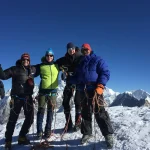
Top 10 Best Peak Climbing In Nepal | Nature Explore Trek.
August 15, 2020
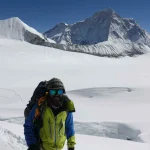
Makalu base camp trek – October and November 2025/2026
Customer Reviews
250 Excellence Reviews
15
Days
Days
US$ 2550 US$ 2300Per Person (Group Size: 2 - 16)
Group Discounts- Best price guaranteed
- Secure & easy online booking
- Flexible booking dates
- Decades of experience
- No. of Pax Per person
- 1 - 1 personUS$ 2650
- 2 - 3 peopleUS$ 2300
- 4 - 7 peopleUS$ 2200
- 8 + people 9999 US$ 2100
- No. of Pax Per person
- 1 - 1 personUS$ 2650
- 2 - 3 peopleUS$ 2300
- 4 - 7 peopleUS$ 2200
- 8 + people 9999 US$ 2100
Have Questions?
Similar Packages
US$ 2300